Hidden door help center

Questions are part of building the right door.

Find straightforward answers about ordering, measurements, swing direction, installation, materials, locks, finishing, freight delivery, and more.

Showing all 55 questions

Ordering

3 questions
How do I get a price?

Select the door you are interested in and choose its size, swing, material, depth, finish, and other options. The product page updates the price as you configure the door; you are not obligated to purchase. For assistance, call 888-928-4534, use website chat, or contact a hidden-door specialist.

What if I cannot find what I am looking for?

Many projects can be custom designed. Visit our Custom Hidden Doors page or submit a custom-design request with your opening dimensions, ideas, and photographs.

What is your current lead time?

Our doors are built to order rather than mass-produced, so production estimates change with order volume, configuration, and finishing requirements. See the current lead-time and order-status page before ordering. Posted lead times are estimates unless a guaranteed rush option is purchased.

General Questions

8 questions
Do objects fall off the shelves?

During normal use, items generally remain stable when the door is operated smoothly and not slammed. Avoid placing fragile or highly valuable objects on a moving door. Museum putty or removable double-sided tape can help stabilize décor. A shelf lip may also be requested before fabrication.

What is TopSeal?

TopSeal is our patent-pending, spring-loaded system for out-swing bookcase doors. It covers the necessary operating gap above the bookcase while still allowing the door to open correctly. TopSeal is included with new Hide-A-Way out-swing bookcase doors. See how TopSeal works.

Can you build a door narrower than 24 inches?

The minimum bookcase-door width is generally 24 inches because narrower bookcases leave very limited pass-through clearance. Certain mirror-door configurations can be built as narrow as 18 inches. Contact sales to confirm the best option for your opening.

Do you build custom projects?

Yes. Custom work includes wall units, libraries, fireplace walls, entertainment centers, unusual sizes, and specialty configurations. Start at our custom-project page.

Why is there a production lead time?

Every door is handcrafted to its order specifications. A project moves through programming, material preparation, CNC machining, assembly, finishing when selected, adjustment, inspection, photography, and crating. The mix of standard, custom, multi-door, and finished orders ahead of yours affects the estimate.

Do the doors arrive with hardware?

Door-specific hinge hardware is included and installed as appropriate. The mechanical latch is installed on site after the door is set and adjusted. Large Double and BiFold units may ship in multiple sections so they can be moved into the residence; review the installation manual for your model before delivery.

What does the back of the door look like?

The available rear appearance depends on the backing and door configuration selected. Finished doors are finished on the back to coordinate with the front unless the product or order states otherwise. Rear-facing bookcases, mirrors, and panels are available on compatible designs. Compare backing options.

What is the story behind Sasquatch?

Sasquatch remains the reigning hide-and-seek champion because—according to company legend—he owns a Hide-A-Way Door. Visit our Just for Fun page for the rest of the story.

Mechanical & Door Operation

7 questions
How much weight can I put on the shelves?

Avoid overloading any moving bookcase. For narrower doors, we recommend no more than approximately 300 pounds of contents, distributed evenly. On wider doors, keep heavier items closer to the hinge side. Consider 3/4-inch backing when heavier storage is planned.

What type of hinges do your doors use?

Bookcase doors use a concealed pivot-pin system that transfers the weight of the door and its contents to the threshold and floor. Certain Alpha and Mirror configurations use specialized hardware suited to their movement and concealment requirements.

How far do the doors open?

Standard out-swing bookcase doors open approximately 90 degrees within the opening. Standard in-swing bookcase doors can open approximately 130 degrees when surrounding conditions allow. Actual travel can be affected by trim, wall depth, nearby walls, and the selected configuration.

How much pass-through clearance will remain?

Pass-through clearance depends on door width, depth, swing direction, and configuration. Deeper bookcases and double or out-swing configurations generally reduce the usable opening more than shallow in-swing doors. Use our pass-through clearance guide and clearance chart.

How deep are the shelves?

We list overall door depth because actual usable shelf depth changes with the backing selected. Available overall depths range from approximately 6-1/4 to 12-1/4 inches on applicable models. Review the product configuration and backing options for the usable depth.

How do I determine left- or right-hand swing?

Stand with your back against the jamb where the hinges will be located. The direction the door moves away from your body—left or right—is its swing direction. Because terminology differs between manufacturers, use our swing-direction guide before ordering.

Important: Standard in-swing bookcase doors have a maximum jamb depth of 6-1/2 inches.
What is the difference between in-swing and out-swing?

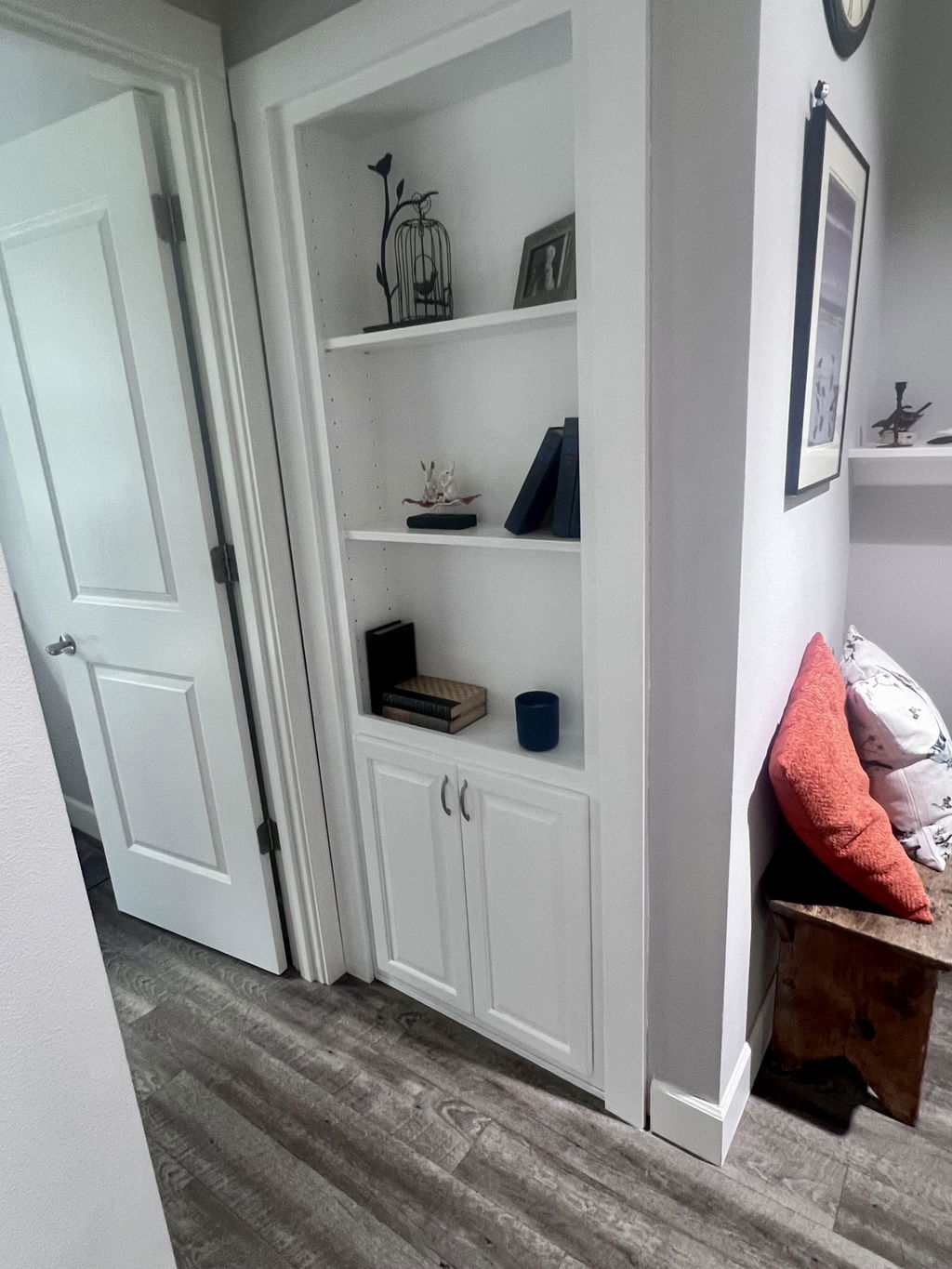
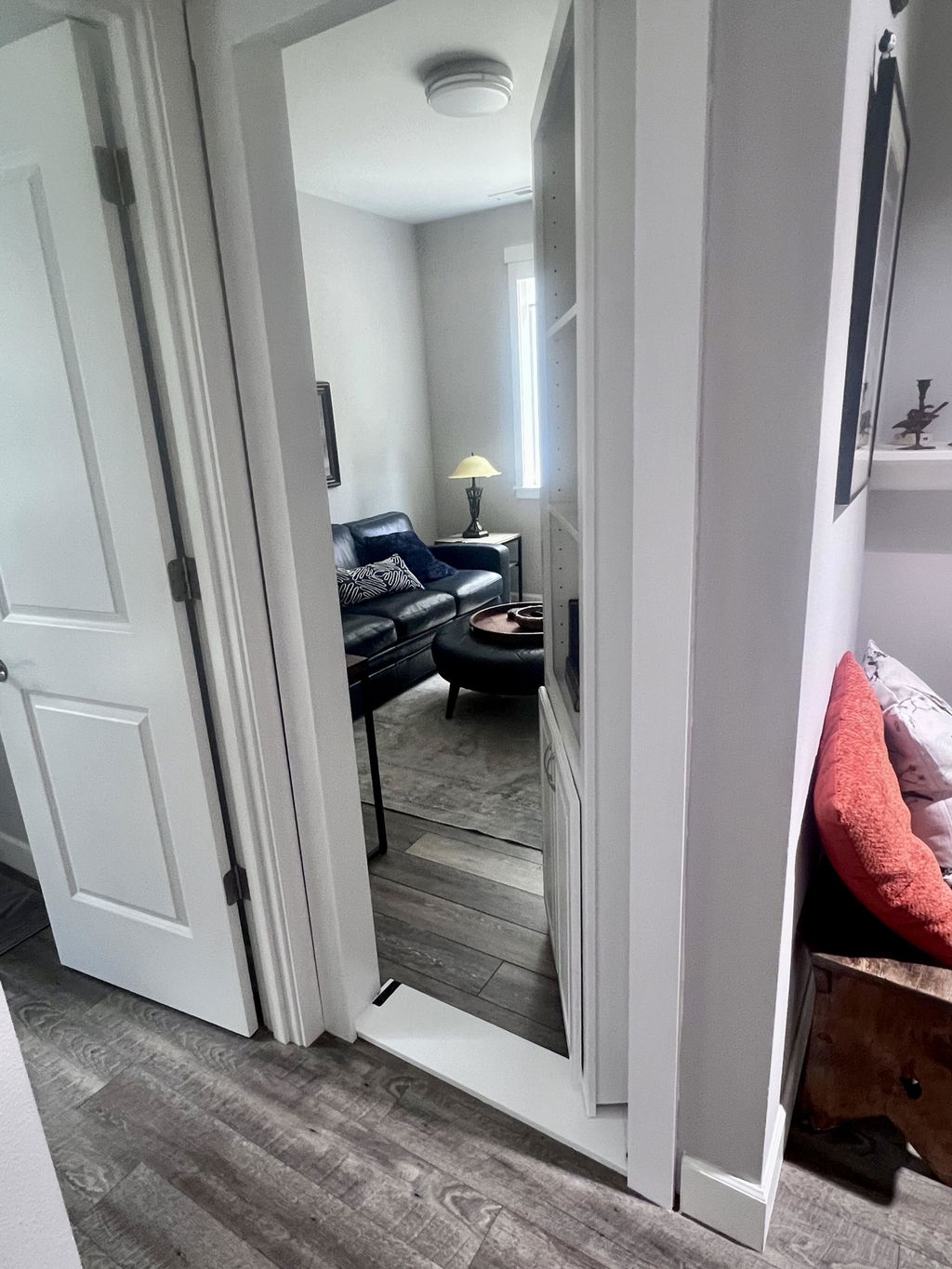
Stand in front of the bookcase face. If you push the bookcase away from you to enter the room, it is an in-swing. If you pull the bookcase toward you, it is an out-swing. See the illustrated swing guide.

Measuring

5 questions
Do you come to my home to measure?

We generally do not travel to individual projects for measuring. A local contractor or qualified installer can assist, and our How to Measure guide provides separate instructions for standard, Double, Alpha, and BiFold doors.

How do I measure an existing doorway?

Do not measure to the outside edges of the existing case molding. Measure the rough framed opening or the finished jamb opening using the method shown in our guide. Measure height from the finished floor—not the subfloor—to the underside of the top jamb when using the finished-opening method.

How do I measure a rough opening?

The rough opening is the framed opening measured from stud to stud and from the finished-floor level to the underside of the header. For standard bookcase doors, the rough opening is generally 2 inches wider and 2 inches taller than the ordered door size. Account for any flooring that has not yet been installed. Follow the complete measuring guide.

How do I measure wall or jamb depth?

Measure the finished wall thickness without case molding. A typical 2x4 wall with 1/2-inch drywall on both sides is 4-1/2 inches thick. Standard in-swing bookcase doors have a maximum jamb depth of 6-1/2 inches; out-swing configurations do not have the same jamb-depth restriction.

What if my opening is an unusual size?

Many unusual openings can be handled with a custom-size door. In some cases, reframing to a standard size may be the more practical option. Send the dimensions and photographs to a hidden-door specialist before altering the opening or placing an order.

Installation

7 questions
Are the doors insulated?

No. Our hidden doors are interior doors intended for finished, climate-controlled spaces. They are not insulated, exterior-rated, or fire-rated. We do not provide insulation or fireproofing recommendations.

Do you install doors or have installers near me?

Hide-A-Way Doors manufactures and ships the doors but does not directly perform installation. See our national installation-services information or hire a qualified local contractor familiar with prehung door installation.

Do you provide installation manuals and videos?

Yes. Visit the installation manual center for model-specific documents and the installation video page for demonstrations.

Can I install a hidden door in a deep wall?

Out-swing doors are not subject to the same jamb-depth limit. Standard in-swing bookcase doors have a maximum jamb depth of 6-1/2 inches. A deeper wall may require site modification or a different configuration; contact us before ordering.

Do I need to remove the existing door and frame?

For standard prehung bookcase and mirror doors, yes. The existing door, jamb, threshold, and case molding are removed because the hidden door is supplied in its own frame. BiFold doors are different: they surface-mount in front of an existing opening.

Can I install the door over an existing floor?

Most doors can be installed over finished flooring, but floating-floor manufacturers often require room for movement and may prohibit fastening through the floor. Confirm flooring requirements with the flooring manufacturer and your installer before ordering.

Can I install a door in a 2x6 wall?

Yes. A finished 2x6 wall is commonly approximately 6-1/2 inches deep, which is the maximum jamb depth for a standard in-swing bookcase door. Both in-swing and out-swing options can work when the finished wall depth and ordered jamb match.

Trim & Threshold

5 questions
Can I use my own case molding?

Possibly, but clearance cannot be guaranteed with trim we have not tested. Our trim profiles are designed around the door's movement. If you intend to try your own molding, request that the factory leave the supplied trim unattached so it remains available if your molding interferes.

Do you offer trim profiles other than flat and fluted?

Our standard case-molding options are flat and fluted. These profiles have been tested for the clearances required by the moving bookcase. See the trim-options guide.

Will your trim cover the area left by my existing trim?

Not necessarily. Hidden-door trim is often wider than conventional door casing, but we cannot guarantee it will cover every prior paint line, wallpaper edge, baseboard cut, or damaged area. Your installer should compare dimensions and plan wall repairs before installation.

How wide are the case molding and crown?

They are typically approximately 3-1/2 inches wide. In some configurations, case molding must be wider to bridge the space between the jamb and bookcase. Contact technical support if exact coverage is critical to the project.

How thick is the threshold, and can it be removed?

The standard threshold is 3/4 inch thick. It is a required structural component and cannot be removed. The bottom pivot system and mechanical-latch ramp attach to it.

Locks & Wiring

6 questions
Do locks come with the doors?

Bookcase doors include a mechanical latch that is installed on site after the door is installed and adjusted. Optional locking and access-control systems can be selected when ordering. Compare locking systems.

What types of locks do you provide?

Compatible Single Bookcase and Alpha Mirror doors may use electronic strikes. Compatible Double Bookcase and out-swing See-Through Mirror configurations may use electromagnetic locks. A front-access mechanical key lock is also available for compatible Single and Double bookcase doors.

What access controllers are available?

Available controller options may include wireless key-fob remotes, keypads, and biometric fingerprint readers. The compatible choices are shown with each locking system during ordering.

Can the locks be controlled with a cell phone?

We do not currently offer a phone-app controller as part of our standard locking packages.

What electrical power is required?

Powered lock packages plug into standard 110-volt household power. The included power supply converts household power to the low-voltage 12-volt power used by the locking components.

Where can I find wiring instructions?

Start with the documentation supplied with your locking package and the installation guide center. For configuration-specific help, contact technical support before drilling or altering the door.

Shipping & Delivery

7 questions
Do you ship to Canada?

Yes, we ship to most Canadian destinations. Available shipping charges, border fees, and applicable duties or tariffs are calculated or communicated as part of checkout.

Do you ship to my area?

We ship throughout the continental United States and most of Canada. Contact us before ordering for Alaska, Hawaii, international destinations, islands, limited-access areas, or locations that cannot accommodate a freight truck.

What should I do if the shipment is damaged?

Inspect the shipment before signing the delivery receipt. Note visible damage on the carrier's paperwork and photograph the freight before unpacking. Concealed damage must be reported promptly and within the applicable reporting period. Follow the shipping-damage reporting instructions.

Will the carrier bring the door inside my home?

No. Standard freight pricing is for curbside delivery only. The driver does not carry the door into the home or complete installation. Long, narrow, steep, gated, or inaccessible driveways may require delivery to a nearby accessible location.

How are the doors packaged?

Many standard units ship upright on a pallet with protective framing and bracing. Oversized, Mirror, Double, and specialty units may ship flat or in a custom crate. Packaging varies according to the door's size and configuration.

How much does a shipment weigh?

A standard crated or palletized bookcase door can exceed 230 pounds. Double and larger configurations can exceed 350 pounds. Arrange enough capable help and suitable moving equipment before delivery.

How long does freight transit take?

Transit commonly takes approximately 3–10 business days after shipment, depending on distance, terminals, weather, and carrier conditions. Transit estimates are not guaranteed delivery appointments.

Materials

3 questions
Why do you use real wood instead of MDF?

A moving bookcase door carries significant weight and must remain durable through repeated use. We use real-wood components and cabinet-grade plywood because they provide strength, fastener holding, repairability, and the appearance expected from a permanent architectural feature.

What wood types are available?

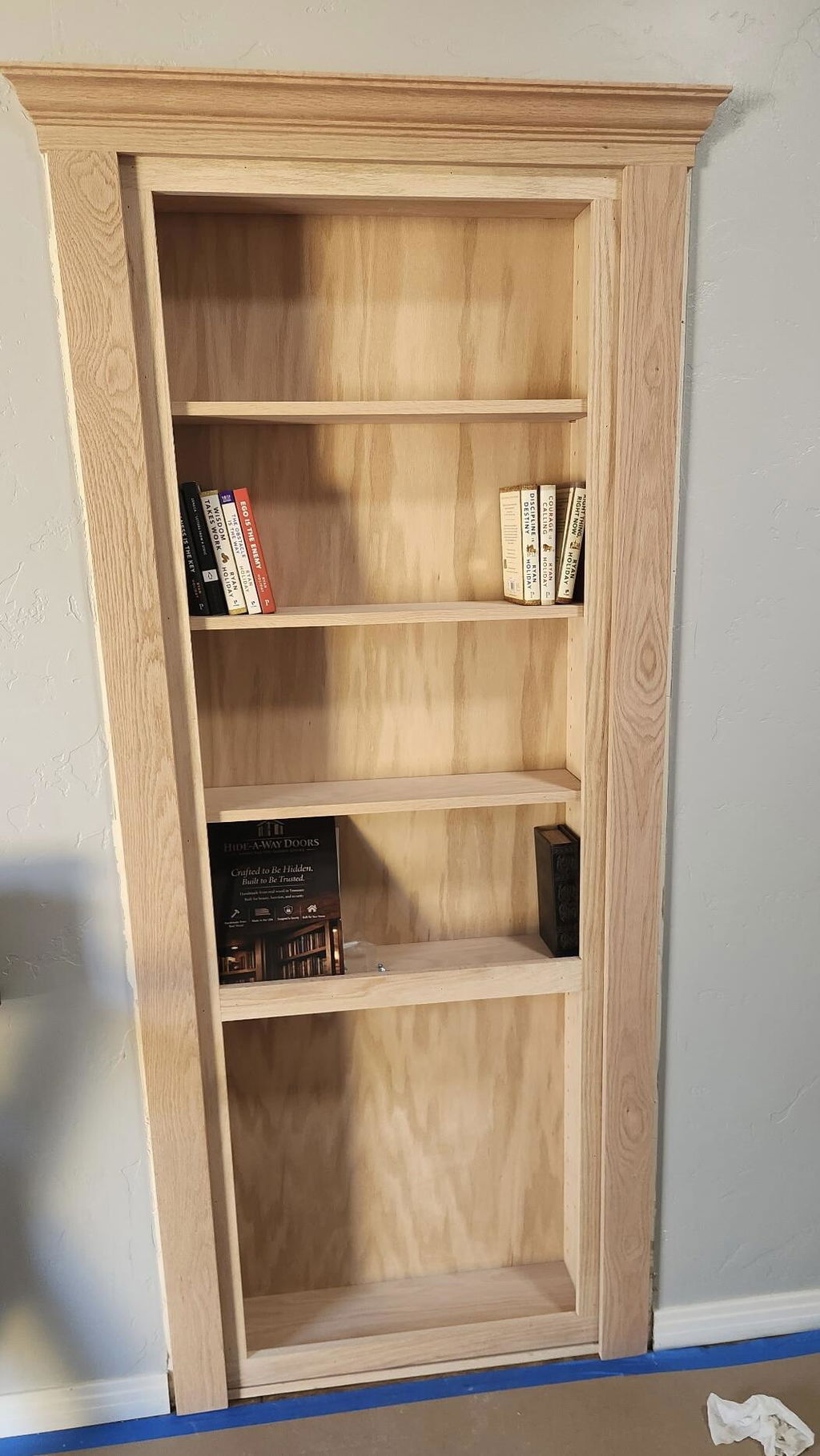
Common choices include Paint Grade Pine, Maple, Red Oak, and Knotty Alder, with availability varying by product. Solid wood is used for components such as face frames and trim, while cabinet-grade plywood is used for bookcase bodies and shelving. Compare material options.

Are the doors fire-rated or insulated?

No. Our products are interior doors for finished, climate-controlled spaces. They are not fire-rated, insulated, exterior-rated, or intended to separate conditioned living space from an unfinished or unconditioned area.

Paint, Stain & Finishing

4 questions
Can I order an unfinished door?

Yes. Select the unfinished option on the product order form. Unfinished doors require customer or installer preparation and finishing after delivery.

Can you match a custom paint or stain color?

Custom matching may be available. For the best result, provide a physical sample approximately 6 by 6 inches on the same wood species selected for the door. Label the back with your name, order number, telephone number, and return address before sending it to our Morristown facility.

What type of finish do you use?

We use sprayed, furniture-quality production coatings, including lacquer systems selected for the ordered material and finish. These coatings are professionally sprayed rather than brushed or rolled. See the finishing-options guide.

Do you prime or prep unfinished doors?

No. When an unfinished door is ordered, the customer assumes responsibility for final filling, sanding, priming, and finishing. Some paint-grade material may arrive from the supplier with a thin primer coat, but much of it is removed during machining and assembly. Factory-finished orders receive the required finish preparation before coating.

Go deeper

Some answers are easier to see than explain.

Use the illustrated planning guides, installation documents, and videos for dimensions, swing diagrams, clearance requirements, and model-specific procedures.

Still have a question?

Get the right team for the kind of help you need.

Contact sales for product selection, pricing, and custom projects. Contact technical support for installation, adjustment, replacement parts, and existing-door questions.

Subscribe to our newsletter

Signup for our newsletter to stay up to date on sales and events.

*By completing this form you're signing up to receive our emails and can unsubscribe at any time