Wall Panel Secret Door: The Master’s Guide to Seamless Concealment in 2026
A secret door is only as invisible as the engineering behind it. If a guest can spot a hairline gap or a slight sag in the wood, the illusion of your wall panel secret door vanishes instantly. You likely understand that true concealment requires more than just a moving partition; it demands a level of precision that standard construction rarely achieves. It's a common struggle to find a solution that matches the elegance of your home without the telltale signs of a hidden entrance.
This guide reveals the methods used to transform any standard wall into a high-security, invisible entrance using handcrafted real wood and elite engineering. You'll learn how to achieve a perfectly flush, furniture-grade finish that resists sagging and sticking for a lifetime. We'll walk through the essential structural requirements and the artisan joinery techniques that make a truly seamless concealment possible in 2026.
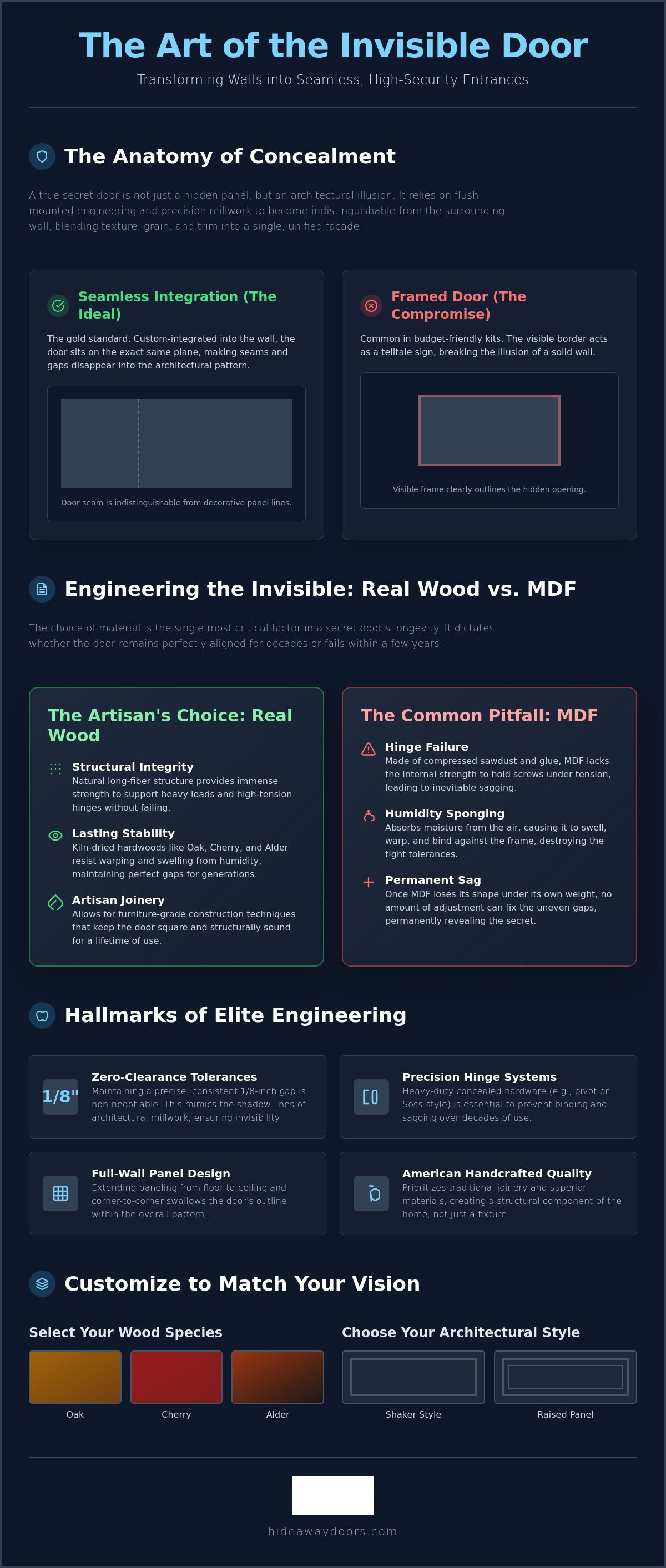
Learn how flush-mounted engineering allows an entrance to mimic architectural millwork and disappear into its surroundings.
Understand why real wood is essential for structural integrity, as common materials like MDF lack the strength to support heavy-duty hinges.
Discover how to customize your wall panel secret door with specific wood species and architectural styles like Shaker or Raised Panel designs.
Gain insights into the technical installation process, including the importance of precise measurements and selecting the right concealed hinge system.
Explore the benefits of handcrafted, American-made construction that prioritizes traditional joinery for a lifetime of reliable use.
A wall panel secret door is the ultimate expression of architectural camouflage. Unlike a bookcase door that uses depth and shelving to distract the eye, a panel door relies on the surface itself to disappear. It's a flush-mounted entrance designed to mimic the surrounding millwork with absolute precision. When executed correctly, the door is indistinguishable from the rest of the wall, using the same wood grain, textures, and trim to create a unified facade. This level of concealment is rooted in the long history of secret passages, where the goal was always to hide in plain sight through superior craftsmanship.
Integrating a wall panel secret door into a high-end interior requires more than just a matching finish. It demands elite engineering. These doors often carry significant weight due to the real wood cladding and decorative trim. To maintain the illusion, the door must operate with "zero-clearance" tolerances. This means the gaps around the door are identical to the shadow lines between the static panels on the wall. Achieving this requires precision-engineered pivot hinges or concealed Soss-style hardware that prevents the door from binding or sagging over years of use.
The Illusion of the Accent Wall
Modern design often utilizes vertical slats or horizontal rails to create visual interest. These features are a master artisan's best friend. By aligning the vertical seams of the door with the existing gaps between slats, the operable parts of the wall become invisible. Shadow lines play a critical role here. By intentionally creating deep grooves throughout the entire wall design, the functional gap needed for the door to swing open is swallowed by the pattern. A full-wall design is the most effective approach; it eliminates the visual footprint of a doorway by extending the paneling from floor to ceiling and corner to corner.
Seamless vs. Framed Secret Doors
Seamless integration is the gold standard for luxury residential projects. A framed door, often found in budget-friendly kits, uses a visible border that acts as a telltale sign of a hidden opening. In contrast, a seamless wall panel secret door is custom-integrated into the existing wood-clad surface or drywall. This approach ensures a perfectly flush finish where the door sits on the exact same plane as the wall. While kit-based frames might offer convenience, they rarely achieve the "wow factor" of a door that truly vanishes. Professional-grade results come from matching the specific wood species and grain patterns of your home, ensuring the transition from wall to door is impossible to detect.
A wall panel secret door carries a burden that standard interior doors never face. While a typical door is a light, hollow-core slab, a secret door must support the weight of real wood cladding, decorative molding, and occasionally integrated trim or mirrors. This additional mass places immense pressure on the frame and hardware. Structural integrity is the ability of a secret door to maintain a 1/8-inch gap over decades of use. Without this rigidity, the door will eventually drag against the floor or misalign with the surrounding wall, instantly revealing the secret entrance to anyone in the room.
Achieving this level of precision requires a deep understanding of the technical aspects of constructing hidden doors. Most mass-produced kits rely on composite materials to keep costs low, but these materials are the primary cause of long-term failure in high-end installations. They simply don't have the internal strength required for the job.
Why MDF Fails in Secret Door Applications
Composite materials like MDF and particle board are essentially compressed sawdust and glue. They lack the long-fiber strength necessary to hold heavy-duty hinges under constant tension. Over time, the screws at the pivot points begin to chew through the soft core of the material. This leads to a permanent sag that no amount of adjustment can fix.
Humidity is another silent enemy of composite doors. MDF acts like a sponge, swelling and warping with seasonal changes in air moisture. Even a few millimeters of expansion will ruin the tight tolerances required for a wall panel secret door to remain invisible. Once the panel loses its square shape under its own weight, the shadow lines become uneven, and the illusion is lost forever.
The Longevity of Handcrafted Wood
Real wood offers the natural cellular structure needed to resist warping and support heavy loads. We use kiln-dried hardwoods like Oak, Cherry, or Alder to ensure maximum stability. These materials are selected for their predictable grain patterns and their ability to stay true for generations. Master artisans utilize furniture-grade joinery to keep the door square, ensuring the unit functions as a structural component of the home rather than a temporary fixture.
This isn't just about aesthetics; it's about engineering a product that functions as well in twenty years as it does on the day of installation. You can learn more about why Solid Wood vs MDF: Why Furniture Grade Materials Matter when choosing your concealment solution. If you want a door that stands the test of time, prioritize the handcrafted quality of real wood construction for your project.
Customization is the bridge between a functional door and a true architectural mystery. A wall panel secret door shouldn't just fit the opening; it must inhabit the room's character. This process begins with the selection of the wood species. Oak is a perennial favorite for its rugged grain and structural density, which naturally helps mask fine seams in traditional settings. For those seeking a modern, glass-smooth finish, Maple offers a tight, uniform surface that takes paint or dark stains with exceptional consistency. Each choice influences how the door interacts with light and shadow across the wall.
The architectural style defines the door's visual DNA. Whether you are matching a minimalist Shaker design, a stately Raised Panel library, or a sleek Flat Panel modern accent wall, the geometry must be exact. Beyond aesthetics, you must consider the mechanics of the swing. Inswing doors are often the preferred choice for maximum concealment because the door stops remain on the interior side, allowing for a tighter exterior fit. Outswing doors, while useful for smaller rooms, require expert management of the hinge-side reveal to remain flush. To complete the "secret" experience, we integrate concealed locking systems. Options range from traditional mechanical latches to sophisticated electromagnetic locks that offer silent, keyless entry for high-security applications.
Matching Your Existing Architectural Millwork
The secret to a successful installation lies in the details of your room's existing millwork. We focus on coordinating stain grades to ensure the door doesn't just match the color, but also the depth and luster of your current library or office paneling. Grain matching is perhaps the most critical step. By selecting panels where the wood grain flows continuously from the stationary wall onto the door surface, we eliminate the visual break that often betrays a hidden entrance. We also customize rail and stile widths to mirror the specific geometric patterns of your room, ensuring the door's proportions are indistinguishable from the surrounding panels.
Advanced Features for Panel Doors
Innovation allows us to push the boundaries of home concealment. Many owners choose to integrate secret switches directly into the panel design. This might include a "magic" slat or a specific molding section that, when pressed, releases the latch. For those building safe rooms or private home theaters, soundproofing options can be added to the core of the wall panel secret door to ensure total privacy. For larger spaces, double door configurations provide a grand entrance that can span an entire accent wall, maintaining a seamless look while offering a wide, functional passage when opened.
Precision is the difference between a high-security entrance and a visible door. Planning a wall panel secret door requires a shift from standard carpentry to master-level joinery. Because these units are heavy and rely on tight tolerances, the installation process is a structural project that demands respect for physics and geometry. You aren't just hanging a door; you're integrated a moving wall component into the existing architecture of your home.
Step 1: Precise measurement of the rough opening and total wall thickness, including the thickness of the decorative paneling.
Step 2: Selecting the right hinge system, such as a heavy-duty pivot hinge for thicker walls or a concealed Soss-style hinge for lighter applications.
Step 3: Structural reinforcement of the door header to support the significant weight of real wood panels without sagging.
Step 4: Alignment and leveling, which is the most critical stage for ensuring the shadow lines remain perfectly consistent.
Step 5: Finishing and trim integration to bridge the gap between the door and the stationary wall, masking the operable seams.
Measuring for a Secret Door
Square and level are non-negotiable requirements. In a standard doorway, a slight variance can be hidden by trim, but a wall panel secret door will bind or show uneven gaps if the opening is even 1/16th of an inch out of alignment. You must also calculate the clearance for the swing arc. If the wall paneling is thick, the door's leading edge may strike the frame as it opens, requiring a specific offset or a beveled edge to maintain a tight seal. Before you begin, it's vital to know How to Measure Your Opening for a Hidden Bookcase Door to ensure a successful fit.
Professional Installation Services
Many homeowners find that the complexity of retrofitting a secret door into a load-bearing wall is best handled by experts. We offer a national network of professional installers who specialize in the unique logistics of hidden entrances. Handling the shipping of a pre-assembled, furniture-grade door requires specialized care to prevent damage to the delicate wood grain. Expert calibration ensures that the final product achieves the "wow factor" of a truly invisible entrance. If you prefer a guaranteed result, you can connect with our professional installation network to manage the technical execution of your project from start to finish.
Every wall panel secret door we produce is born in Morristown, Tennessee. We don't believe in assembly lines or overseas outsourcing. Instead, master artisans build each unit by hand, ensuring that every joint is tight and every finish is flawless. This commitment to local manufacturing allows us to maintain a level of quality control that mass-market retailers simply can't match. We use only real wood. You won't find MDF, particle board, or thin veneers in our shop. By using solid hardwoods, we provide a product that possesses the natural strength to support its own weight without the sagging issues common in lesser materials.
The Alpha Door engineering is the backbone of our reputation. It's designed to be the strongest secret door in the industry, capable of supporting heavy loads while maintaining a smooth, silent swing. Whether you're concealing a private library or a high-security safe room, the structural rigidity of the Alpha Door ensures that your 1/8-inch gap remains consistent for decades. We've combined traditional woodworking with modern engineering to solve the common failures of hidden entrances. Our units are built to be a permanent part of your home's heritage.
Artisan Quality vs. Mass Production
There's a profound difference between a store-bought kit and a custom-built architectural element. A kit is designed for the average home; our doors are designed for yours. We view ourselves as a family-owned manufacturer dedicated to preserving traditional skills in a world of disposable furniture. For a deeper look at our philosophy, read The Master Artisan’s Guide to Handcrafted Hidden Doors for 2026. This resource explains how we balance heritage techniques with the precision required for modern luxury homes.
Securing Your Home with Style
Security shouldn't look industrial. Our panel doors provide peace of mind by creating a hard-to-detect barrier that blends perfectly with your home's aesthetic. The Alpha Door series is specifically engineered for those who prioritize high-security concealment without sacrificing the beauty of their interior design. We support our customers with national shipping and professional installation across the U.S. and Canada. This ensures your investment is handled with care from our workshop to your wall. If you're ready to transform your space, explore our custom wall panel secret doors today.
A truly invisible entrance requires more than just a hidden hinge. It demands the strength of real wood and the precision of artisan joinery. Throughout this guide, we've explored why avoiding composite materials like MDF is vital for maintaining a perfectly flush seam over time. By choosing furniture-grade hardwoods, you prevent the structural sag that often betrays lesser installations. Every wall panel secret door we build is a testament to the rugged, dependable craftsmanship that only handcrafted manufacturing can provide.
Our master artisans in Tennessee take pride in creating functional art that secures your home without sacrificing its sophistication. We've eliminated the guesswork by offering a national installation network to ensure your custom unit is calibrated for a lifetime of reliable use. Now is the time to turn your vision into a reality. Design Your Custom Wall Panel Secret Door and discover the peace of mind that comes with elite engineering. Your home deserves a legacy of quality that stands the test of time.
Can a wall panel secret door be installed on any wall type?
Yes, you can install a wall panel secret door on most wall types, including load-bearing and partition walls. The primary requirement is a reinforced header and a level rough opening. Because real wood doors are significantly heavier than standard slabs, the wall must be structurally sound to prevent the frame from shifting over time. If you're retrofitting into a load-bearing wall, a professional should verify the structural support first.
How do I make the seams of my secret door completely invisible?
Achieving total invisibility requires aligning the door's seams with the existing shadow lines of the wall paneling. By using vertical slats or decorative molding, you can hide the functional gaps within the room's natural geometric patterns. Matching the wood grain across the door and the stationary wall is also essential. This ensures the eye doesn't catch the subtle break where the operable panel begins.
Do wall panel secret doors come with locks?
Yes, we offer several concealed locking options to enhance both security and privacy. You can choose from mechanical deadbolts hidden within the frame or electromagnetic locks that release via a secret switch or keypad. These systems are designed to be entirely invisible from the exterior, ensuring your entrance remains a secure barrier without revealing its location to guests or intruders.
Can I install a secret door in an existing doorway?
Yes, retrofitting a secret door into an existing doorway is a frequent request for home offices and master suites. Our units are designed to fit standard rough openings, though you may need to adjust the surrounding trim to achieve a flush, seamless look. Using an Alpha Door frame simplifies this process because it provides the structural rigidity needed to square the unit within an older, potentially unlevel opening.
What is the weight capacity of a real wood panel secret door?
Our real wood doors are engineered to support significant weight, often exceeding 500 pounds when equipped with our heavy-duty pivot hinges. This capacity is necessary because a wall panel secret door often includes thick wood cladding and decorative millwork. Unlike MDF units that sag under their own weight, our handcrafted solid wood construction maintains its shape and alignment even when fully loaded with trim or mirrors.
How does a wall panel secret door open without a handle?
These doors typically utilize a push-to-open mechanical latch or a concealed electronic trigger. A simple push on a specific area of the paneling engages a spring-loaded mechanism that pops the door open just enough to grab the edge. Alternatively, we can integrate hidden switches into the molding or slats. These triggers allow the door to open without the need for visible handles that would betray the secret.
Is professional installation required for secret doors?
While we offer DIY Door Kits for experienced carpenters, professional installation is strongly suggested for the most seamless results. Proper calibration is necessary to ensure the gaps are uniform and the door swings without binding. Our national network of installers understands the technical nuances of leveling heavy wood units. This expertise is what creates the "wow factor" of a door that truly disappears into the wall.
What wood species is best for a secret door that will be painted?
Maple is the superior choice for a wall panel secret door that requires a painted finish. Its tight, uniform grain and smooth surface ensure that paint adheres evenly without the grain "telegraphing" through the topcoat. Poplar is also a reliable, cost-effective option for paint-grade projects. Both hardwoods provide the structural stability needed for a hidden unit while offering a flawless, furniture-grade canvas for your specific color palette.