Finding Professional Hidden Door Contractors: A Guide to Seamless Installation in 2026
What if the most expensive mistake in your home renovation isn't the material you choose, but the hands that install it? You've likely spent months envisioning a seamless, secret entrance, yet the fear of a sagging bookcase or a ruined floor keeps you from starting the project. It's a common anxiety. Most homeowners worry that a standard general contractor won't respect the tight tolerances required for true concealment. Finding specialized hidden door contractors who treat your project as a precision-engineered mechanical assembly is the only way to ensure your investment stands the test of time.
We understand that a secret door is more than just furniture; it's a piece of functional art that requires a master's touch. You deserve the peace of mind that comes from knowing your door will swing as smoothly in a decade as it does on day one. This guide will show you exactly how to identify, vet, and hire the right professionals to install a secret door that lasts a lifetime. We'll explore the critical questions to ask an installer, the structural requirements for long-term stability, and how to facilitate perfect coordination between the master craftsmen at the factory and the experts in your home.
Understand why standard carpentry skills often fail when faced with the high-precision tolerances required for a truly invisible entrance.
Learn when a local general contractor is sufficient and when your project demands specialized hidden door contractors to handle complex systems like the Alpha Door.
Identify the technical deal-breakers, such as floor leveling and wall squaring, that your installer must address before the first screw is turned.
Master a two-step evaluation process to vet a contractor’s expertise in heavy-load cabinetry and their familiarity with handcrafted concealment systems.
Find out how to access a national network of master installers who bridge the gap between high-end manufacturing and flawless on-site execution.
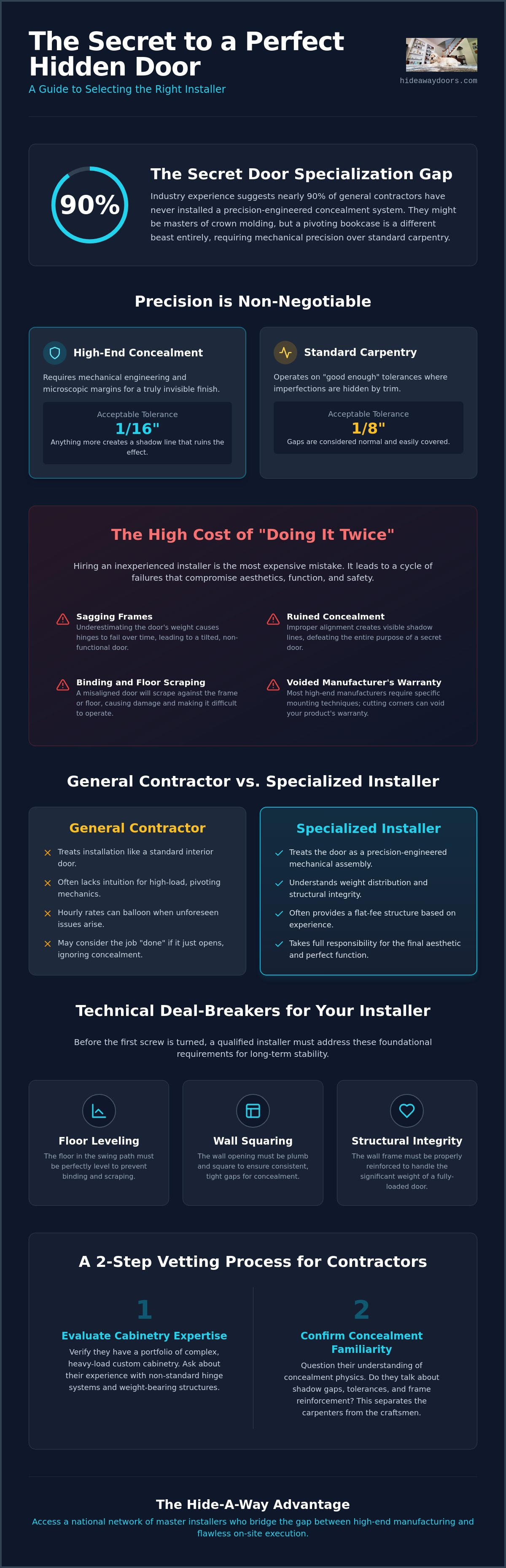
Most homeowners assume a skilled finish carpenter can handle a secret entrance. They're usually wrong. While the history of secret passages is filled with architectural wonder, modern execution requires mechanical engineering as much as woodworking. The "Secret Door Specialization Gap" is a real hurdle; industry experience suggests that nearly 90% of general contractors have never actually installed a precision-engineered concealment system. They might be masters of crown molding or kitchen cabinetry, but a pivoting bookcase is a different beast entirely.
Finding professional hidden door contractors is about more than hiring someone who can read a level. It's about finding a technician who understands that a secret door is a mechanical assembly rather than a standard piece of trim. In 2026 home renovations, the focus has shifted toward longevity and seamless integration. You don't just need it installed; you need it to stay perfectly aligned for a lifetime. A true specialist treats the installation as a high-stakes puzzle where the goal is total invisibility.
Precision vs. Standard Carpentry
Standard carpentry operates on "good enough" tolerances. If a bedroom door is off by an eighth of an inch, the trim usually covers the gap. In the world of high-end concealment, a 1/16th inch variance is a catastrophic failure. That tiny gap creates a shadow line that screams "hidden door" to anyone in the room. Specialized hidden door contractors work with these microscopic margins every day. They understand the mechanical complexity of pivoting a heavy Double Bookcase Door or a Mirror Door. It isn't just about the swing; it's about the weight distribution and the structural integrity of the surrounding wall frame.
The Risks of Inexperienced Labor
Hiring an amateur or a generalist often leads to a cycle of "doing it twice." A common failure is the sagging frame. When a contractor underestimates the sheer weight of a fully loaded bookcase door, the hinges eventually give way. This leads to binding, floor scraping, and a ruined concealment effect. Beyond the aesthetic damage, poor installation can actually void your manufacturer's warranty. Most high-end manufacturers require specific mounting techniques to guarantee performance. If your installer cuts corners to save time, you're left with a heavy, non-functional piece of furniture rather than a secure passageway. Precision takes time, and in 2026, it's the only standard that matters for a project of this caliber.
Choosing between a general contractor and a specialist is the most critical decision in your project's lifecycle. While a general contractor (GC) is likely already on-site for your 2026 renovation, they often lack the mechanical intuition required for high-load, pivoting cabinetry. Specialized hidden door contractors treat the opening as a precision instrument rather than a standard interior entrance. This choice impacts not just the initial labor cost, but the long-term accountability of the installation. If the door begins to bind six months after the project ends, you need a professional who stands by the structural execution, not someone who blames the "unusual" nature of the product.
General contractors typically operate on hourly rates or broad project estimates. This can be problematic if they encounter unforeseen leveling issues, causing labor costs to balloon as they "figure it out" on your time. Specialists often provide flat-fee structures because they've seen every possible obstacle before. Most importantly, a specialist ensures the door actually "disappears" by managing the shadow-gap physics that keep the secret safe. They take responsibility for the final aesthetic, whereas a GC might consider the job done as long as the door simply opens and closes.
When Your General Contractor is Enough
A local general contractor can be a viable choice if they employ a dedicated, high-end finish carpenter with a portfolio of custom cabinetry. Before hiring, verify their credentials against contractor licensing requirements to ensure they have the proper insurance and bonding for structural modifications. You must provide them with the exact engineering specs for your specific model. They need to understand the structural integrity of bookcase doors, particularly how the weight is distributed across the pivot points. If they treat the unit like a heavy closet door, it will eventually sag.
The Case for Specialized Installers
Specialized hidden door contractors bring a level of efficiency that a generalist simply cannot match. They often complete a complex installation in half the time because they arrive with proprietary leveling tools and custom shimming techniques designed specifically for secret passageways. This expertise is non-negotiable for a double bookcase secret door, where two separate units must meet perfectly in the center without any visible light leak. It's about buying peace of mind alongside a functional entryway. If you're looking for the ultimate in concealment, you might consider the Alpha Door for its superior engineering and ease of professional setup.
Precision is the silent partner of concealment. While the previous sections established the need for a specialist, the actual success of your project depends on the technical environment your installer prepares. Most hidden door contractors will tell you that the door itself is only as good as the wall and floor surrounding it. A secret entrance isn't just a piece of trim; it's a heavy mechanical assembly that requires a foundation far more stable than a standard interior door. If the structural preparation is off by even a fraction of an inch, the "secret" will be revealed by uneven shadow lines or a dragging frame.
Security and utility must also be integrated during the rough-in phase. If you're planning on electromagnetic locks, biometric scanners, or internal LED lighting, your contractor must coordinate with electricians before the drywall is finished. This foresight prevents the need for invasive retrofitting later. High-end 2026 home designs prioritize these integrated technologies, but they demand a contractor who understands how to route wiring through a pivoting axis without risking a short circuit or mechanical binding.
The Floor and Header Foundation
The floor is the most common point of failure for secret passageways. A professional installation requires a floor that is perfectly level within 1/32 of an inch across the entire swing path. If the floor slants, the door will either scrape the ground or leave a wide, tell-tale gap at the bottom. Furthermore, because solid wood bookcase doors weigh significantly more than MDF alternatives, the overhead header must be reinforced. A standard 2x4 header will eventually bow under the 500-pound load of a fully stocked library, causing the door to bind in the frame.
Rough Opening Preparation
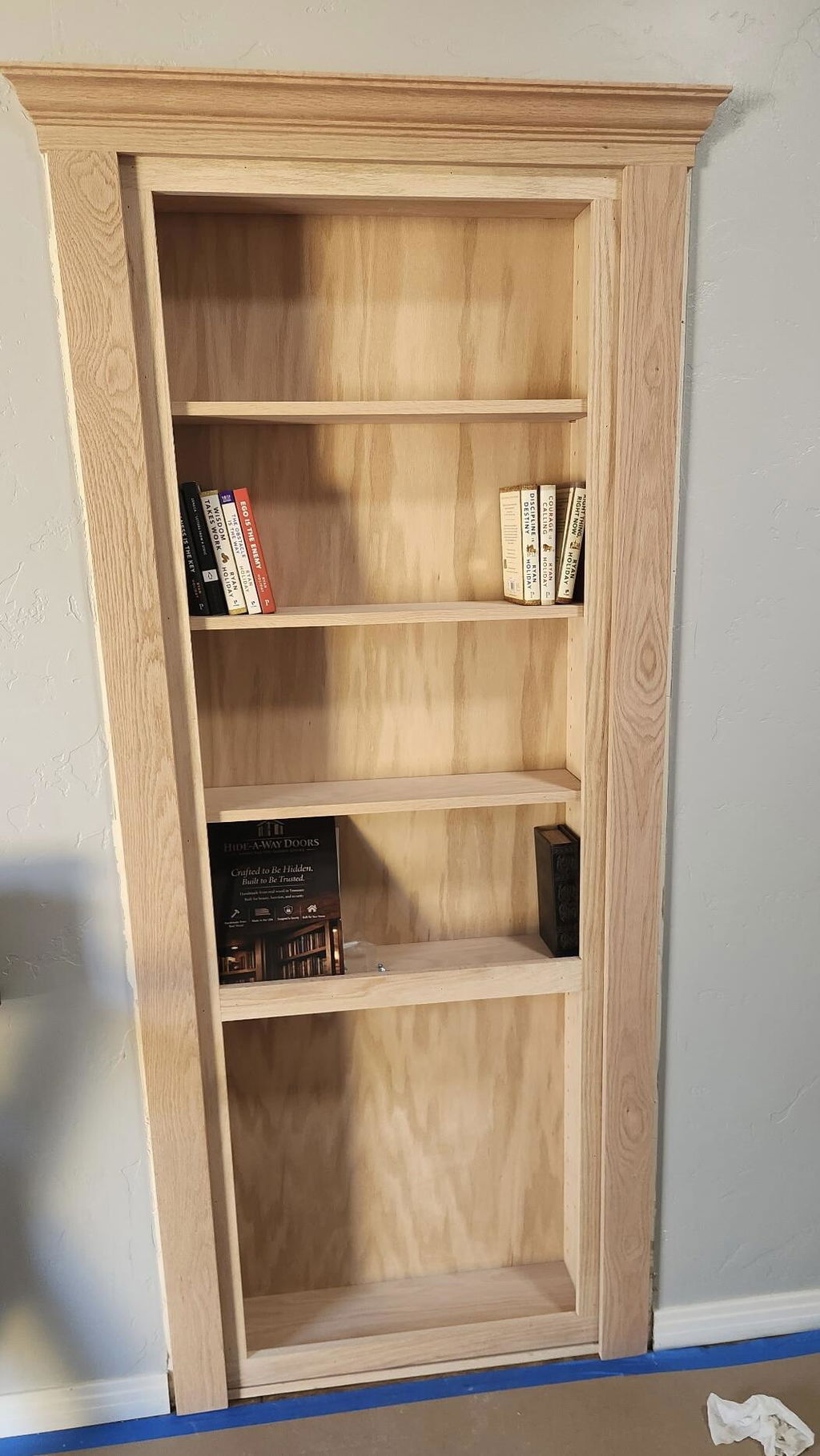
Wall squaring is the next hurdle. A "standard" rough opening is rarely square enough for a concealment system. Expert hidden door contractors meticulously shim the framing to ensure the side jambs are perfectly parallel. This precision is what allows for a minimal "reveal," which is the tiny gap between the door and the wall. The Penny Test is a diagnostic standard where a contractor ensures a single penny can slide through the reveal with uniform clearance along the entire perimeter of the door. Managing this gap is the difference between a door that looks like a built-in shelf and one that looks like a poorly fitted renovation.
Vetting hidden door contractors requires a shift in perspective. You aren't simply looking for a carpenter; you're searching for an installer who respects the laws of physics and the art of deception. The difference between a lifetime of smooth operation and a sagging, visible door often comes down to the contractor’s understanding of load-bearing geometry. A professional will welcome technical questions because they know that precision is the only way to achieve true invisibility.
Start by reviewing their portfolio for more than just aesthetics. Look for pivoting structures or heavy-load cabinetry. Ask specifically about their experience with high-quality handcrafted hidden doors. Real wood behaves differently than synthetic materials, and an expert must account for the natural expansion and contraction of the grain. Finally, verify their references for long-term stability. A door that swings perfectly on day one might bind after six months if the structural reinforcement wasn't handled correctly. If you're ready to secure a system built for this level of performance, browse our professional bookcase door collections today.
Interview Questions for Potential Installers
When you speak with potential hidden door contractors, their answers should be immediate and technically grounded. Ask how they handle floor variances for a 500-pound pivoting load. They should mention specific shimming or floor-leveling techniques rather than suggesting they'll "make it work" on the fly. Inquire about their process for adjusting the reveal after the door is fully loaded with books or collectibles. Most importantly, ask if they've ever worked with alpha concealment door systems. These elite setups require a specific sequence of installation steps that a generalist might overlook.
Red Flags to Watch For
Be wary of any contractor who dismisses the need for precise measuring for a hidden door. If they claim a standard rough opening is "close enough," they don't understand the tight tolerances required for concealment. Another major red flag is a suggestion to use MDF or particle board to "save weight." While lighter, these materials lack the structural integrity to hold a pivot hinge over time. A professional installer will always arrive with specialized tools, such as laser levels and heavy-duty floor jacks, rather than relying on a basic bubble level and a hammer. If the tools look standard, the result likely will be too.
The gap between a precision-engineered product and a successful installation is where most home improvement dreams falter. A secret door is a significant investment in both security and style; it shouldn't be left to chance. Hide-A-Way Doors addresses the specialization gap mentioned earlier by providing a direct bridge between our master craftsmen and your job site. We've spent years cultivating a national network of hidden door contractors who understand the nuances of our specific designs and hardware requirements.
By utilizing this vetted network, you ensure that the person turning the screws is as familiar with the pivot points and weight distribution as the artisans who built the unit in our workshop. This professional coordination removes the guesswork and the potential for costly errors during the final reveal. It's about ensuring that the "wow factor" remains intact for decades, rather than just the first week of ownership.
Seamless Project Management
The transition from an e-commerce purchase to on-site execution is handled with deliberate care. When you select a door from our collection, the logistics don't end at the delivery truck. We provide comprehensive technical support to your chosen hidden door contractors, ensuring they have access to the exact measurements and structural data required for a permanent fit. This collaborative approach creates a streamlined path to ownership. You benefit from the clarity of fixed-price product sales combined with the reliability of expert labor. It's a structured system designed to respect your time and your home's integrity.
Handcrafted Quality Meets Professional Execution
Real wood craftsmanship requires a specialist’s touch to truly shine. Unlike mass-produced MDF or particle board alternatives that lack longevity, our doors are built from premium species like Oak, Alder, and Cherry. These materials possess a tactile quality and structural strength that demand precise handling during the installation process. Whether you are installing a standard bookcase or a high-security gun concealment door, the final execution must be as beautiful as it is secure.
A specialist understands how to balance the weight of solid wood while maintaining the invisibility of the seams. They ensure that the intrigue of the discovery is never spoiled by a mechanical flaw or an uneven gap. Your home deserves a legacy piece that operates with quiet confidence and rugged dependability. To begin your journey toward a perfectly concealed entrance, view our products and find an installer today.
A secret door is more than a novelty; it's a permanent architectural upgrade that demands respect for structural physics. You've learned that true concealment relies on microscopic tolerances and a foundation that can support 500 pounds of solid wood without flinching. Success in 2026 home design isn't about finding the fastest carpenter, but the most precise technician. By vetting hidden door contractors for their mastery of pivot-hinge geometry and floor-leveling techniques, you protect your home from the common pitfalls of sagging frames and visible seams.
Since 2012, our family-owned business has prioritized the rugged durability of real wood materials over the fleeting convenience of MDF. We bridge the gap between artisan manufacturing and flawless on-site execution through our national network of professional installers. You don't have to navigate the technical complexities of concealment alone. Let us help you turn your vision into a sturdy, seamless reality that will intrigue and secure for generations to come.
Can a regular handyman install a hidden bookcase door?
A standard handyman typically lacks the specialized tools and experience in high-precision cabinetry required for these systems. While they're often skilled in general home repairs, the 1/16th inch tolerances and heavy-load pivot geometry of a secret door demand a master's touch. Hiring hidden door contractors ensures your door swings smoothly without compromising the concealment effect or damaging your floors. This expertise is what separates a successful project from a costly mistake.
How much does it typically cost for a contractor to install a secret door?
Installation costs vary significantly based on the complexity of the unit and the condition of your existing framing. You should expect to pay professional labor rates that reflect the high level of precision and structural reinforcement required for a 500-pound assembly. Custom security integrations or double-door setups will naturally require a larger labor budget than a standard single-door installation. Always request a clear estimate that accounts for both the structural prep and the final trim work.
Do I need to reinforce my floor before a hidden door contractor arrives?
Reinforcement is often necessary if your subfloor isn't perfectly level or built to handle concentrated weight. Most professional systems require a floor level within 1/32 of an inch across the entire swing path to prevent the unit from dragging. Your contractor will evaluate the joist support to ensure it can sustain the weight of solid wood materials and a full load of books over many years. This preparation is the foundation of long-term structural integrity.
What happens if my contractor installs the door and it doesn’t close properly?
Improper closing or binding is usually a result of the wall frame being out of square or the floor being unlevel. A specialist will address this by meticulously shimming the jambs or adjusting the pivot hardware to restore the perfect reveal. If you hire a generalist who can't solve these mechanical issues, you may end up paying twice to have a specialist fix the initial errors. Precision is non-negotiable for a door meant to stay hidden.
Does Hide-A-Way Doors provide installation services nationwide?
We provide access to a national network of vetted professional installers to help bridge the gap between our workshop and your home. While we are the manufacturers, we coordinate with experienced local partners who understand our specific hardware and assembly sequences. This ensures that your handcrafted unit is installed by someone who treats it with the respect it deserves. We take pride in connecting our customers with professionals who share our commitment to enduring quality.
How long does a professional hidden door installation take?
A professional installation generally takes between four and eight hours depending on the amount of site preparation needed. This timeframe includes the structural reinforcement of the header, the precision leveling of the floor, and the final adjustment of the trim. General contractors who haven't installed these systems before often take twice as long as they navigate the learning curve on your time. Efficiency comes from experience and having the right specialized tools on hand.
Can a hidden door be retrofitted into an existing standard doorway?
Yes, retrofitting into an existing doorway is a standard practice for many 2026 home renovations. However, the existing trim must be removed and the rough opening often needs to be squared or reinforced to meet the door's engineering specs. Your installer will manage the transition to ensure the new bookcase blends seamlessly with your existing wall treatments. It's a fantastic way to add intrigue to a room without major structural demolition.
Should I hire a contractor before or after I purchase my secret door?
It's best to consult with a contractor before you finalize your purchase. This allows the professional to verify your rough opening dimensions and floor conditions against the technical requirements of the door. Engaging hidden door contractors early in the planning phase prevents the frustration of ordering a custom unit that won't fit your home's unique structural constraints. A pre-purchase consultation ensures a smooth journey from initial inspiration to final execution.