The Ultimate Guide to Hidden Pool Cue Rack Doors for 2026
True luxury in a game room isn't found in what you see, but in the seamless engineering of what you don't. You've likely spent years curating a space that reflects your style, only to have it disrupted by the visual noise of cues and balls scattered about. It's a common frustration to want a tidy space without sacrificing accessibility. We understand the hesitation that comes with secret entrances. Nobody wants a flimsy door that sags under the weight of a full billiard set or feels like a cheap prop. Your home deserves a hidden pool cue rack door that functions as a piece of high-performance machinery, utilizing handcrafted real wood to ensure structural integrity and aesthetic perfection.
In this guide, you'll discover how to combine sophisticated billiard storage with a secure, seamless room entrance that matches your high-end finishes. We'll walk through the technical requirements of real-wood engineering and the "buy-it-for-life" craftsmanship that sets professional-grade doors apart from mass-produced alternatives. From weight-bearing capacities to custom wood species, we're providing the roadmap to a clutter-free room that conceals your most private spaces with quiet confidence.
Key Takeaways
Explore the dual-purpose utility of architectural elements that blend professional billiard storage with the intrigue of a secret entryway.
Understand why real hardwood engineering is essential to support the dynamic load of cues and balls without the sagging common in inferior materials.
Learn how to customize your hidden pool cue rack door with specific wood species and finishes to match your existing game room decor.
Discover the precision measurements and layout considerations required for a seamless installation that remains undetectable to the untrained eye.
Identify the structural advantages of furniture-grade construction that ensure your concealment solution remains functional for a lifetime.
A hidden pool cue rack door is a masterclass in dual-purpose architecture. While the history of secret passages dates back centuries, the modern iteration focuses on high-performance utility. It's a professional-grade billiard rack that happens to serve as a secret entryway. In 2026, the "Speakeasy" aesthetic has evolved from a niche hobby to a standard in high-end home design. Homeowners aren't just looking for a door; they're looking for a conversation piece that preserves the room's flow while protecting what lies behind it.
Beyond the "wow factor," these units offer serious organizational benefits. Instead of leaning cues against the wall or using bulky floor stands, this system integrates cues, bridges, chalk, and ball sets into a single vertical unit. It's about reclaiming floor space and eliminating the clutter that often plagues game rooms. For those requiring higher levels of security, options range from standard pivot doors to the alpha concealment door, which offers enhanced structural reinforcement and elite-level craftsmanship for those who prioritize security alongside style.
The Anatomy of a Billiard Concealment System
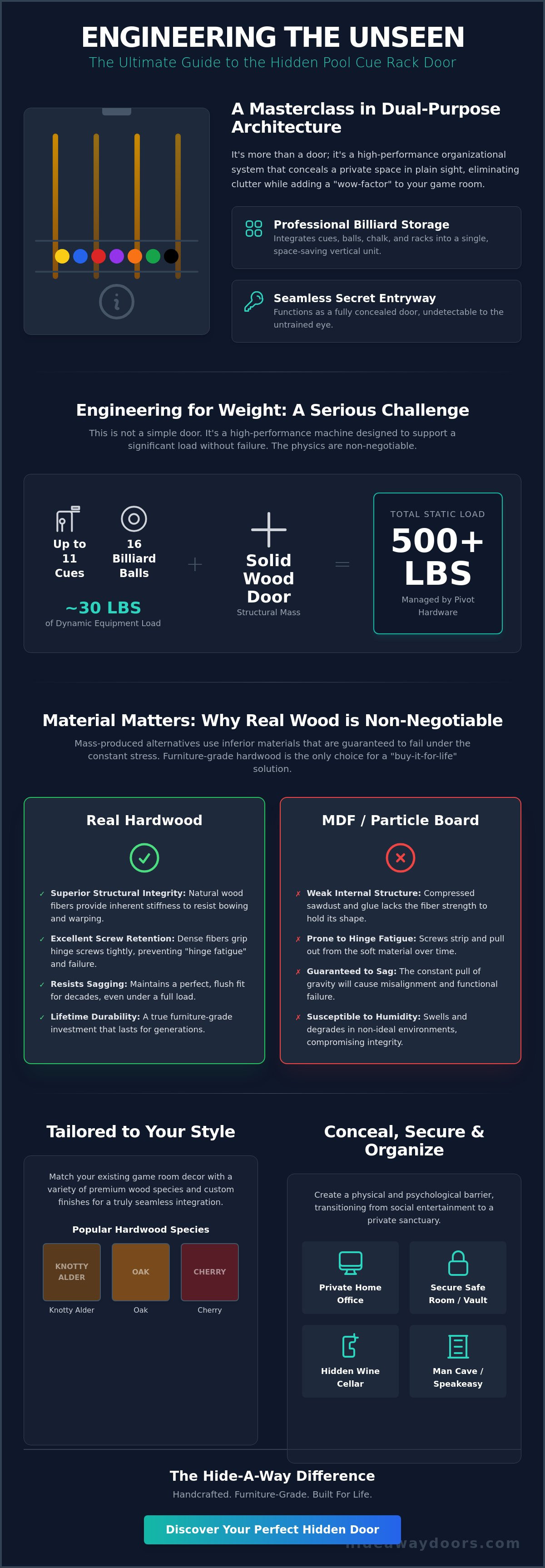
The Rack Face features precision-milled slots designed to hold cues securely without scratching the finish. Below, dedicated shelving keeps ball sets and racking triangles within reach. The Pivot Hinge is the unsung hero of the build. It's engineered to allow a door weighing hundreds of pounds to swing open with the nudge of a single finger. Finally, the Jamb and Casing are crafted to match standard wall openings, ensuring no tell-tale gaps reveal the hidden pool cue rack door to guests. Every component is designed to withstand the dynamic load of billiard equipment while maintaining a perfect, flush fit.
Common Uses for Hidden Game Room Entrances
These doors are perfect for concealing a private home office or a "man cave" from the main entertainment area. They provide a physical and psychological barrier that signals the transition from social play to private work or relaxation. Many clients use them to secure a safe room or a vault behind a functional hobby display. In other homes, they create a seamless transition to a hidden wine cellar door, turning a standard basement into a multi-layered destination. Whether it's for security, privacy, or pure aesthetic intrigue, these systems turn a simple doorway into a functional piece of furniture-grade art.
Engineering for Weight: Why Real Wood is Non-Negotiable
A hidden pool cue rack door is more than a design choice; it's a significant weight-bearing challenge. Physics doesn't lie when it comes to hanging a functional library of billiard equipment on a moving hinge. A standard 36-inch unit often carries 11 cues, a full set of 16 balls, racking triangles, and various bridges. This adds roughly 25 to 30 pounds of dynamic load to the door's own structural mass. When you factor in the force of the swing, the hardware must manage over 500 pounds of static load to prevent sagging or misalignment over time.
Many mass-market manufacturers use MDF or particle board to keep costs down, but these materials are fundamentally ill-suited for this application. MDF is essentially compressed sawdust and glue. It lacks the internal fiber structure needed to hold heavy-duty screws under constant tension. Over time, humidity and the persistent pull of gravity lead to "hinge fatigue," where the screws eventually pull through the soft material. We rely on the technical principles outlined in Wood as an Engineering Material to ensure every joint and pivot point remains stable through decades of use. Using solid hardwoods like Knotty Alder, Oak, and Cherry provides the structural rigidity necessary to keep the door perfectly flush.
Real Wood vs. MDF: A Durability Comparison
The longitudinal alignment of natural wood fibers provides the inherent stiffness required to resist bowing, even when supporting the unbalanced load of a full rack of billiard balls. Hardwoods offer superior screw retention, meaning the heavy-duty pivot hinges stay exactly where they were installed without loosening. Beyond the mechanical benefits, the finish quality of real wood creates a deep, furniture-grade luster. You can't replicate the authentic grain patterns or the tactile warmth of solid timber with painted sawdust.
Maintenance and Longevity of Billiard Doors
Real wood allows for easy refinishing and repairs, ensuring the door ages gracefully alongside your home's architecture. While climate control is helpful for maintaining tight tolerances, solid wood handles environmental shifts far better than engineered alternatives that swell and crumble when exposed to moisture. Investing in quality means your door won't just look good on day one; it will function perfectly on day 10,000. This level of craftsmanship is why a secret pool cue rack door is a value-adding home investment rather than a temporary fixture. You can view our full range of solid hardwood billiard doors to see how we balance physics with aesthetics.
Customizing Your Hidden Door: Woods, Finishes, and Features
Customization is the bridge between structural necessity and personal expression. While we've established that real wood is essential for weight management, the specific species you select determines how the hidden pool cue rack door integrates with your home's atmosphere. We strictly follow the Architectural Woodwork Standards to ensure every custom finish meets elite cabinetry expectations. Whether you're matching a century-old mahogany table or a sleek, modern game room, the material choice is your first critical decision.
Beyond the wood itself, the configuration of the rack face can be tailored to your specific collection. A standard 8-cue rack serves most casual players, but serious enthusiasts often require expanded 15-cue layouts. These custom configurations don't just hold more equipment; they reorganize the shelving for ball sets and chalk to maintain a balanced, flush appearance. Security also plays a role in customization. While a simple magnetic catch is standard, many homeowners opt for advanced RFID or biometric locks that remain entirely invisible from the outside. These systems ensure that your secret entrance stays accessible only to those you trust.
Wood Species for Every Game Room Aesthetic
Knotty Alder is a perennial favorite for rustic or traditional basement bars. It offers a warm, rugged character that hides minor dings from heavy use. Maple and Cherry hardwoods provide a smooth, tight grain ideal for contemporary billiard rooms where a modern, polished finish is the priority. For those who want the door to disappear entirely into the wall color, paint-grade options allow for a seamless match with your existing drywall or trim, leaving only the pool cues as a visual focal point.
Advanced Concealment Features
The true "wow factor" often lies in the hidden locking mechanism. Some advanced designs use a specific pool cue as a "key." Tilting it to a precise angle triggers the internal latch, allowing the door to swing open. To ensure the secret remains safe, an automatic return system can be integrated, gently pulling the door shut and engaging the lock after use. For those using the hidden space as a private sanctuary, acoustic seals provide soundproofing that keeps your "man cave" or office truly separate from the social noise of the game room. This attention to detail transforms a simple door into a piece of high-functioning machinery.
Planning and Installation: Preparing Your Game Room
Precision is the primary difference between a true secret entrance and a visible door that simply looks like furniture. A hidden pool cue rack door relies on tight tolerances to remain undetectable. If your rough opening is even a quarter-inch out of square, the shadow lines will give away the secret to anyone in the room. Before you order, verify that your framing is perfectly plumb. Standard openings in older homes often settle over time, so you might need to adjust the studs to ensure the casing sits perfectly flush against the drywall.
Choosing between in-swing and out-swing depends entirely on your floor plan and how you use the space. An in-swing door preserves the "rack" look from the game room side but requires several feet of empty clearance inside the secret room. Conversely, an out-swing model pulls into the billiard area. Consider the path of your pool cues and the players. You don't want the door swinging into a player's back during a high-stakes game. Planning the swing path early ensures the room remains functional regardless of whether the door is open or closed.
Weight distribution is the most overlooked factor in game room planning. While we've discussed the door's internal engineering, your home's framing must be equally stout. A standard door header is designed for a lightweight interior slab, not a 500-pound furniture-grade unit. You should double the header to prevent sagging. Ensure your floor joists are solid and free of deflection. If the floor dips under the weight of the rack and cues, the door will eventually drag, ruining the illusion and damaging your flooring.
Structural Requirements for Heavy Secret Doors
Header reinforcement is non-negotiable for long-term stability. Use a double 2x6 or 2x8 header depending on the span of your opening. Floor clearance is equally vital. If you're planning for thick plush carpeting, the pivot point must be set higher to prevent friction. Don't forget electrical work. Moving light switches or outlets that sit within the swing path is a common step that homeowners miss during the initial planning phase. These small details ensure the hidden pool cue rack door operates without interference.
Professional vs. DIY Installation
Experienced woodworkers with the right tools might opt for a diy hidden door kit to build a custom solution from scratch. However, the complexity of a heavy-duty pivot system often warrants hidden door installation by a specialist. A professional ensures the unit is perfectly level and plumb. This prevents a "ghost swing," where the door drifts open or closed on its own due to gravity. Buying a pre-hung, fully assembled unit saves hours of frustration and guarantees the secret remains safe. Ready to start your project? You can browse our pre-hung billiard doors to find a unit that arrives ready to install.
The Hide-A-Way Difference: Handcrafted Game Room Security
Quality isn't accidental. It's the result of decades spent refining the intersection of traditional joinery and modern home security. At Hide-A-Way Doors, our heritage is rooted in Tennessee craftsmanship, where we prioritize substance over mass production. Every hidden pool cue rack door we build is a testament to the master artisan's touch. Unlike imported units that rely on automated assembly lines, our doors are bench-made. This ensures that every joint is tight, every finish is even, and every pivot is tested for a lifetime of service. We take pride in local manufacturing because it allows us to maintain a level of oversight that overseas factories simply can't match.
Our "No-MDF Promise" is the cornerstone of our brand. While we've discussed the structural necessity of hardwoods for weight management, for us, it's also a matter of integrity. We believe that a secret door should feel as substantial as the room it protects. By using only real hardwoods, we ensure your hidden pool cue rack door remains a legacy piece of furniture. It won't swell, it won't sag, and it won't fail when you need it most. This commitment to permanent quality is why we offer national shipping and comprehensive support. Whether you're in a high-rise in New York or a ranch in Montana, your custom door arrives fully assembled and ready to become the centerpiece of your home.
Why Real Wood is a Superior Investment
Choosing solid wood isn't just about durability; it's a savvy financial move. High-quality architectural features consistently increase home appraisal values, as buyers recognize the worth of bespoke, permanent installations. Then there's the tactile experience. There is a specific, muffled "thud" that only a solid wood door makes when it seats into the jamb. It's a sound that communicates security and precision. Customization allows you to tailor this experience, ensuring the wood species and rack layout reflect your personal style while providing a functional utility that mass-produced alternatives lack.
How to Start Your Custom Project
The journey from inspiration to installation begins with a conversation. We recommend consulting with a design expert to determine the best Alpha Door configuration for your specific space. You can review wood samples and finish options online to find the perfect match for your existing billiard table or room trim. Our team is here to guide you through the measurements and technical specs to ensure a flawless fit. Design your custom hidden pool cue door today at Hide-A-Way Doors.
Elevate Your Game Room with Masterful Concealment
Your game room is more than a place for social play; it's a reflection of your appreciation for fine craftsmanship and home security. By choosing a hidden pool cue rack door, you're investing in a sophisticated architectural element that eliminates clutter while introducing an element of intrigue. We've examined how real hardwood engineering provides the necessary structural rigidity to handle heavy billiard loads and how precision planning ensures your secret entrance remains undetectable to the untrained eye.
Every project we undertake is handcrafted in Morristown, Tennessee, with a strict adherence to real hardwood construction. We never use MDF because we believe in building objects that last for generations. With reliable national shipping across the USA and Canada, your custom concealment solution is ready to be delivered directly to your door. It's time to transform a simple doorway into a legacy piece of furniture that secures your home with quiet confidence.
The capacity of the rack is determined by the width of the door you select. A standard 30 to 34-inch wide model typically holds 9 cues, while a 36-inch wide unit accommodates up to 11 cues. This layout also provides dedicated shelving for a full set of 16 billiard balls and racking triangles. Every slot is precision-milled to ensure your equipment remains organized and accessible without cluttering your room.
Is the door heavy to open when fully loaded with billiard balls and cues?
While a fully loaded hidden pool cue rack door can weigh several hundred pounds, it remains effortless to operate. We utilize a heavy-duty pivot hinge system that distributes the weight vertically into the floor rather than pulling on the side jambs. This engineering allows the door to swing smoothly with the push of a single finger. You get the security of a massive hardwood unit without the physical strain of a heavy door.
Can I install a hidden pool cue door in an existing wall opening?
Yes, our doors are designed as pre-hung units that fit into standard rough openings. If your current doorway is square and the framing is sturdy, the installation process is similar to that of a traditional interior door. However, because these units are significantly heavier than a standard slab, you must verify that your header is reinforced. We provide detailed measurements to ensure your hidden pool cue rack door fits seamlessly into your home's architecture.
What is the difference between a standard bookcase door and a pool cue door?
The primary difference lies in the specialized milling and internal configuration. A standard bookcase door features deep shelving for literature and decor, whereas a pool cue door is engineered with vertical slots specifically for billiard sticks. It also includes shallow, felt-lined shelves designed to hold ball sets and chalk. While both offer the same level of concealment, the billiard model is optimized for the specific dimensions and weight of gaming equipment.
Do hidden billiard doors come with a locking mechanism?
Every door comes standard with a magnetic catch to keep it flush, but we offer several advanced locking upgrades. You can choose from mechanical deadbolts, invisible RFID sensors, or biometric fingerprint scanners for enhanced security. Some enthusiasts even opt for a secret cue trigger, where a specific stick acts as a lever to release the latch. These options ensure your private room remains accessible only to those with the proper credentials.
Will the pool cues fall off the rack when the door is opened or closed?
Cues remain perfectly secure due to the gravity-fed design of the milling and the smooth motion of the pivot hinge. The top of each cue rests in a precision-cut notch, while the base sits in a recessed cup that prevents sliding. Because the door does not jerk or vibrate during its swing, your equipment stays vertical and silent. This stability is a hallmark of furniture-grade engineering and artisanal construction.
Can I customize the wood species to match my pool table?
We offer a wide range of hardwoods including Knotty Alder, Oak, Cherry, and Maple to ensure a perfect match with your existing decor. Each species can be stained or painted to replicate the finish of your billiard table or room trim. Because we use solid timber rather than MDF, the grain patterns and wood density will feel consistent with high-end furniture. This allows the door to disappear into the room's aesthetic completely.
How long does it take to ship a custom handcrafted hidden door?
Bespoke, fully assembled doors typically have a lead time of 5 to 8 weeks for production and shipping. Each unit is built to order in our Tennessee facility, allowing our master artisans the time needed for precision joinery and hand-finishing. This duration ensures that your door meets our rigorous quality standards before it is crated and shipped. We provide tracking information so you can prepare your game room for the arrival of your new centerpiece.