The Ultimate Guide to DIY Hidden Door Kits: Quality vs. Convenience
A secret passage should be a masterpiece of engineering, not a project that ends in a sagging floor. Most homeowners assume that achieving professional-grade concealment requires a five-figure custom contract; however, the right diy hidden door kit can bridge the gap between high-end aesthetics and approachable assembly. It's about finding that rare intersection of rugged durability and refined design that stands the test of time.
We understand the hesitation that comes with many DIY solutions. You've likely worried that a kit will arrive looking like flimsy, flat-pack furniture or that the hinges won't support a full library of books. It is a valid concern, as a door that sticks or drags immediately ruins the illusion of a secret entrance. You deserve a solution that feels as solid as it looks. In this guide, you'll discover how to identify kits with the structural integrity of a custom build without the bespoke price tag.
We will explore the vital differences between hardware-only packages and full, furniture-grade wood kits. You'll learn what to look for in materials to ensure your project can be stained to match your home's existing trim perfectly. From measuring for a seamless fit to understanding weight capacities, we're providing the roadmap to a secret door that operates with silent, lasting precision.
Key Takeaways
Understand the structural demands of a secret passage, including why real wood is necessary to support loads exceeding 300 pounds without sagging.
Compare the three levels of assembly to select a diy hidden door kit that aligns with your woodworking skills and aesthetic goals.
Learn the essential planning steps, such as verifying your opening is square and level to ensure smooth, silent operation.
Discover how to avoid a generic furniture look by choosing furniture-grade wood that can be stained to match your home's unique interior.
Beyond the Hinge: What Defines a True DIY Hidden Door Kit?
The allure of a hidden room is timeless. Throughout the history of secret passages, the focus has always been on the seamless blend of utility and mystery. In modern home design, a diy hidden door kit serves as the bridge between a simple weekend project and a high-end architectural feature. It taps into a deep-seated desire for privacy and discovery. However, the magic of a secret door is instantly broken if the integration isn't perfect. To achieve that satisfying, silent swing of a heavy bookcase, you must look beyond the surface aesthetics and evaluate the structural foundation of the kit you choose.
A true kit provides a complete, engineered solution. It isn't just a box of screws or a set of printed instructions. It is a system designed to handle the unique stresses of a rotating furniture piece. Most options on the market fall into three distinct categories:
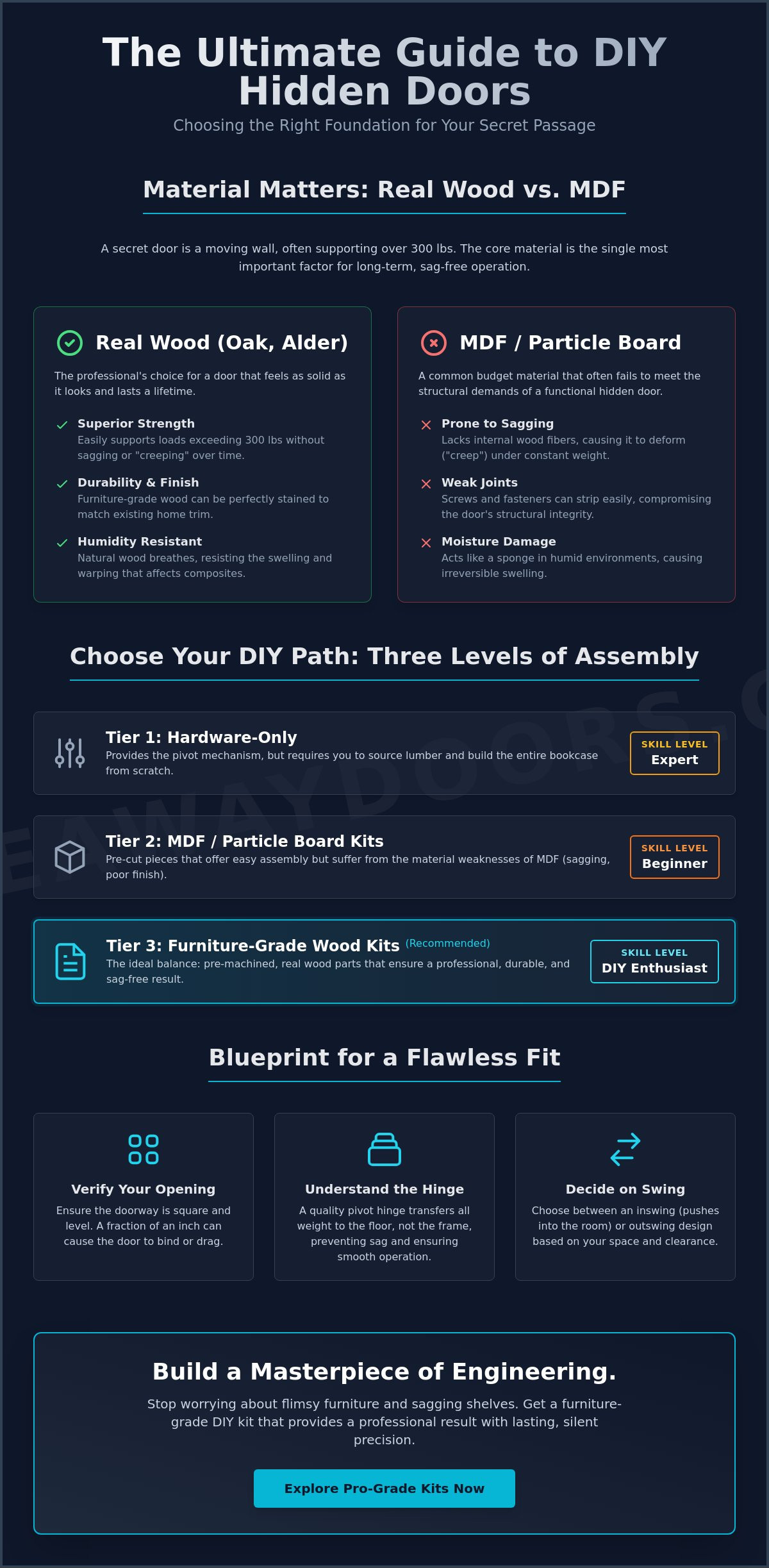
Hardware-Only: These provide the pivot mechanism but leave the complex construction of the door entirely to you.
MDF or Particle Board: These offer pre-cut pieces made from compressed wood fibers, which often lack the lateral strength for long-term use.
Real Wood Kits: These utilize furniture-grade hardwoods that offer the structural integrity required for a heavy, functional bookcase that will be used daily.
Hardware-Only vs. Component Kits
Choosing to source your own lumber might seem cost-effective at first glance, but the hidden expenses and technical challenges quickly mount. You need a fully equipped woodshop and advanced joinery skills to ensure every cut is precise. Secret doors leave no room for error; a fraction of an inch off-square can cause the entire unit to bind or drag against the floor. A component-based diy hidden door kit eliminates this frustration. By providing pre-machined parts where the pivot points are already perfectly aligned, these kits ensure a professional result for those who value both their time and the final finish. It reduces the margin of error significantly, allowing you to focus on the craftsmanship of the assembly rather than the stress of the engineering.
The Role of the Pivot Hinge System
The heart of any hidden door is its hinge system. Standard interior door hinges are designed for lightweight panels, not a bookcase that might easily exceed 300 pounds once you add your collection. A professional-grade kit utilizes an all-steel pivot system that distributes the load vertically. This design transfers the weight directly into the floor rather than pulling on the door frame, preventing the sag that plagues cheaper alternatives. You must also consider the mechanics of your specific space. You'll need to decide between an inswing design, which pushes into the secret room, or an outswing model that pulls into your main living area. Each requires specific clearance and hardware configurations to maintain the illusion of a solid wall. By prioritizing these engineering details, you transform a clever home hack into a piece of bespoke artisanry that functions flawlessly for years.
The Engineering of Secrecy: Why Real Wood Trumps MDF in DIY Projects
A secret door is a moving wall. It is a heavy-duty piece of engineering disguised as a library shelf, and its performance depends entirely on the material at its core. While many entry-level options rely on Medium Density Fiberboard (MDF) to lower costs, this material often fails to meet the long-term demands of a functional secret passage. A fully loaded bookcase can easily exceed 300 lbs when filled with hardbacks and collectibles. This immense weight creates a constant downward force that tests the structural rigidity of every joint and fastener in your diy hidden door kit.
The primary issue with MDF is its lack of internal structure. As a composite of compressed sawdust and resin, it doesn't possess the longitudinal fibers that give natural timber its strength. Over time, MDF suffers from a phenomenon known as "creep," where the material slowly deforms under a constant load. This leads to the dreaded sag. Real wood species, such as Oak or Alder, maintain their shape with far more resilience. They provide the necessary stiffness to ensure the door remains perfectly square within its frame, even after years of supporting a substantial library. Environmental factors also play a critical role. In areas with fluctuating humidity, MDF acts like a sponge, swelling at the edges and losing its crisp lines. Real wood breathes, handling seasonal changes without the permanent structural degradation seen in synthetic alternatives.
Screw Retention and Joint Integrity
Success in any DIY project relies on the security of its fasteners. In a secret door, the hinges and shelf supports must stay anchored despite constant movement. Real wood offers superior screw retention because the metal threads bite into natural wood grain, creating a mechanical bond. In contrast, screws in MDF often strip the surrounding fibers, leading to loose joints that can't be easily repaired. Choosing a furniture-grade diy hidden door kit allows you to utilize professional joinery techniques like dado cuts and pocket holes. These methods create multiple points of contact, ensuring the unit remains a single, rigid monolith rather than a collection of shifting panels.
Long-Term Durability and Resale Value
The tactile experience of opening a secret door should be one of smooth, silent precision. A sagging door doesn't just ruin the mystery; it can physically damage your home by dragging across hardwood floors or gouging the surrounding drywall. Homebuyers recognize this difference immediately. They value the permanence and craftsmanship of solid wood over the "flat-pack" feel of synthetic kits. A secret passage built from authentic materials adds genuine character and resale value to a property. It ensures the "wow factor" of your discovery remains intact for decades, operating as flawlessly in year ten as it did on the day you finished the installation.
Comparing DIY Hidden Door Tiers: From Hardware-Only to Unfinished Kits
Selecting the right diy hidden door kit requires an honest assessment of your woodworking experience and the tools at your disposal. While the concept of a secret passage is universal, the execution varies wildly across different product tiers. The market generally offers three paths, each presenting a different balance of upfront cost, labor intensity, and final aesthetic quality. Understanding these tiers ensures you don't start a project that exceeds your technical bandwidth or fails to meet your expectations for home integration.
Tier 1: The Hardware-Only Approach. This is essentially a box of specialized hinges and fasteners. It is designed for the master artisan who possesses a full woodshop and the patience to engineer a cabinet from the ground up.
Tier 2: The Primed MDF Kit. These kits are often the most affordable "complete" solutions. They serve well for temporary installations or budget-conscious projects where a simple painted finish is acceptable and the door won't face heavy daily use.
Tier 3: The Unfinished Real Wood Kit. Often called the "Goldilocks" choice, these kits provide the structural superiority of solid timber with the convenience of pre-machined components. They offer a professional foundation while allowing for deep customization.
The trade-off between time and money is the most significant factor here. A hardware-only build might save you a few hundred dollars initially, but it demands an immense investment in labor and sourcing. Conversely, a high-quality diy hidden door kit arrives with the engineering already solved, allowing you to focus on the finish and installation rather than the physics of the pivot.
The Hidden Difficulty of Hardware-Only Builds
Building a secret door from scratch is a lesson in extreme precision. The most challenging aspect is maintaining a consistent "reveal," which is the narrow gap between the door and the frame. If your cabinet is even slightly out of square, that gap will be uneven, immediately tipping off anyone who looks at the wall. Furthermore, sourcing "straight" lumber from local big-box retailers is a notorious hurdle; even a minor warp in a long vertical board can ruin the illusion of a flush-mounted shelf. Sourcing parts and building from scratch can easily consume forty hours of labor, whereas a pre-machined kit reduces that commitment to a single productive afternoon.
Why Unfinished Kits Offer the Best Customization
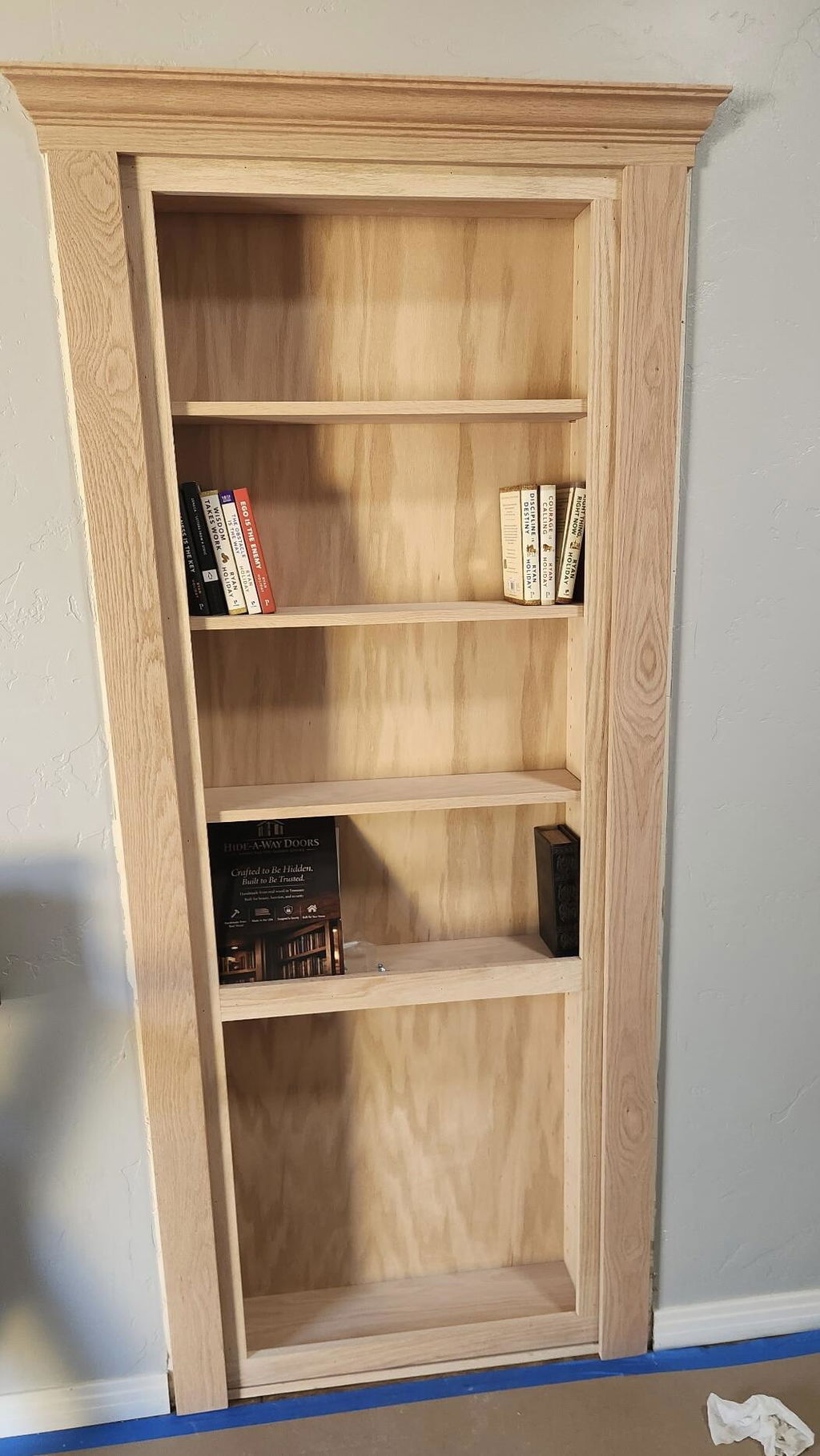
An unfinished wood kit provides a blank canvas that pre-painted or primed options simply cannot match. It allows you to use the exact stain or topcoat that already exists on your home's baseboards and crown molding. This level of detail is what separates a "secret door" from a piece of furniture that just happens to be in front of a hole in the wall. Beyond color matching, unfinished kits allow for site-specific modifications. If your floor is slightly uneven or your walls aren't perfectly plumb, you can make minor adjustments to the wood during assembly. There is a profound sense of satisfaction in applying a hand-rubbed finish to a handcrafted wood product, knowing it was built to endure as a permanent part of your home's architecture.
Planning Your Build: Essential Measurements and Structural Requirements
Precision is the silent partner of secrecy. While the previous sections established the superiority of real wood and the various kit tiers, those benefits are only realized through meticulous planning. A diy hidden door kit is a high-performance machine; it requires a perfectly prepared environment to operate with the silent, effortless motion that defines a professional installation. Before you pick up a drill, you must master the geometry of your doorway.
Successful installation begins with understanding your rough opening versus your finished opening. The rough opening is the raw framing of the wall, while the finished opening includes the jambs and casing. You must also confront the three enemies of a hidden door: square, level, and plumb. If your side studs aren't perfectly vertical or your header isn't perfectly horizontal, a heavy bookcase door will bind or reveal uneven gaps that betray its location. Your floor requires equal scrutiny. It must be able to support a concentrated load of several hundred pounds and be perfectly level throughout the door's entire swing radius to prevent dragging.
Wall thickness is another critical variable that many home installers overlook. Standard 2x4 framing results in a 4.5-inch wall depth, while 2x6 framing creates a 6.5-inch depth. This measurement dictates the pivot point and the overall swing geometry of the door. You must also perform a thorough clearance check. A bookcase door has a significant "footprint" when open; ensure it won't strike nearby furniture, wall art, or low-hanging light fixtures during its arc of travel.
The Critical Importance of the Header
The top pivot of a secret door bears a significant portion of the unit's weight and torque. A standard door header is rarely sufficient for this task. You must often add solid wood blocking to the framing to provide a secure anchor for the hardware. This reinforcement prevents the "door lean" that eventually causes misalignment. A mere 1/8-inch deviation at the header can translate into a full 1-inch gap at the floor, completely ruining the flush look of your installation. For those ready to begin, selecting a precision-engineered diy hidden door kit ensures that your hardware is backed by the structural support it requires.
Electrical and Obstruction Planning
Concealment requires a clean, uninterrupted wall surface. This often means moving light switches, thermostats, or electrical outlets that currently reside within the door's footprint. When relocating these, always consult local building codes to ensure your hidden room remains safe and compliant. Integration also extends to your trim. You'll need to plan how your baseboards and crown molding will terminate or "break" at the door's edge to maintain a seamless appearance. Finally, if you intend to use magnetic locks or secret latches, plan their wiring or placement during the framing stage. It's much easier to hide these components before the final wood panels are in place.
The Hide-A-Way Advantage: Furniture-Grade DIY Solutions
Heritage matters in woodworking. In Morristown, Tennessee, our master artisans build each diy hidden door kit with a level of attention that automated factories simply cannot replicate. We take immense pride in local manufacturing, utilizing traditional skills to create products that are both aesthetically beautiful and functionally secure. This project is about more than just a box of wood; it's about providing a foundation for a secret passage that will intrigue and protect for generations. You aren't just installing a door. You're installing a piece of American craftsmanship.
Our Real Wood Guarantee is the cornerstone of our philosophy. We refuse to use MDF or particle board because those materials cannot sustain the weight of a true library door over time. Every kit we ship is built from solid timber, ensuring that the joints remain tight and the frame stays square under the pressure of a full collection. This structural integrity is inherited directly from the engineering of our flagship Alpha Door models. You are getting the same professional-grade mechanics used in our most sophisticated custom builds, packaged specifically for the capable home installer who values substance over fleeting trends.
Wood Species Options for the Discerning DIYer
Choosing the right grain is essential for the seamless integration we discussed in previous sections. We offer four primary species to suit any interior: Alder, Oak, Cherry, and Walnut. Alder is a versatile, fine-grained wood that takes stain beautifully, while Oak is known for its rugged strength and classic grain patterns. Cherry offers a sophisticated look that darkens and richens with age, and Walnut remains the pinnacle of luxury with its deep, dark tones and exceptional durability. Stain-grade wood allows you to highlight these natural characteristics perfectly. Because these are authentic wood products, they offer a luxury MDF cannot: the ability to be sanded and refinished decades from now as your home's style evolves.
Assembling Your Hide-A-Way Kit
When your diy hidden door kit arrives, you'll find a complete system of pre-machined components and heavy-duty hardware. We've handled the complex geometry and pivot alignments in our shop so you can focus on the satisfaction of the build. Our "No-Sag" promise is a result of superior internal bracing and the inherent strength of the timber itself. This ensures your door operates with quiet confidence, maintaining its flush fit year after year. If you encounter a unique structural challenge during the process, our national support network of professionals is available to provide guidance. We ensure your secret room project is a resounding success from the first measurement to the final swing.
You now understand the critical role that material integrity plays in the success of a secret entrance. Choosing a diy hidden door kit built from real wood ensures your project remains a permanent, functional part of your home's architecture. We've explored the physics of the pivot and the necessity of a reinforced header to prevent the sagging that often plagues lesser installations. By prioritizing professional-grade hardware and handcrafted timber, you eliminate the structural risks associated with flimsy composite materials.
Our solutions are handcrafted in the USA, featuring authentic wood construction with absolutely no MDF. Each kit includes heavy-duty hardware with a capacity of 300lbs or more, providing the rugged dependability your home deserves. It's time to bridge the gap between initial inspiration and a perfectly executed secret room. You have the knowledge to select a foundation that won't fail over time.
Your journey from dreaming to doing begins with a commitment to quality. We're here to provide the tools and craftsmanship necessary to make your secret passage a lasting masterpiece that functions flawlessly for years to come.
Frequently Asked Questions
Is a DIY hidden door kit hard to install for a beginner?
Installation is manageable for homeowners with basic carpentry skills and a commitment to precision. The most challenging aspect is ensuring your doorway is perfectly square and level, but a pre-machined system handles the complex pivot engineering for you. If you can follow methodical instructions and use a level, you can achieve a professional result in a single afternoon.
How much weight can a DIY bookcase door kit actually hold?
A professional-grade diy hidden door kit is engineered to support loads exceeding 300 pounds. This high weight capacity allows you to fully stock your shelves with hardback books or heavy collectibles without risking structural failure. The all-steel pivot system transfers this weight directly to the floor, preventing the unit from pulling on the wall studs over time.
Do I need special tools to assemble a real wood hidden door kit?
You don't need industrial machinery, but a few standard power tools are essential for a clean finish. A drill, a level, a tape measure, and a rubber mallet are the primary requirements for assembly and installation. If you choose an unfinished wood kit, you will also need basic supplies for staining or painting to match your existing home decor.
Can I install a hidden door in an existing doorway without tearing out the wall?
Yes, you can install a hidden door into a standard rough opening without major structural demolition. The kit replaces the existing door and jamb entirely. While you don't need to tear down the wall, you will need to remove the current trim and door frame to ensure the new unit fits flush and operates with the necessary clearance.
What is the difference between an in-swing and an out-swing DIY kit?
The difference lies in the direction of the arc and the depth of the cabinet. An in-swing kit pushes into the room behind the door, which is ideal if you have limited space in your main hallway. An out-swing kit pulls toward you, which often allows for a deeper bookcase but requires more clearance in the primary living area to avoid striking furniture.
How do I hide the gap around the door so it stays truly 'secret'?
Concealment is achieved through matching trim and a consistent 1/8-inch reveal gap. By using the same baseboards and casing that exist throughout the rest of your room, you create a visual pattern that the eye naturally glosses over. The small gap around the perimeter is easily disguised by the shadows of the surrounding molding, maintaining the illusion of a solid wall.
Can I use a DIY kit for a gun safe or panic room entrance?
Our kits are frequently used as the primary entrance for secure storage and safe rooms. The rugged real wood construction and heavy-duty weight capacity make them ideal for concealing heavy steel doors or specialized cabinets. For these high-security applications, we recommend integrating magnetic locks or RFID latches during the framing and assembly phase for maximum utility.
Why should I choose real wood over the cheaper MDF kits found on Amazon?
Real wood offers superior screw retention and structural rigidity that compressed sawdust cannot replicate. Choosing a real wood diy hidden door kit prevents the sagging and joint failure that happens when MDF is subjected to heavy loads over time. Additionally, natural timber can be stained to a furniture-grade finish and refinished in the future, providing lasting value and durability.