The Master Artisan’s Checklist: Hidden Door Finishing Options for 2026
What if the most sophisticated piece of engineering in your home is betrayed by a single brushstroke? You've likely spent hours dreaming of a secret passage, yet the fear of a mismatched wood grain or paint peeling on a high-use bookcase door can be paralyzing. It's a valid concern because a secret door is only as effective as its ability to blend into the room. Choosing the right hidden door finishing options is about more than just aesthetics; it's a structural requirement for true concealment.
You deserve a result that looks like an heirloom and functions with quiet, rugged reliability. We'll show you how to select the perfect wood species and finish to make your entrance truly invisible while ensuring lifelong durability. This guide provides a clear path through the technical landscape, from navigating the 2026 VOC standards for interior coatings to choosing between paint-grade poplar and stain-grade hardwoods. You'll gain the clarity needed to ensure your project remains a seamless, well-protected mystery for decades.
Key Takeaways
Understand why real wood is the essential foundation for a secret entrance's optical illusion and how it outperforms synthetic materials.
Navigate the most effective hidden door finishing options by identifying whether your project requires stain-grade aesthetics or the smooth stability of paint-grade timber.
Discover the "Master Artisan" approach to wood selection, including why Walnut remains the pinnacle of luxury for high-end concealment.
Learn the professional preparation sequence, from the "Three-Stage Sanding" rule to the critical step of hardware removal before any finish is applied.
Compare the durability of on-site applications against professional factory finishing in controlled "Clean Room" environments for a dust-free, heirloom-quality result.
The Role of Finishing in Mastering Total Concealment
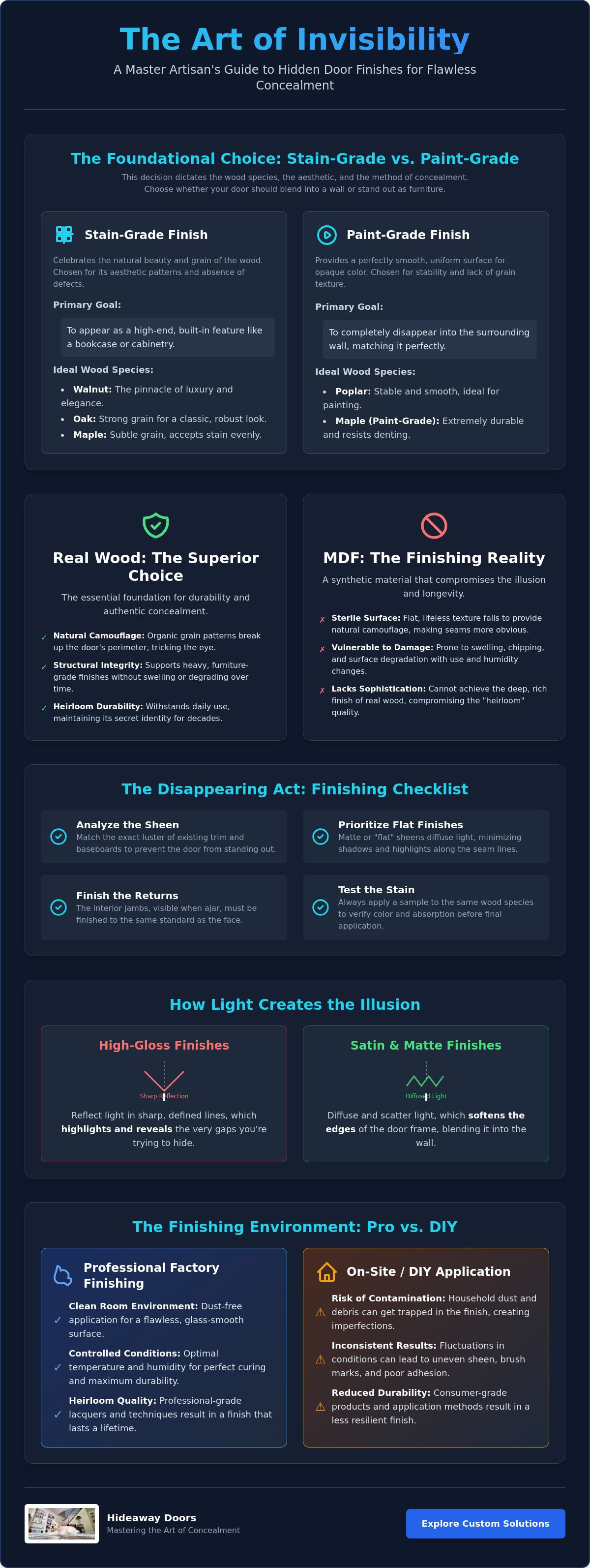
The finish on a secret entrance is the final layer of an optical illusion. It's the difference between a door that looks like a built-in fixture and a door that looks like a secret passage. When you evaluate hidden door finishing options, you aren't just choosing a color; you're choosing how light interacts with the surface to either reveal or conceal the seams. A high-performance real wood hidden door handles these treatments with a level of sophistication that cheap MDF simply cannot match. Because our Alpha Door operates on such tight tolerances, the thickness and consistency of the finish are critical to maintaining smooth movement and perfect alignment.
Light refraction plays a major role in this deception. High-gloss finishes reflect light in sharp, defined lines, which often highlights the very gaps you're trying to hide. Satin or matte sheens diffuse light, softening the edges of the door frame and blending it into the surrounding environment. For a deeper understanding of these technical layers, you might review this overview of the wood finishing process to see how prep work affects the final sheen and durability.
The Disappearing Act: Finishing for Invisibility
To achieve total concealment, the door must become an extension of your existing architecture. This requires a meticulous approach to matching your home's current details. Use this checklist to ensure your hidden door finishing options align with the room's design:
Analyze the Sheen: Match the exact luster of your existing crown molding and baseboards to ensure the door doesn't stand out.
Prioritize Flat Finishes: Use matte or "flat" paints to minimize shadows and highlights at the seam lines.
Finish the Returns: Ensure the interior jambs and the "returns," which are the parts of the door visible when it's slightly ajar, are finished to the same standard as the face.
Test the Stain: Always apply a sample to the same wood species to account for natural variations in absorption.
Real Wood vs. MDF: The Finishing Reality
Real wood grain provides an organic depth that acts as a natural camouflage. While MDF creates a flat, sterile surface, the varied texture of oak, maple, or walnut breaks up the visual field, making it harder for the eye to track the door's perimeter. Structural integrity is also a factor. Real wood can support heavy, furniture-grade lacquers and deep stains without the swelling or surface degradation often seen in particle-based alternatives. Real wood remains the only viable choice for homeowners who demand a durable, furniture-grade finish that withstands the rigors of daily use without losing its secret identity.
Stain-Grade vs. Paint-Grade: The Selection Checklist
Deciding between a stain-grade or paint-grade finish is the most consequential choice you'll make after selecting your door's mechanical design. This decision dictates the species of wood we select for your build. Stain-grade wood is hand-picked for its aesthetic grain patterns and a complete absence of surface defects. Conversely, paint-grade wood is selected for its high stability and ultra-smooth surface, typically utilizing species like Maple or Poplar that won't reveal grain texture through multiple coats of pigment. Understanding your hidden door finishing options requires a clear vision of whether you want your door to match the surrounding wall or contrast as a standalone piece of fine furniture.
The "Match or Contrast" rule is your guiding principle here. If the goal is a seamless wall where the door completely disappears, paint is almost always the superior choice. However, if you want the door to look like a high-end, built-in bookcase that happens to be a secret entrance, a rich stain can provide that heirloom quality. Before finalizing your choice, evaluate your room’s existing light and color palette. North-facing rooms with cool, blue-toned light can make dark stains feel heavy. In contrast, bright, south-facing libraries can handle deep Walnut tones with ease. If you're unsure which material suits your home’s architecture, exploring a custom Alpha Door can help you visualize how these finishes perform in a real-world setting.
The Stain-Grade Decision Checklist
Stain emphasizes the heritage of the timber. If you're looking for the rustic, knotty character of Alder or the traditional strength of Oak, stain grade is the path forward. Verify if you need a UV-inhibitor for doors positioned near large windows to prevent fading. You should also determine if grain-filling is required; open-grain woods like Oak often need this extra step to achieve a smooth, professional finish that meets professional factory finishing standards.
The Paint-Grade Decision Checklist
For a door that disappears into a painted wall, paint grade is the standard. Ensure the wood species is hard enough to resist dings. Maple is significantly superior to Poplar for high-traffic bookcase doors because it doesn't dent as easily. Professional priming is non-negotiable to prevent wood tannins from bleeding through your topcoat. Finally, use "Self-Leveling" paints on shelves to eliminate brush marks and ensure a durable, smooth-as-glass surface for your collection. These hidden door finishing options ensure your project remains both beautiful and functional for decades.
Matching Wood Species to Your Architectural Vision
Wood selection is where the artisan's intuition meets the homeowner's vision. When exploring hidden door finishing options, the chemical composition of your topcoat matters as much as the wood grain itself. Oil-based finishes are prized for their ability to penetrate deep into the fibers, providing a warm, amber glow that develops a rich patina over time. Conversely, modern water-based finishes offer a crystal-clear shield that preserves the wood's natural, raw color without yellowing. Choosing the right species ensures that your door doesn't just function; it belongs.
Walnut represents the pinnacle of secret door luxury. Its deep, chocolatey tones and complex grain patterns offer a sense of permanence that few other materials can replicate. For a hidden mirror door, the frame species must be selected to anchor the glass within the room's existing decor. Alder acts as a chameleon in these scenarios. It possesses a uniform pore structure that accepts stain with remarkable consistency, allowing it to mimic more expensive species like Cherry or Mahogany while maintaining its own rugged durability.
Traditional Strength: Oak and Alder
Oak remains a staple for homes requiring a sense of heritage and strength. To achieve a classic "Mission" or "Craftsman" look, we recommend quartersawn Oak treated with dark, penetrating stains that highlight the medullary rays. If your vision leans toward a rustic or distressed aesthetic, Alder is the superior choice. Its relatively soft texture allows for beautiful hand-distressing, and its unique knots provide a tactile character that feels grounded and authentic. Staining techniques for Alder should focus on wiping stains that settle into the grain to emphasize these natural "imperfections."
Elite Luxury: Cherry and Walnut
Walnut is so naturally vibrant that a simple clear coat is often superior to a colored stain. Adding pigment to Walnut can muddy the natural transition between the heartwood and sapwood, which is where the wood's true beauty lies. Cherry offers a different kind of sophistication; it is a photo-reactive species that will naturally darken and "age" into a deep reddish-brown when exposed to light. When designing a secret room behind a mirror, using these elite species for the surrounding cabinetry ensures the entrance feels like a deliberate architectural choice rather than a secondary addition. These hidden door finishing options provide the durability and elegance required for high-end home concealment.
The Master Artisan’s Finishing & Prep Checklist
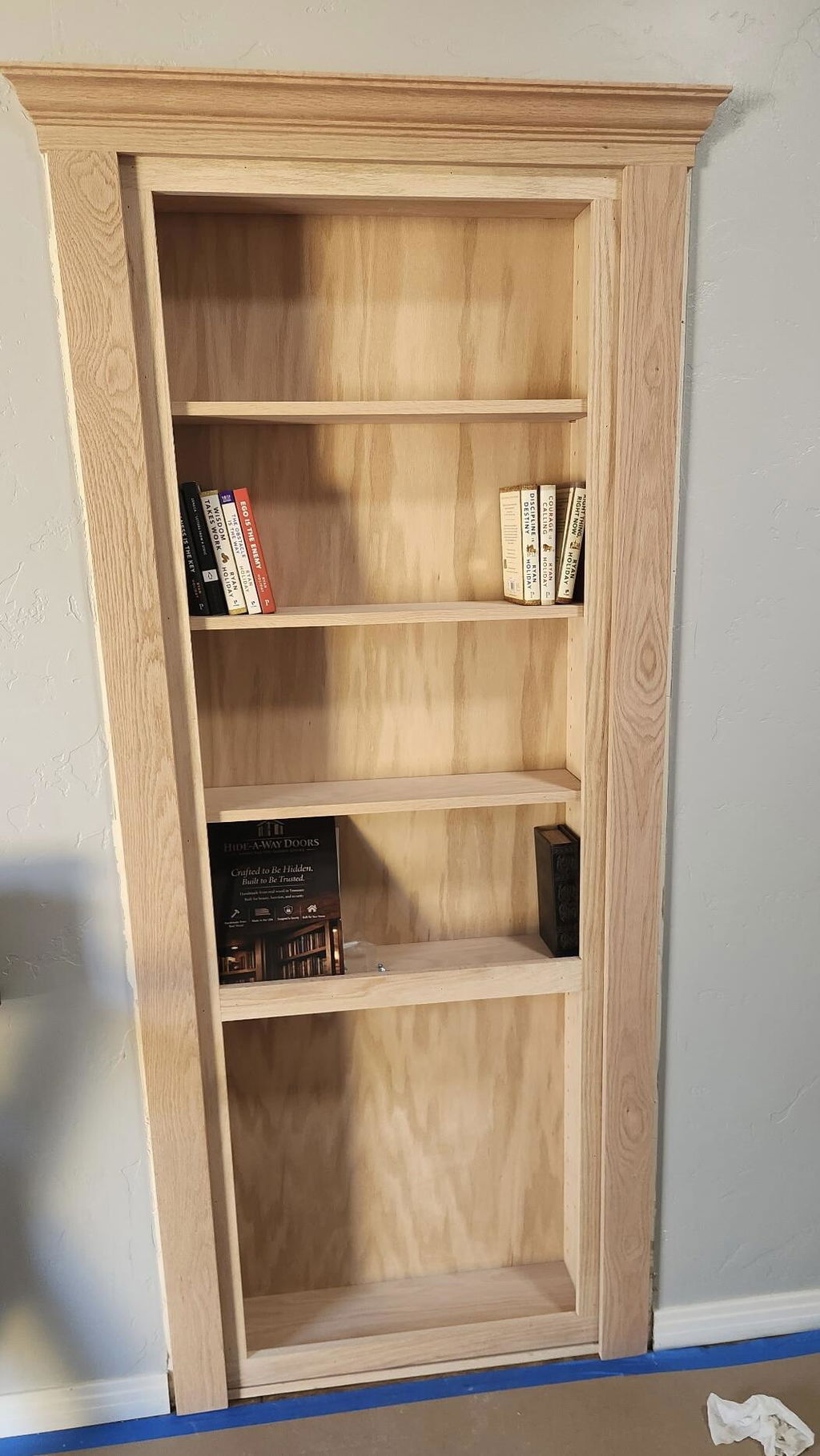
The transition from a raw wood assembly to a finished masterpiece requires more than just a brush and a can of lacquer. It demands a disciplined approach to preparation. Even if you've purchased one of our DIY Door Kits, you must remove every piece of hardware before evaluating your hidden door finishing options. Leaving hinges or magnetic latches in place creates unsightly build-up and can lead to mechanical binding. A secret door relies on precision tolerances; any excess finish in the hinge pockets can compromise the door's swing and its ultimate concealment. By stripping the unit down to its core components, you ensure that every surface receives a uniform application.
Professional results are born from the "Three-Stage Sanding" rule. We begin with 120-grit to level the surface, move to 150-grit to remove scratches, and finish with 180-grit or 220-grit for a glass-smooth foundation. Don't overlook the "blind spots" that are only visible when the door is open. These are the areas often ignored because they're hidden when the door is closed, such as the top of the door slab, the underside of the header, and the recessed jambs. If these aren't finished to the same standard as the face, the illusion is shattered the moment the door swings open. Maintain a controlled environment with humidity levels between 30% and 50% to ensure the finish cures without blushing or trapping moisture.
Phase 1: Pre-Finish Preparation
Step 1: Inspect for "mill marks," those subtle ripples left by industrial planers that often stay invisible until a stain hits them. Also check for minor shipping dings that need a light steam or additional sanding to ensure a perfectly level surface.
Step 2: The "tack cloth" ritual is mandatory. Use a fresh cloth to remove every micro-speck of dust that could ruin the surface tension of your topcoat. Even a single particle can create a visible defect in a high-quality finish.
Step 3: Apply a pre-stain conditioner if you're working with porous species like Alder. As we discussed in previous sections, this step prevents blotching and ensures an even, professional distribution of color across the entire surface.
Phase 2: Application and Sealing
Success in finishing follows the "Thin to Win" rule when applying your hidden door finishing options. It's always better to apply multiple thin, controlled coats than one thick, heavy layer that is prone to runs and drips. Between each coat of polyurethane or lacquer, lightly sand the surface with 320-grit paper to knock down "nibs" or raised grain. This creates the signature furniture-grade feel our clients expect. Your final inspection should involve a high-intensity raking light to check for "holidays," those small missed spots, and any lingering drips along the edges of the bookcase shelves. For those who want to ensure their project meets the rigorous standards of Hide-A-Way Doors from day one, you can explore our fully pre-finished Alpha Door collections.
Why Professional Factory Finishing Outperforms DIY
The allure of a weekend project often leads homeowners to consider finishing their secret entrance themselves. However, when you weigh the technical complexity against the desired outcome of total invisibility, the professional path becomes the logical choice. Selecting factory-applied hidden door finishing options isn't just about convenience; it's about achieving a level of permanence and precision that's virtually impossible to replicate in a residential garage. A master artisan understands that a secret door is a high-use mechanical object, and Hide-A-Way Doors ensures every unit withstands the rigors of daily operation with a finish that won't fail.
A factory environment offers a Clean Room advantage that home environments lack. In our facility, we control every variable, from air filtration to ambient humidity, which prevents the microscopic specks of dust that settle into wet lacquer at home. Finishing a pre-assembled unit is also significantly more difficult once the shelves and backing are in place. Reaching into the tight corners of a bookcase to apply an even coat requires specialized equipment and a steady, experienced hand to prevent pooling and uneven drying.
The Factory Process Advantage
Industrial spray booths provide a level of atomization that hand-brushing or rolling simply can't mimic. While a brush leaves behind subtle ridges, a high-volume, low-pressure system creates a smooth skin across the wood. We utilize catalyzed lacquers, which are chemically superior to standard hardware store paints. These finishes create a cross-linked bond that resists hand oils and shelf dings. This level of consistency is especially vital for a double bookcase secret door, where both units must match perfectly in grain and sheen to maintain the illusion of a single, continuous fixture.
Custom Matching and Peace of Mind
The Value of Time calculation is often what tips the scales for our clients. When you factor in the hours spent sanding and waiting for multiple coats to dry in a non-controlled space, professional finishing is a sound investment. We can match your existing cabinet door samples to ensure your new entrance integrates with your home's current architecture. At Hide-A-Way Doors, our commitment to handcrafted excellence means every door is treated as a piece of fine furniture. By choosing our professional hidden door finishing options, you secure a result that protects your investment for a lifetime. Explore our handcrafted finishing options today and let our master artisans bring your vision to life with the quiet confidence of a perfect finish.
Mastering the Art of Invisibility
A secret door is more than a novelty; it's a testament to your home's character and your personal security. We've explored how the right hidden door finishing options transform a functional object into a seamless architectural element. Whether you choose the rich depth of stained Walnut or the clean stability of painted Maple, your selection defines the longevity of the illusion. Precision prep work and an understanding of light refraction are what separate a masterwork from a simple project. These details ensure that your entrance remains undetectable to the untrained eye while functioning with rugged, dependable grace.
You don't have to navigate these technical decisions alone. Our team prioritizes authentic materials and traditional skills to ensure your entrance remains a durable, heirloom-quality mystery. We rely exclusively on Real Wood Construction, avoiding the structural weaknesses of MDF to provide a product that's truly handcrafted in the USA. With a National Network of Professional Installers ready to assist, your vision for a secure, beautiful home is within reach. Browse Our Handcrafted Hidden Door Collections to find the perfect foundation for your next discovery. Your home's most intriguing feature is just one finish away.
Expert Insights: Finishing Your Secret Entrance
Can I paint a hidden bookcase door myself?
Yes, you can paint a hidden bookcase door yourself if you follow a rigorous preparation process. You must remove all hardware first to prevent binding and apply multiple thin coats of high-quality, self-leveling paint. This prevents the thick build-up that often leads to peeling on high-use surfaces like shelves. Taking the time to sand between coats ensures the final texture matches the surrounding wall perfectly.
What is the best wood species for a stained secret door?
Walnut is the premier choice for a stained secret door due to its rich, chocolatey tones and elegant grain. If you're looking for a more traditional or rustic feel, Oak and Alder are exceptional alternatives. These species accept deep stains beautifully and offer the structural permanence required for a secret entrance. They provide a sturdy foundation that holds its shape over decades of use.
How do I match my secret door to my existing trim?
You match your door to existing trim by identifying the wood species, stain color, and sheen level of your current molding. We recommend testing your hidden door finishing options on a scrap piece of the same species before applying it to the door. This ensures the light reflects off the new surface exactly as it does on your baseboards, creating a seamless visual transition.
Does the finish affect how much weight a bookcase door can hold?
No, the finish doesn't directly impact the weight capacity, but it's essential for long-term stability. A professional finish seals the wood fibers against humidity changes. This protection prevents the wood from swelling or warping; such movements could compromise the door's tight tolerances and smooth swing. Durable real wood construction remains the primary factor for supporting heavy loads like books or collectibles.
Should I use oil-based or water-based stain for my hidden door?
Choose an oil-based stain for a warm, amber patina or a water-based finish for a clear, non-yellowing shield. Oil-based options penetrate deeper into the grain, highlighting the natural character of species like Cherry or Oak. Water-based finishes are ideal for modern designs where you want to preserve the raw, light color of the timber without the wood yellowing as it ages.
What sheen level is best for a secret door?
Satin or matte sheens are the best choices for secret doors because they minimize light refraction. High-gloss finishes tend to create sharp reflections that highlight the small gaps between the door and the wall. By using a lower sheen, you diffuse light across the surface. This technique makes the seams nearly invisible to the eye and helps the unit blend into the room's shadows.
How do I maintain the finish on a hidden door over time?
Maintain your finish by dusting regularly and using a slightly damp microfiber cloth for deeper cleaning. Avoid using harsh household chemicals or abrasive cleaners, as these can degrade the protective catalyzed lacquer or paint over time. A well-maintained finish ensures your secret entrance remains a durable, heirloom-quality feature of your home that functions as smoothly as the day it was installed.
Is it better to buy a primed door or an unfinished one?
It's better to buy a primed door if you intend to paint, as it provides an ultra-smooth, professional foundation. If you plan to stain, always start with an unfinished door. This allows you to explore various hidden door finishing options while ensuring the stain penetrates the wood grain evenly. Starting with raw timber is the only way to achieve a consistent, high-end appearance with stained hardwoods.