The Ultimate Buying Guide for Hidden Door Security Features & Hardware in 2026
What if the most sophisticated security system in your home is the one that nobody ever suspects is there? You probably already know that a secret room is only as good as its concealment, yet many installations fail because of sagging hinges or visible gaps that betray the entrance. To maintain a truly deceptive threshold, you must focus on the precision mechanical hardware and hidden door security features that provide both strength and silence. It's the difference between a door that feels like furniture and a bookcase that functions like a vault.
We'll show you how to select the heavy-duty components that keep your secret room secure, functional, and completely invisible to the naked eye. You'll learn which ANSI Grade 1 hardware can support the weight of real wood without dropping a fraction of an inch over time. We are going to break down the latest 2026 hardware trends, from the dominance of matte black finishes to advanced mechanical latches; this ensures your project achieves a seamless, flush-mount finish that lasts as long as the home itself.
Key Takeaways
Understand why mechanical latching serves as the "invisible spine" of any secret entrance, providing the necessary physical resistance without compromising concealment.
Learn how to evaluate specific hidden door security features to determine when a simple latch is sufficient and when a keyed mechanical lock is required for high-security vaults.
Discover the "Zero-Failure" philosophy of mechanical hardware and why it remains superior to electronic systems that are vulnerable to power outages and solenoid fatigue.
Identify the engineering solutions for common performance frustrations, such as correcting door sag to ensure your heavy bookcase remains perfectly flush against the wall.
Explore a curated collection of precision hardware designed by master builders to ensure your secret door operates with silence and reliability for a lifetime.
The Invisible Spine: Understanding Hidden Door Security Features
Security is often perceived as a series of visible barriers. We think of steel plates, deadbolts, and reinforced frames. However, in the world of high-end concealment, the most effective defense is the one that never enters an intruder's mind. True security for a secret room exists at the precise intersection of total concealment and physical resistance. If a door remains undetectable, it doesn't need to withstand a battering ram; yet, it must be sturdy enough to do so if discovered. This dual requirement makes hidden door security features the most critical part of your build.
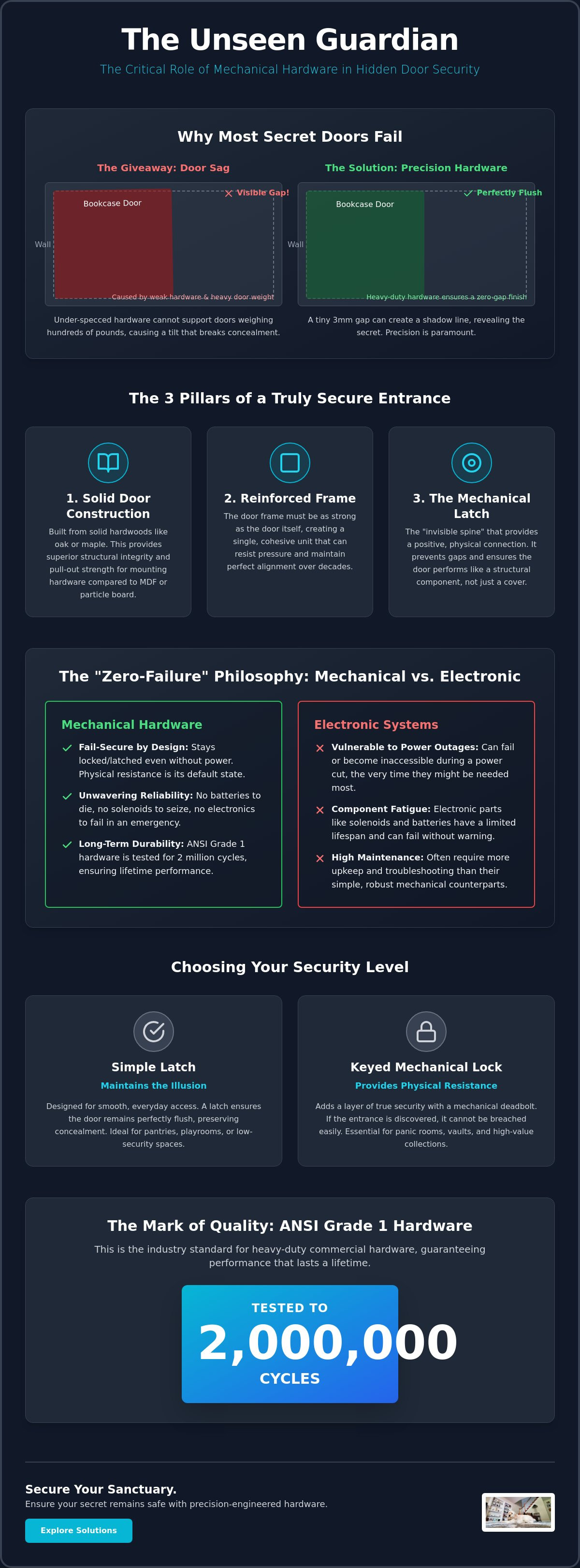
Mechanical latching serves as the invisible spine of any secret entrance. While some builders rely on magnets or simple friction, a mechanical latch provides a positive, physical connection between the door and the frame. This ensures the unit doesn't just look like a wall; it performs like a structural component. To achieve a perfect flush-mount finish, the hardware must operate within incredibly tight tolerances. Even a three-millimeter gap can create a shadow line that reveals the door's presence to the naked eye. This level of precision requires hardware that is designed to work with the structural density of real wood rather than flimsy alternatives like MDF or particle board.
Concealment vs. Traditional Security
The history of hidden doors shows that "hidden in plain sight" has always been the first line of defense for safe rooms and private vaults. A standard interior latch is designed for a lightweight, hollow-core door that weighs very little. In contrast, concealment-grade hardware must support a fully loaded Alpha Door or a Double Bookcase Door that can weigh hundreds of pounds. Precision engineering prevents the "reveal" caused by door sagging. When hardware is under-specced, the weight of the furniture causes the door to drop, creating a visible tilt at the top and making the hidden door security features useless because the secret is out.
The Anatomy of a Secure Hidden Entrance
A truly secure entrance relies on three pillars: the door itself, the reinforced frame, and the mechanical latch. Because handcrafted hidden doors are built from solid hardwoods, they provide a superior structural anchor for security hardware. Material density is vital here. A screw driven into solid oak or maple has significantly higher pull-out strength than one driven into compressed sawdust. This physical integrity allows for the use of ANSI Grade 1 hardware, which is tested to 2 million cycles. This ensures your sanctuary remains secure and functional for decades, maintaining its mystery through every single use.
Comparing Mechanical Latching and Locking Options
Selecting the right hidden door security features depends entirely on the value of the assets you're concealing. A walk-in pantry hidden behind a Mirror Door has different requirements than a panic room designed for personal safety. Mechanical systems provide a distinct "fail-secure" advantage that electronic alternatives often lack. In an emergency, you don't want to worry about whether a battery is dead or if a solenoid has seized. Physical hardware stays in its set position until you manually change it. This reliability aligns with enhanced security performance requirements, ensuring the door assembly functions as a single, cohesive unit under pressure.
Choosing between a simple latch and a keyed lock comes down to how often you access the room and the level of threat you're mitigating. A latch is about maintaining the illusion; a lock is about physical resistance. For high-value collections, the added layer of a mechanical deadbolt ensures that even if the secret entrance is discovered, it cannot be easily breached. It's a pragmatic approach to security that values long-term durability over flashy, high-maintenance tech gadgets.
The Hidden Bookcase Door Latch: Smooth Everyday Access
The Hide-A-Way Doors Hidden Bookcase Door Latch is designed for smooth, everyday access. Priced at $44.95, it's a cost-effective way to ensure your door stays flush against the wall. Because it's crafted from real wood, it doesn't look like a piece of security hardware; it looks like part of the furniture. This latch is the perfect solution for low-risk applications like secret closets or playrooms. It provides enough resistance to keep the door from swinging open due to air pressure changes in the home, which is a common "tell" for poorly installed hidden doors. It's simple, effective, and completely invisible from the outside.
Mechanical Key Locks: High-Security Protection
When the stakes are higher, a physical key is non-negotiable. The Mechanical Key Lock for Hidden Doors, available for $139.95, offers high-security protection without compromising the secret. It's an essential component for gun concealment doors where safety and restricted access are the top priorities. This lock is bored directly into the solid wood frame, leaving no external evidence of its existence. It provides a level of pull-out strength that simply isn't possible with surface-mounted magnets. If you're building a sanctuary for your family or a vault for your collection, this is the hardware that provides true peace of mind. You can view our full collection of mechanical latches to find the right balance of concealment and strength for your project.
Mechanical Reliability: Why Physical Locks Outperform Electronic Systems
The allure of high-tech gadgets often masks a fundamental truth in home defense: complexity is the enemy of reliability. While electronic keypads and magnetic locks offer a modern aesthetic, they introduce multiple points of failure that can compromise your safety. We adhere to a "Zero-Failure" philosophy that prioritizes the immutable laws of physics over digital convenience. When you engage a mechanical latch, you aren't hoping for a software handshake or a battery charge. You are relying on solid metal components forged to work every single time. This dependable approach is what separates professional-grade hidden door security features from retail novelty items.
Electronic systems carry inherent risks that are often ignored in marketing brochures. A power outage can leave your "fail-secure" door permanently locked or, worse, "fail-safe" and completely open. Solenoids are prone to seizing after years of sitting idle, and hidden wiring can degrade or short-circuit within the wall. Mechanical hardware requires no power, no firmware updates, and no complex troubleshooting. It provides immediate tactile feedback; you can feel the weight of the bolt sliding into place and hear the definitive "thud" that confirms your sanctuary is sealed. This sensory confirmation is a vital security indicator that digital screens simply cannot replicate.
Emergency Egress and Panic Room Safety
Safe rooms are designed for the most stressful moments of your life. In a crisis, you must be able to exit a secret door to a safe room without fumbling for a code or waiting for a system to reboot. Mechanical bypasses are the gold standard in high-security environments because they offer a guaranteed exit path regardless of the home's electrical status. A mechanical deadbolt relies on the immutable laws of physics; a solenoid depends on a fragile electrical impulse that can fail exactly when you need it most. This simplicity ensures that your exit is as reliable as your entrance.
Longevity and Wear: The Real Wood Advantage
Mechanical hardware is designed to age alongside the solid wood it's anchored to. Unlike plastic electronic housings that become brittle over time, our metal-on-wood systems are built for generational use. The natural density of hardwoods like oak or maple provides a stable foundation that doesn't warp or shift, keeping the latch perfectly aligned for decades. To maintain this level of readiness, we recommend keeping Replacement Keys for Hidden Bookcase Doors ($12.95) on hand. These hidden door security features are maintenance-free, requiring only a rare drop of lubricant to remain as smooth and silent as the day they were installed.
Solving Common Hidden Door Performance Issues
Precision is the hallmark of a master builder. Even the most meticulously crafted secret entrance must eventually contend with the laws of physics and the natural settling of a home. Gravity never sleeps. The most frequent frustration for owners of concealment furniture is an "out-swing" door that fails to stay flush at the top edge. When a door kicks out even a fraction of an inch, it creates a shadow line that immediately alerts the eye to something unusual. Maintaining your hidden door security features requires more than just a strong lock; it requires hardware that can compensate for the immense leverage exerted by a heavy, wood-filled bookcase.
Door sag is rarely a failure of the wood itself. Instead, it's usually a result of the frame shifting or the hinges needing a slight adjustment to handle the torque of a fully loaded unit. Strike plate alignment is another critical factor. If the latch doesn't meet the plate with perfect center-line accuracy, you lose the silent, "soft" close that is essential for maintaining the illusion. A secret door that requires a forceful shove to close isn't just loud; it's a liability. Fine-tuning these mechanical points ensures that your sanctuary remains both undetectable and easy to operate as the years pass.
The Out-Swing Door Catch Solution
Stubborn bookcase doors that refuse to stay tucked into the wall require a specialized mechanical intervention. The Out-Swing Door Catch, priced at $19.95, is engineered specifically to solve this problem. It provides a positive, tactile engagement at the top edge of the door, pulling the unit into a perfect seal against the trim. This accessory is particularly vital for double bookcase secret doors. Because double doors have a larger meeting point in the center, the risk of one side drifting outward is doubled. This simple, rugged catch ensures both sides remain perfectly aligned for a seamless look.
Fine-Tuning Your Installation
Achieving a flush-mount finish often comes down to the subtle use of shims and spacers. These small adjustments allow you to square the frame within an imperfect wall opening, ensuring that your hidden door security features engage without friction. You should test your latch tension regularly. It should feel firm but smooth, providing a secure closure without requiring excessive force. High-quality, heavy-duty hinges are the foundation here; they must support the significant load of an alpha concealment door without allowing the unit to drag on the floor or tilt within the jamb. If you are experiencing alignment issues, you can order precision alignment hardware to restore your door's perfect finish.
Secure Your Sanctuary: The Mechanical Latching & Locking Collection
Selecting the right components is the final step in transforming a standard room into a secure sanctuary. We've explored the physics of door sag and the undeniable reliability of mechanical systems; now, it's time to assemble the specific hidden door security features that suit your lifestyle. The "Hide-A-Way Standard" isn't a marketing slogan. It represents a curated collection of hardware designed, tested, and used daily by the very artisans who build our doors. These components are engineered to work in harmony with solid wood, ensuring that your installation remains as sturdy as the home itself.
Every piece in our collection serves a distinct purpose in the ecosystem of concealment. Whether you're securing a private library or a high-security vault, the goal remains the same: a silent, effortless operation that leaves no trace of the room beyond. By choosing hardware designed by builders rather than mass-market retailers, you're investing in the longevity and "wow factor" that only professional-grade equipment can provide. This is the definitive path to completing your handcrafted hidden door project with total confidence.
Standout Products for Your Security Project
The Bookcase Door Latch: This is the best all-around choice for daily concealment. It provides the necessary tension to keep your door flush without the need for a physical key, making it ideal for high-traffic areas like pantries or playrooms.
The Mechanical Key Lock: For those requiring secure storage for valuables or firearms, this is the professional's choice. It offers a higher level of physical resistance while remaining completely hidden within the wood frame.
The Out-Swing Catch: Alignment is the key to invisibility. This catch is the essential fix for alignment perfection, pulling the top of the door tight against the jamb to eliminate revealing shadow lines.
Why Choose Hide-A-Way Doors Hardware?
Compatibility is the primary reason to stick with the master artisan's choice. Every latch, lock, and catch we offer comes with a compatibility guarantee for all Hide-A-Way door models. You won't have to worry about whether a bolt is too long or if a strike plate will align with your specific wood species. If you ever run into a technical hurdle, you have direct access to support from our Morristown-based team. We don't just sell parts; we provide the expertise earned through thousands of successful installations. You can Browse the Mechanical Latching, Locking & Accessories Collection to find the final hidden door security features needed to secure your home.
Mastering the Art of Concealment
Building a secret room is more than a simple home improvement project; it's the realization of a lifelong intrigue. You now understand that the true strength of your sanctuary lies in the invisible spine of its hardware. By prioritizing mechanical reliability over fragile electronic systems, you ensure that your entrance remains functional during power outages and critical moments. Choosing precision-engineered components specifically designed for the weight of real wood prevents the sagging that often plagues lesser installations. It keeps the mystery alive by maintaining a perfect, deceptive finish.
Our hardware is handcrafted in the USA and precision-engineered for real wood to guarantee a flush, seamless result every time. If you aren't a seasoned builder, our national installation network is available to help you execute your vision with professional accuracy. It's time to invest in the hidden door security features that provide both the "wow factor" of discovery and lasting peace of mind. Shop the Mechanical Latching, Locking & Accessories Collection today and take the final step toward securing your home with a touch of mystery. Your sanctuary is waiting.
Frequently Asked Questions
What are the most important hidden door security features for a safe room?
The most critical hidden door security features for a safe room are those that provide physical resistance without creating visible gaps. You need a mechanical deadbolt that anchors deeply into solid wood and high-strength hinges that prevent sagging. These components ensure the door stays perfectly flush against the wall. Without a tight seal, the shadow line will betray the room's location long before an intruder even reaches the lock.
How do I lock a bookcase door from the inside?
Locking a bookcase door from the inside is achieved through a mechanical bypass or an interior thumb-turn latch. These mechanisms allow you to secure the entrance manually once you've entered the sanctuary. It's a vital safety feature for any panic room. This setup ensures you have total control over the threshold from both sides, providing security while maintaining a clear, reliable path for emergency egress without needing external power.
Is a mechanical lock better than a magnetic lock for a hidden door?
Mechanical locks are superior to magnetic locks because they don't rely on electricity to maintain their state. A magnetic lock can fail during a power outage or a wiring short, leaving your secret room either stuck shut or completely unsecured. Mechanical hardware follows a "Zero-Failure" philosophy. It uses solid metal bolts to provide a physical connection that remains consistent regardless of your home's electrical status or battery levels.
Can I install a mechanical key lock on a DIY hidden door kit?
Yes, you can install a mechanical key lock on our DIY Door Kits. Our hardware is designed for modularity and works seamlessly with the solid wood components provided in the kits. You'll need to follow the provided templates to ensure the bore hole is precise. This allows you to upgrade a standard DIY project into a high-security entrance without needing specialized industrial machinery or complex electrical expertise.
What should I do if my out-swing bookcase door won't close fully at the top?
If your out-swing bookcase door won't close fully at the top, you should install a specialized out-swing door catch. This accessory provides the necessary tension to pull the top edge of the unit tight against the jamb. Over time, houses settle and frames shift slightly. This small mechanical adjustment corrects those alignment issues and eliminates the shadow lines that could reveal your secret room to an observant guest.
Are replacement keys available for Hide-A-Way mechanical locks?
Replacement keys are readily available for all Hide-A-Way mechanical locks through our online store. We understand that keys can be misplaced over years of use, so we maintain a stock of replacements to ensure you never lose access to your sanctuary. Keeping a spare set on hand is a simple way to maintain your security. These are specifically cut to match our high-security mechanical cylinders and provide a perfect fit.
How do I hide the keyhole on a high-security secret door?
Hiding the keyhole on a high-security door is typically done by placing the lock behind a movable trim piece or a false book. This ensures that the external face of the bookcase remains completely clean and indistinguishable from standard furniture. Some builders also use recessed placement within a shelf's shadow to keep the hardware out of the direct line of sight. This extra layer of concealment is what makes the entrance truly secret.
Does adding heavy security hardware cause the bookcase door to sag?
Adding heavy security hardware won't cause sagging if you use solid wood doors and professional-grade hinges. Sagging is usually a symptom of using weak materials like MDF or under-specced hardware. Our Alpha Door and Double Bookcase Door models are engineered to handle the additional weight of mechanical locks and steel plates. When properly anchored into a reinforced frame, the hardware actually strengthens the overall integrity of the secret entrance.