The Hidden Door Hinge System: Engineering the Perfect Secret Entrance
A secret door is only as invisible as the engineering supporting it. Without the right hardware, your hidden entrance is just a heavy bookshelf waiting to ruin your hardwood floors. You want that seamless, flush look that leaves guests wondering where the room went, but you're likely worried about the physics of it all. It's a valid concern; a standard door frame isn't built to hold a three-hundred-pound oak bookcase without eventually sagging or scraping. Choosing the wrong hidden door hinge system doesn't just ruin the aesthetic; it compromises the safety and longevity of your home's design.
We understand the pride that comes with a perfectly executed project. This article will show you the technical precision and structural requirements needed to keep your secret entrance functional for a lifetime. You'll learn the critical differences between heavy-duty pivot systems and concealed hinges, including why a weight capacity of up to 330 pounds is often the minimum for a real wood bookcase. We'll examine the geometry required for a perfectly flush fit and how to achieve a silent operation that never drags. By the end, you'll have the confidence to select hardware that supports your vision with the strength of a master artisan's touch.
Key Takeaways
Understand why a purpose-built hidden door hinge system is the essential mechanical foundation for achieving a zero-clearance, flush aesthetic.
Compare the mechanical advantages of floor-to-ceiling pivot points against invisible butt hinges to ensure your hardware supports extreme weight.
Identify why structural integrity begins with material choice, favoring the permanence of real wood over unstable alternatives like MDF.
Master the nuances of a flush fit by learning the critical importance of floor leveling and precise bearing alignment during installation.
Discover how the proprietary Alpha Hinge System bridges the gap between elegant home design and vault-grade security.
A secret door is a masterclass in illusion. The magic doesn't happen in the wood or the finish; it happens in the mechanical heart of the passage. A professional hidden door hinge system is the specialized hardware that allows a heavy, functional object like a bookcase to swing with the grace of a standard door while remaining completely invisible. The primary goal is a zero-clearance aesthetic. This means the gap between the door and the frame is so minute that it disappears into the natural shadows of the room's architecture. It's the difference between a door that looks like a door and a door that looks like a wall.
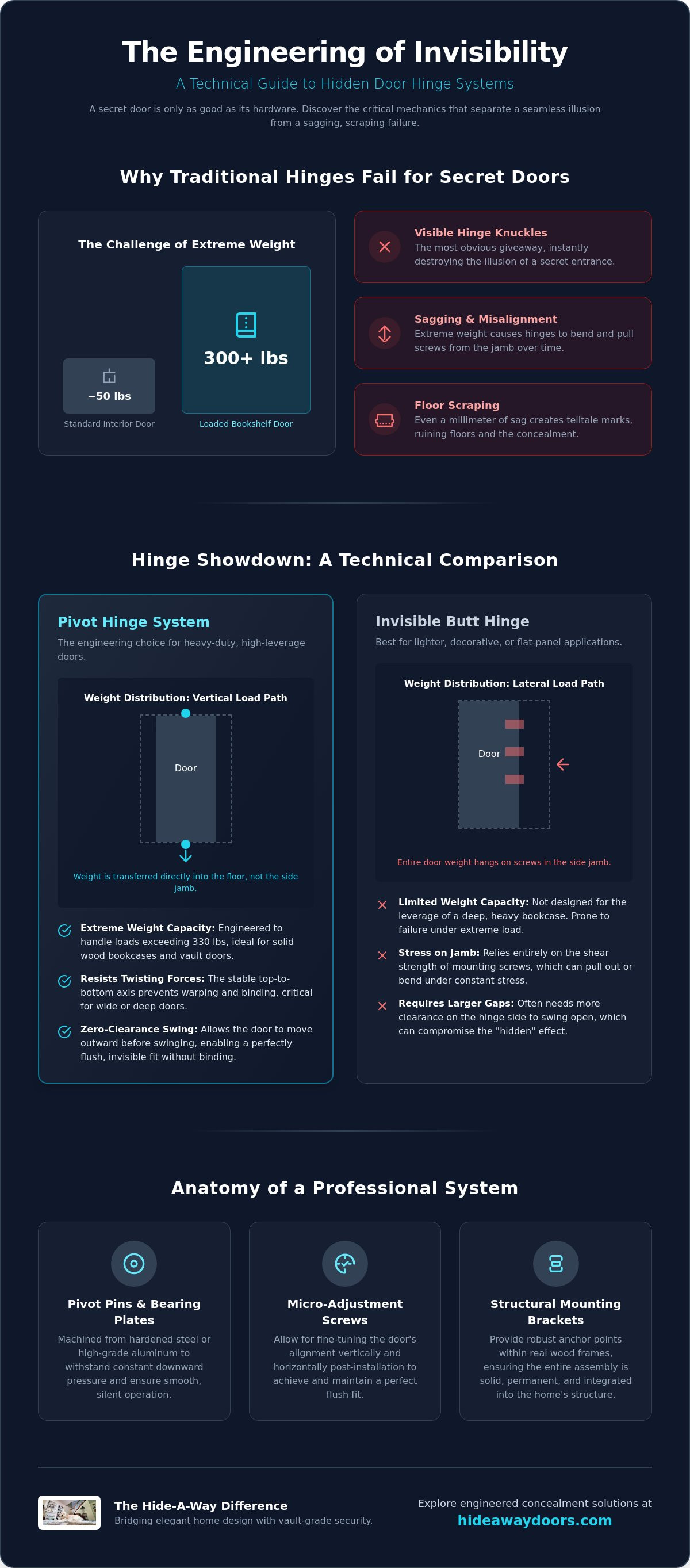
Standard butt hinges rely on a visible knuckle. This is a dead giveaway for any secret entrance. A concealed hinge, however, is mortised into the door and frame, tucking the pivot point entirely out of sight. For a secret entrance to stay secret for a lifetime, the hinge must support extreme weight without a fraction of an inch of sag. Even a millimeter of drop can cause the door to scrape the floor, creating a telltale mark that ruins the concealment. A high-quality system ensures the door remains perfectly aligned, maintaining the illusion through thousands of uses.
The Components of a Professional System
The foundation of any heavy-duty movement lies in the pivot pins and bearing plates. These components are engineered to withstand the constant downward pressure of a loaded bookcase or a solid wood Mirror Door. Unlike flimsy residential hardware, these parts are often machined from hardened steel or high-grade aluminum. Adjustment screws are another critical element. They allow for fine-tuning the door’s vertical and horizontal plane after installation. This ensures the door remains perfectly flush with the surrounding wall even as the house settles over time. Finally, structural mounting brackets provide the necessary anchor points within real wood frames, ensuring the entire assembly feels solid and permanent.
Why Traditional Hinges Fail in Secret Applications
Traditional hinges fail because of the simple physics of knuckle visibility. If you can see the hinge pin, you can see the door. Beyond aesthetics, weight distribution is a major hurdle. A standard interior door weighs about 50 pounds; a fully loaded Wine Rack Door can easily exceed 300 pounds. Standard hinges aren't built for that kind of leverage. They will eventually pull the screws from the jamb or bend under the stress. A professional hidden door hinge system utilizes a pivot point that remains entirely internal. This geometry allows the door to move outward before swinging, which prevents the edges from binding and eliminates the need for large, visible gaps on the hinge side.
Pivot Hinges vs. Invisible Hinges: A Technical Comparison
Engineering a secret entrance requires a choice between two primary mechanical philosophies: the pivot system and the concealed butt hinge. While both aim for invisibility, their load-bearing capabilities and swing paths differ significantly. A standard hidden door hinge system must be selected based on the depth and weight of the door, as a mistake here leads to structural failure. Pivot hinges are designed to manage the massive leverage of a deep bookcase, whereas invisible butt hinges like Soss or Tectus styles excel in flat-panel or decorative applications. Understanding the physics of these movements is the difference between a door that glides and one that grinds.
The mechanical advantage of a pivot point lies in its vertical alignment. By placing the pivot pins at the very top and bottom of the door, the system creates a stable axis that resists the twisting forces common in wide or heavy doors. This is why "invisible" butt hinges have much stricter weight limitations; they rely on the sheer strength of the mounting screws in the side jamb to hold the door level. For a detailed engineering overview of hinge mechanics, one can see how material stress varies between these two designs. When your project involves a high-depth bookcase, the pivot hinge is almost always the superior choice.
The Strength of Pivot Hinge Systems
The primary advantage of a pivot system is weight distribution. Instead of hanging the entire load off the side jamb, pivot hinges transfer the force directly into the floor. This vertical load path is essential for Alpha concealment doors and heavy bookcases that may hold hundreds of pounds of literature or collectibles. By utilizing sealed bearing technology, these systems provide a maintenance-free operation that remains silent for decades. This floor-to-ceiling alignment prevents the door from sagging, ensuring the tight tolerances required for a secret entrance remain intact. If you're building for longevity, these systems offer the peace of mind that comes from vault-grade hardware.
Concealed Soss and Tectus Styles
For projects like Mirror Doors or lightweight decorative panels, Soss and Tectus hinges offer a refined solution. These hinges use an intricate, multi-pivot fold-out mechanism that stays completely hidden within the door's thickness when closed. While they provide excellent 3D adjustability for fine-tuning gaps, they require precision routing into both the door edge and the jamb. This makes them a favorite for master artisans who value a clean, minimalist finish on thinner door profiles. However, they lack the heavy-duty weight capacity of a floor-mounted pivot. Before you begin your build, consider exploring our DIY Door Kits to see which hardware configuration best suits your specific architectural needs.
Structural Integrity: Weight Capacity and Material Choice
The strength of your hidden door hinge system is only as reliable as the material it's anchored into. While some manufacturers suggest MDF (medium-density fiberboard) is a suitable material for hidden doors, this choice often leads to long-term failure. MDF is essentially compressed sawdust and glue; it lacks the fiber strength required to hold heavy-duty fasteners under constant tension. Over time, the massive weight of a loaded bookcase causes screws to "creep" or pull out entirely. This creates the dreaded floor-scraping and misalignment issues that ruin the secret of your entrance. Structural integrity starts with the selection of premium lumber, not composite substitutes.
When engineering these systems, we account for two distinct types of stress: "Dead Load" and "Live Load." Dead Load refers to the weight of the door itself. Live Load is the weight of the items you place on the shelves. A professional-grade system doesn't just support the door; it anticipates the hundreds of pounds of books, collectibles, or secret storage that will be added later. By utilizing real wood, our systems provide the density required for a permanent, secure bond between the hardware and the frame.
Why Real Wood is Essential for Heavy-Duty Hardware
Hardwoods like Oak and Maple possess superior screw-holding power. The cellular structure of natural wood fibers grips the threads of a fastener, preventing it from loosening during the thousands of cycles of opening and closing. Unlike composite materials, real wood maintains its shape over decades, resisting the "sag factor" that ruins the flush aesthetic of a secret entrance. Handcrafted hidden doors outperform mass-produced alternatives because they are built with the structural foresight that only natural timber provides.
Weight Ratings You Can Trust
It's vital to distinguish between static weight and dynamic movement stress. A hinge might hold 300 pounds while stationary, but the force exerted when that door is swinging is significantly higher. This is why we prioritize systems rated for 500+ lbs for double bookcase secret doors. Engineering for a safety margin of double the expected load ensures the bearings and pivot pins won't fail under pressure. For those utilizing 3-way adjustable concealed hinges, these ratings become even more critical to maintain the precise gaps that keep the door invisible. Choosing hardware with a robust weight rating is the only way to ensure your door operates smoothly for a lifetime.
Installation Mastery: Achieving a Flush, Secret Fit
Precision is the soul of secrecy. Even the most advanced hidden door hinge system will fail to deceive the eye if the installation lacks architectural accuracy. The process begins with the floor. If your subfloor or finished surface isn't perfectly level, the pivot bearing will experience uneven wear; this leads to a "heavy" swing or a door that refuses to stay in place. A master artisan knows that "close enough" is the enemy of a flush fit. You're aiming for uniform 1/8-inch gaps around the entire perimeter, a tolerance that demands a perfectly squared jamb. If your rough opening is out of square by even a quarter inch, the door will bind against the drywall, forcing you to increase the gaps and ruin the concealment.
Achieving this level of accuracy requires a methodical approach to the framing. You must ensure that the side jambs are not only plumb but also parallel to one another. Any "twist" in the framing will be magnified once the heavy door is hung, resulting in a door that sticks at the top corner while leaving a wide gap at the bottom. This is why professional installers often spend more time prepping the opening than they do hanging the actual door. When the foundation is correct, the hardware can do the job it was engineered to do.
The Floor Bearing Installation
The bottom pivot is the anchor of the entire assembly. Whether you're mounting to a concrete subfloor or a finished hardwood surface, the fastener depth must be sufficient to resist lateral movement. Once the bottom plate's secured, the top pivot must be located with absolute plumb precision. Using a laser level or a high-quality plumb bob is non-negotiable here. In new construction, you've the luxury of reinforcing the framing before the drywall goes up. For existing doorways, you must ensure the header's structurally sound enough to support the top pin without flexing under the door's weight. A flex in the header will cause the door to "walk" or drift, making it impossible to maintain a tight, secret seal.
Adjusting for Seamless Concealment
Final alignment is where the illusion is perfected. Professional systems include 3D adjustment screws that allow you to fine-tune the door's position within the frame. This capability's vital for accounting for natural home settling over the years. By adjusting these points, you can eliminate "sag" gaps at the top and ensure the vertical lines remain parallel to the casing. The final step is setting the magnetic or mechanical "stop." This component dictates exactly where the door rests when closed; it must be calibrated so the door face is perfectly flush with the wall. A silent, smooth operation's your confirmation that the geometry is correct. If the door's weight is balanced properly, it'll move with minimal effort, coming to a soft, precise rest without bouncing or rattling. If you're ready to start your own project, explore our DIY Door Kits to get the professional-grade hardware required for a successful build.
The Alpha Hinge System: The Hide-A-Way Difference
The Alpha Hinge System was born out of necessity. We found that off-the-shelf hardware rarely met the rigorous demands of a true concealment project. A generic hidden door hinge system might work for a light panel, but it often falters when faced with the substantial weight and depth of our handcrafted units. We engineered a proprietary solution that marries the refined aesthetics of high-end furniture with the uncompromising security of a vault. This isn't just about movement; it's about a permanent, dependable closure that remains invisible even under the closest scrutiny.
For homeowners seeking specialized security, such as gun concealment doors, the mechanical requirements are even more stringent. These doors must provide rapid access while maintaining absolute secrecy. Our system ensures that the added weight of tactical gear or firearms doesn't compromise the swing or the flush fit. For complex installations or large-scale residential projects, we maintain a national network of professional installers. These experts understand the nuances of our hardware, ensuring that your investment is installed to the highest possible standard of craftsmanship.
Handcrafted Precision in Every Pivot
Our Tennessee-based artisans don't simply attach hardware to a frame; they integrate the two into a single, cohesive unit. This process involves precise mortising into real wood, ensuring the load is distributed evenly across the entire structure. Before any door leaves our facility, it undergoes a rigorous testing protocol. We simulate years of use to verify that the pivot pins, bearings, and adjustment points function flawlessly. This dedication to quality allows us to offer custom hinge solutions for unique architectural openings that standard hardware kits simply can't accommodate.
Future-Proofing Your Secret Entrance
A secret door is a lifetime addition to your home. Because houses naturally settle and shift, we've designed our hinges to be fully serviceable and adjustable decades after the initial installation. You won't have to worry about a door that eventually sticks or sags due to environmental changes. This commitment to longevity is backed by our family-owned manufacturing warranty, providing a level of peace of mind that mass-produced imports can't match. If you're ready to transform your space with a blend of mystery and master-level engineering, explore our Alpha Door collection today.
Master the Art of the Invisible Entrance
Engineering a secret door is a commitment to architectural precision. You've seen how the right hidden door hinge system transforms a simple bookcase into a high-security gateway that remains flush for decades. By prioritizing floor-bearing pivot points and the structural density of real wood, you ensure your project avoids the common pitfalls of sagging and misalignment. The difference between a temporary fixture and a professional installation lies in these technical details. It's about building something that lasts beyond the initial "wow" factor.
Our team in Morristown, Tennessee, takes pride in this level of detail. Every door we build is handcrafted from solid timber, never MDF, to provide a lifetime of dependable operation. Whether you're planning a complex gun cabinet or a simple mirror door, our national installation network is ready to support your vision with seasoned expertise. Browse Our Handcrafted Hidden Doors and Hardware Systems to find the perfect mechanical foundation for your home. Your secret room deserves nothing less than vault-grade integrity and a smooth, silent operation that never gives your secret away.
Frequently Asked Questions
What is the weight limit for a hidden door hinge system?
Weight limits vary by design, typically ranging from 200 lbs for standard units to over 1,100 lbs for extreme-duty pivot systems. A professional hidden door hinge system is usually rated for at least 330 lbs to accommodate a fully loaded bookcase. It's essential to calculate both the door's "dead load" and the "live load" of items on the shelves to ensure the hardware operates smoothly without failing under the constant stress of the weight.
Can I use hidden hinges on a custom-built DIY bookcase?
You can use these hinges on a DIY project, provided you use real wood and avoid unstable materials like MDF. Composite boards don't have the screw-holding power required for heavy-duty hardware. If you're building your own, ensure the frame is perfectly square and the load is transferred directly to the pivot points. For those who want professional results without the guesswork, our DIY Door Kits provide the exact hardware and structural blueprints needed.
Are pivot hinges better than Soss hinges for secret doors?
Pivot hinges are generally superior for heavy bookcase doors because they transfer weight directly to the floor. Soss or Tectus hinges are excellent for flat panels, mirror doors, or decorative entrances where the door is relatively thin. While Soss hinges offer a clean, fold-out mechanism, they rely on the side jamb for support. This makes them less ideal for carrying the massive leverage of a deep, fully loaded bookshelf.
How do I hide the gap around a secret door with these hinges?
Achieving a hidden gap requires a combination of zero-clearance hardware and precision trim work. Professional hinges allow for a tight 1/8-inch clearance that disappears into the natural shadow lines of your room's architecture. By using 3D adjustment screws, you can fine-tune the door's position until the face is perfectly flush with the wall. This eliminates the telltale gaps that often reveal a secret entrance to the casual observer.
Do hidden door hinges require regular maintenance?
High-quality hidden door hinges are designed to be virtually maintenance-free thanks to sealed bearing technology. These components are lubricated for life and protected from dust and debris. You won't need to oil them regularly; however, you should occasionally check the alignment. If your home experiences significant seasonal shifts, a quick turn of the adjustment screws will keep the door swinging smoothly and prevent it from dragging on the floor.
Can a hidden hinge system be installed on a carpeted floor?
Yes, you can install these systems on carpeted floors, but it requires mounting the bottom pivot directly to the subfloor. For the best results, we recommend a permanent step-over threshold, which provides a stable, level surface for the bearing to rest upon. This prevents the door from snagging on the carpet fibers and ensures the pivot point remains perfectly plumb, which is critical for maintaining the door's structural integrity over time.
What happens if my house settles? Can the hinges be adjusted?
Professional-grade hinges are designed with integrated 3D adjustment screws specifically to handle house settling. If your frame shifts over the years, you can easily correct the vertical and horizontal alignment without removing the door. This flexibility ensures that your secret entrance remains flush and functional even as the building moves. It's a standard feature in any high-end hidden door hinge system, providing the peace of mind that your investment is future-proof.
Do I need a special frame for a hidden door hinge system?
You must use a structurally reinforced wood frame to support the significant weight of a secret door. A standard residential door jamb is not built to hold the leverage of a heavy bookcase and will eventually pull away from the wall studs. A professional system requires a frame made from solid hardwoods like Oak or Maple. This provides the necessary density for fasteners to grip securely and ensures the entire assembly remains rigid under load.