Residential Panic Room Doors: The Master Artisan’s Guide to Discreet Security
Your home's most secure sanctuary shouldn't look like a cold, industrial vault. You've likely felt the tension between wanting elite protection and fearing that a heavy steel entrance will ruin your interior design or lower your property value. It's a valid concern that high-security residential panic room doors might be bulky eyesores or, worse, flimsy novelty items that sag and fail after a few months of use. You deserve a solution that reflects the same quality as your finest furniture while offering unyielding defense for your family.
You don't have to choose between a fortress and a beautiful home. This guide explores how master-crafted, real-wood hidden doors provide a 100% invisible entrance that guests will never suspect. We'll examine the precision engineering behind the Alpha Door, the necessity of avoiding MDF or particle board, and how professional installation ensures your security system remains a seamless, durable part of your living space. Discover how to blend secret utility with elegant design to achieve true peace of mind through furniture-grade craftsmanship.
Learn why total visual concealment is often a more effective deterrent than visible steel vaults by ensuring intruders never identify the entrance to your safe haven.
Understand why solid wood construction is non-negotiable for residential panic room doors to support heavy pivot loads without the tell-tale sagging common in inferior materials.
Compare specialized concealment styles like the Alpha Door for deep-cabinet storage and the Mirror Door for elegant, low-profile protection in private suites.
Master the technical requirements for a flawless installation, from calculating the precise rough opening to choosing between secure inswing and outswing configurations.
Discover how furniture-grade finishes and master artisan techniques preserve your home's aesthetic integrity and long-term appraisal value.
Traditional security often relies on the visual threat of heavy iron and thick steel. While effective in a commercial bank, this approach can backfire in a private residence. An industrial vault door acts as a beacon; it tells an intruder exactly where your most valuable possessions or loved ones are located. If a door is obvious, it becomes a challenge to be solved with brute force or specialized tools. You've essentially provided a roadmap to your home's most sensitive area.
True security is found in the "Hidden in Plain Sight" principle. When you install high-quality residential panic room doors that appear to be nothing more than a standard bookcase or mirror, you remove the target entirely. An intruder cannot breach what they cannot find. This shift from reactive defense to proactive concealment is the hallmark of modern, high-end security. Handcrafted secret doors maintain the architectural flow of a luxury home, ensuring that your safety measures don't disrupt the aesthetic you've worked hard to build.
While brute force resistance is vital, it assumes the intruder has already reached the entrance. Concealment prevents that interaction entirely. In your own home, time is your greatest ally. A hidden entrance buys you the critical minutes needed to contact authorities or move your family to safety while an intruder searches fruitlessly elsewhere. It's a strategic advantage that heavy steel alone cannot provide.
The Psychological Benefit of Concealment
Living in a home that feels like a fortress can inadvertently increase daily anxiety. Seeing bars and steel plates every time you walk down the hall is a constant reminder of potential threats. Discreet security offers a "wow factor" of discovery rather than a "fear factor" of industrial hardware. It's about providing absolute peace of mind without creating a claustrophobic atmosphere. Your home remains a sanctuary, not a bunker.
When to Choose a Secret Door Over a Vault Door
Not every home is built to support the massive weight of a 1,000-pound steel vault door. For many homeowners, retrofitting a second-story room into a safe room requires a lighter yet equally durable solution. This is where handcrafted hidden doors excel. They serve as the primary layer of defense by utilizing the element of surprise. While a vault door signals a destination, a secret door preserves the architectural flow and keeps your security measures entirely private. By integrating residential panic room doors into your floor plan, you ensure that your most sensitive areas remain invisible to the naked eye.
Single-point suspension requires absolute material stability. Unlike a standard interior door supported by three or four hinges along the frame, a secret door relies on a specialized pivot system. This hardware bears the entire weight of the unit from a single vertical axis. When you add the weight of solid shelving, a full library of books, or heavy security hardware, the structural load increases significantly. Using inferior materials in this scenario doesn't just lead to a squeaky hinge; it leads to a total system failure.
Material choice is a critical security factor. Many mass-produced options utilize MDF or particle board, which are essentially compressed sawdust and resins. Under constant tension, these engineered materials suffer from "creep," a slow and permanent deformation. This leads to the tell-tale sag that eventually causes the door to scrape the floor or create uneven gaps in the trim. In the context of residential panic room doors, a visible gap isn't just an aesthetic flaw. It's a security breach that reveals the hidden space to any observer. Choosing furniture-grade materials ensures your security remains invisible for decades, and you can explore our range of handcrafted secret doors to see how we combine these engineering principles with traditional aesthetics.
Real Wood vs. MDF: A Security Comparison
Solid hardwoods like Oak, Alder, and Walnut offer a superior strength-to-weight ratio that engineered boards can't match. These species possess a dense cellular structure that resists splitting and absorbs impact during forced entry attempts. Solid wood also provides exceptional screw-holding power. This is essential when mounting heavy-duty hidden door locking mechanisms that must remain anchored even under extreme pressure. While MDF might crumble under the stress of a pry bar, solid wood holds its ground, maintaining the integrity of the entrance when it matters most.
Impact Resistance: Hardwoods flex slightly and rebound, whereas MDF often snaps or shatters upon heavy impact.
Longevity: Real wood doesn't "settle" or sag like particle board, keeping the door perfectly aligned with the casing.
Hardware Security: Bolts and screws bite deeper into natural grain, preventing hardware from pulling out during a breach attempt.
Engineering the Perfect Pivot
A high-security entrance is only as strong as its foundation. We utilize a heavy-duty steel pivot system rated to handle hundreds of pounds with effortless movement. A standard 36-inch bookcase door must be engineered to support a structural load of up to 500 pounds while maintaining a perfectly plumb swing. This precision engineering ensures a flush fit every time the door closes. By eliminating light leaks or hairline gaps, we preserve the illusion of a solid wall or a fixed piece of furniture. This level of craftsmanship is what separates a professional security feature from a DIY novelty. When you invest in residential panic room doors, you're investing in a mechanical system designed to perform under pressure without ever revealing its true purpose.
Effective concealment requires more than just a door that stays shut; it requires a design that belongs in its environment. A secret entrance is most successful when it mimics a functional, everyday object that guests and intruders alike have no reason to question. Choosing the right style for your residential panic room doors depends heavily on the room's existing architecture and your specific storage needs. From grand libraries to compact master suites, the goal is to create a seamless transition that defies detection.
For grand entryways or larger safe rooms, double bookcase doors offer a sophisticated solution. These units provide a symmetrical, balanced look that can anchor a room's design while hiding a wide passage. In contrast, specialized hobby doors, such as wine racks or pool cue racks, serve as the ultimate diversion. They provide a specific context for the door's presence, making the idea of a hidden room behind them feel even more improbable. By matching the style to the room's purpose, you ensure the security feature remains entirely above suspicion.
The Alpha Door: Maximum Utility and Secrecy
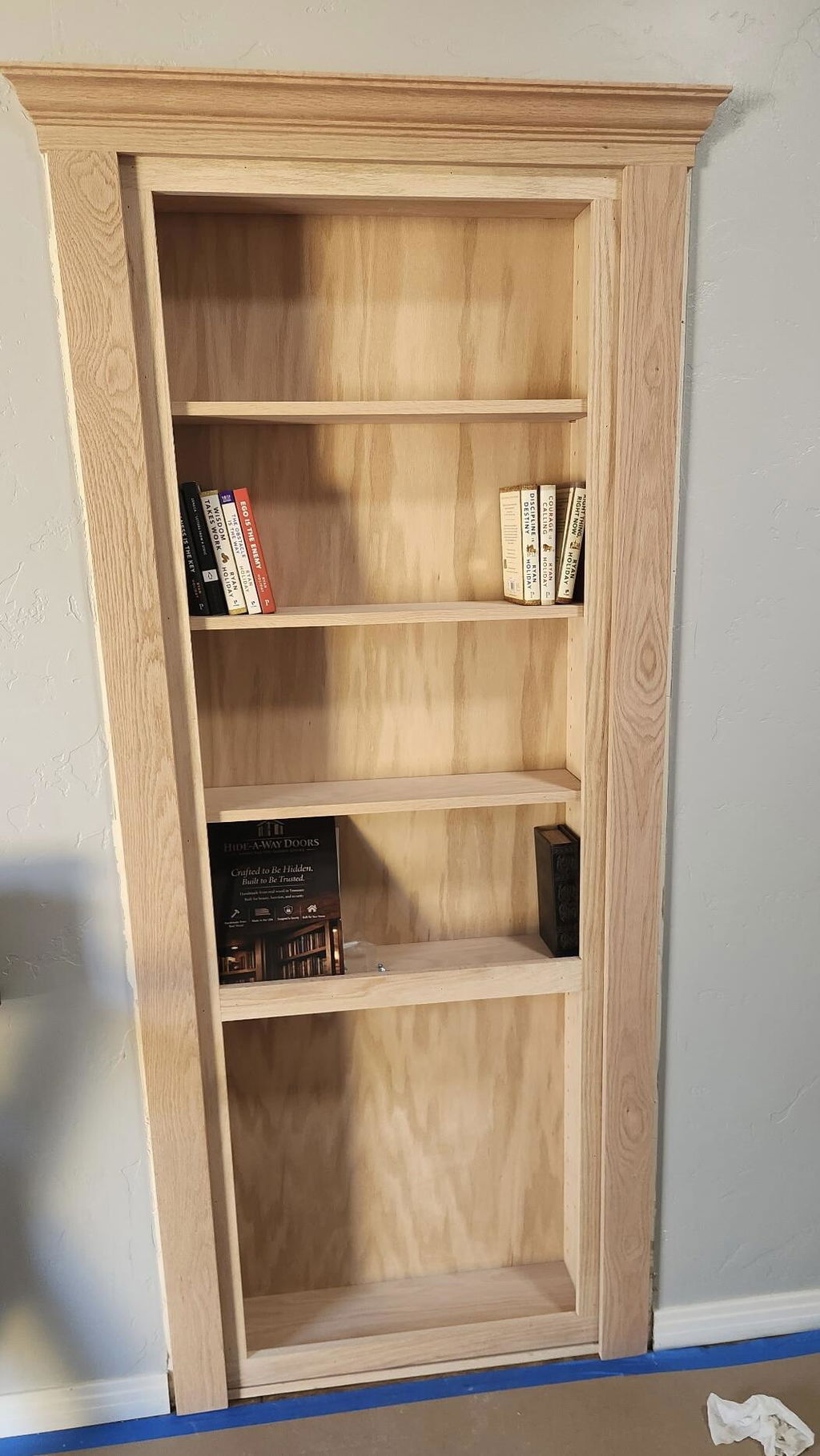
The Alpha Concealment Door represents the gold standard for homeowners who refuse to compromise on either storage or invisibility. Unlike shallow novelty doors, the Alpha design utilizes deep-cabinet shelving that can support actual book collections, heavy decorative items, or tactical gear. This depth is a critical security feature. It allows the unit to sit flush within the wall, eliminating the "swing gap" or protruding trim that often plagues cheaper, mass-produced models. You can customize these configurations to include dedicated gun cabinets or ammunition storage, keeping your defensive tools organized and accessible within your sanctuary.
Niche Concealment: Mirrors and Hobby Racks
Not every security application requires a full bookcase. In tight hallways, walk-in closets, or master bathrooms, a Mirror Door provides a sleek, space-saving alternative. It offers the same structural integrity as our heavier units but with a lower profile that blends naturally into dressing areas. For basement safe rooms or entertainment wings, utilizing a hidden pool cue rack door creates a perfect "hide in plain sight" scenario. The key to successful integration lies in selecting the right wood species. Whether you require the rugged grain of Oak, the smooth finish of Maple, or the refined look of Cherry and Alder, matching the wood to your existing cabinetry is essential for maintaining total visual invisibility. When residential panic room doors share the same tactile quality and finish as the rest of your home's woodwork, they become impossible to distinguish from standard furniture.
A secret door is more than a piece of furniture; it's a precision-engineered mechanical system. While the aesthetic finish captures the eye, the underlying measurements determine whether your entrance remains a secret or becomes a source of frustration. Successful integration starts long before the first piece of wood is cut. It begins with a clear understanding of your wall structure and how the door will function within your daily life. Precision is everything. Even a slight misalignment can compromise the "no-gap" finish that makes residential panic room doors so effective at avoiding detection.
The rough opening is the most critical number in your project. This is the literal space between the wall studs where the door frame sits. Unlike a standard interior door where trim can hide minor measurement errors, a hidden door requires absolute accuracy to ensure it sits flush with the surrounding wall. We've found that the primary cause of installation failure is a rough opening that isn't perfectly square or plumb. Before you begin your renovation, consult our measurement guides to ensure a perfect fit for your custom security solution.
Determining the Right Door Swing
Choosing between an inswing and outswing configuration is a strategic decision. Inswing doors are often the preferred choice for residential panic room doors because they are naturally easier to barricade from the inside. If the door swings into the safe room, the frame itself acts as a secondary stop against forced entry. However, if your safe room is compact, an outswing door allows you to maximize the internal footprint. You must also clear the "arc of travel." Ensure the door's path doesn't hit furniture, wall-mounted lights, or adjacent doors, as any obstruction can hinder a quick retreat during an emergency.
National Installation and Support
Getting a handcrafted, solid-wood door from our workshop in Morristown, TN, to your home requires specialized logistics. We crate every unit in reinforced wood frames to protect the furniture-grade finish during transit across the 50 states and Canada. Once it arrives, the quality of the installation is what preserves your structural warranty. While a standard handyman might be skilled at hanging a basic door, a specialized hidden door installer understands the nuances of pivot tension and flush-mount alignment. We maintain a national network of professionals who specialize in these high-stakes installations. This ensures that your door operates with a silent, smooth motion that never betrays the room's location. From the moment the crate is opened to the final adjustment of the trim, professional support guarantees that your investment provides the elite protection you expect.
Our workshop in Morristown, TN, operates on a simple principle: security should be as enduring as the home it protects. While the modern market is flooded with mass-produced, flat-pack kits, we've remained dedicated to the traditions of American craftsmanship. This family-owned heritage means every unit is built with a level of personal accountability that industrial manufacturers simply can't replicate. We don't just assemble components. We select every board and refine every joint to ensure your residential panic room doors perform flawlessly when your family’s safety is on the line.
Quality control starts with the raw materials. We've built our reputation on the absolute rejection of MDF and particle board. These materials are the antithesis of security; they're heavy, brittle, and prone to structural failure. Instead, we work exclusively with 100% real wood species, including Oak, Maple, Walnut, and Alder. This commitment to solid timber ensures that your door possesses the natural strength to support its own weight and the resilience to withstand an attempted breach. When you choose Hide-A-Way, you're choosing a master artisan's approach to home defense.
Bespoke Engineering for Unique Spaces
Every luxury home presents its own architectural challenges. Standardized models from competitors often leave homeowners struggling with awkward gaps or mismatched trim. Our design team specializes in solving these unique hurdles through custom fabrication. Whether you're navigating a non-standard rough opening or looking to integrate grand double bookcase secret doors into a library, we provide the engineering expertise to make it happen. Our multi-step handcrafted finishing process ensures that each unit resists the wear of daily use while maintaining its furniture-grade luster for generations. We bridge the gap between high-security utility and sophisticated interior design.
Securing Your Legacy with Hide-A-Way
An investment in your home's security should also be an investment in its value. A failing MDF door will eventually need replacement, costing you more in the long run and potentially damaging your walls as it sags. By contrast, our solid wood residential panic room doors are built to be heirloom-quality pieces of furniture. They add a layer of intrigue and tangible worth to your property that standard vault doors can't provide. You aren't just buying a door; you're securing a legacy of protection and craftsmanship. Design your custom residential panic room door today.
True protection happens at the intersection of master craftsmanship and absolute concealment. By prioritizing solid wood over failing engineered materials, you ensure your entrance remains invisible and structurally sound for decades. Whether you choose the deep utility of the Alpha door or the sleek profile of a mirror, you're investing in a mechanical system designed to perform under pressure. High-quality residential panic room doors do more than just provide a defense; they preserve the architectural soul of your sanctuary.
Since 2012, we've handcrafted every unit in the USA with a strict Real Wood Guarantee. We never use MDF or particle board, ensuring your security feature doubles as heirloom-grade furniture. With our national installation network, your project is executed with professional precision from the initial measurement to the final swing. It's time to stop settling for industrial eyesores and embrace the power of discreet protection. Build Your Secure Custom Hidden Door today and secure your home with the quiet confidence of a master artisan. Your peace of mind is worth the investment in quality that lasts.
Are wooden hidden doors strong enough for a panic room?
Solid hardwood doors are exceptionally strong and provide a formidable barrier against forced entry. Unlike hollow-core interior doors or flimsy MDF units, our solid wood construction offers high impact resistance and superior screw-holding power for heavy-duty security hardware. When a door is handcrafted from dense species like Oak or Walnut, it becomes a structural asset that remains entirely invisible to an intruder.
Can I install a secret panic room door in an existing doorway?
Yes, you can retrofit our units into most standard rough openings with the correct measurements. The process involves removing the existing door and trim to accommodate the specialized hidden frame. Because residential panic room doors require absolute precision to maintain their "no-gap" finish, we recommend verifying that your existing wall studs are plumb and square before beginning the installation process.
What is the best wood species for a high-security hidden door?
Oak and Walnut are the premier choices for security applications due to their extreme density and structural stability. These hardwoods resist warping under the weight of heavy shelving and provide the best foundation for anchoring multi-point locking systems. Alder and Maple are also excellent options for homeowners who need to match existing high-end cabinetry without sacrificing the door's long-term durability.
How do hidden locking mechanisms work on a bookcase door?
We integrate electromagnetic or mechanical locks directly into the door's solid wood frame, making them invisible from either side. These systems are typically triggered by a discreet "tell," such as shifting a specific book, using a biometric scanner, or engaging a wireless remote. This ensures the entrance remains securely latched against brute force while allowing for rapid, intuitive access during an emergency situation.
Do you provide professional installation services nationwide?
Yes, we maintain an established network of specialized professionals who provide installation services across all 50 states and Canada. These experts understand the unique mechanical requirements of our pivot systems and ensure that your door is perfectly leveled for silent operation. Professional installation is the best way to guarantee that your residential panic room doors remain 100% undetectable to guests.
Can a secret door be made bullet-resistant?
While natural hardwood provides significant protection, we can custom-fabricate doors with internal ballistic-rated materials like Kevlar or steel plating. This reinforcement allows the door to meet specific UL 752 standards without altering its appearance as a piece of fine furniture. It's a specialized upgrade for high-net-worth individuals who require a secondary layer of ballistic defense within their home's sanctuary.
How much weight can a Hide-A-Way bookcase door actually hold?
Our heavy-duty steel pivot system is engineered to support a structural load of up to 500 pounds. This high weight capacity allows you to fill your shelves with actual book collections, heavy collectibles, or tactical equipment without causing the door to sag. Because we use real wood instead of MDF, the unit maintains its shape and alignment even when fully loaded with your essential assets.
What is the difference between an Alpha Door and a standard Murphy-style door?
The Alpha Door is a premium concealment system featuring deep-cabinet storage and a specialized flush-mount design that eliminates visible gaps. Standard "Murphy-style" doors often use shallow shelving and generic hinges that can reveal the room's location over time. The Alpha Door is specifically engineered for high-security environments, offering the depth needed for a convincing library or storage cabinet aesthetic.