Bookshelf Door Weight Capacity: How Much Can a Secret Door Really Hold?
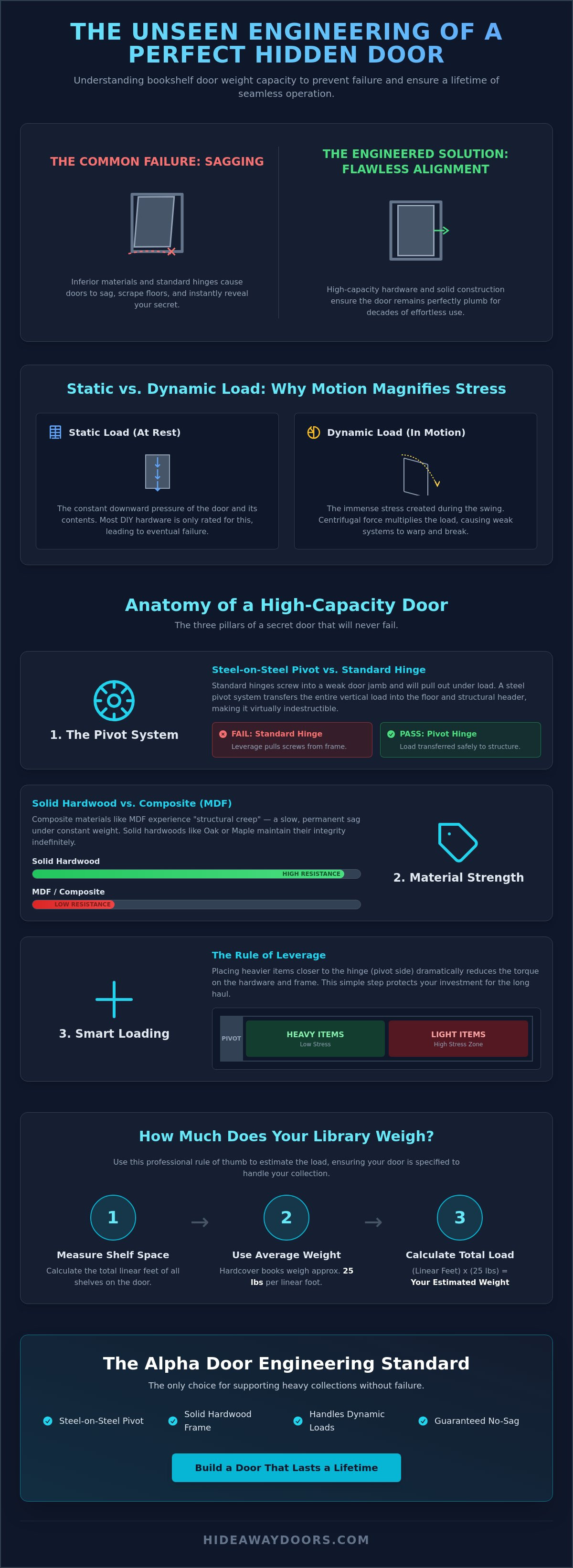
Will your collection of leather-bound classics eventually turn your secret passage into a floor-scraping nuisance? It's a valid concern for any homeowner who values both form and function. You likely dream of a seamless, hidden entrance, yet you worry that the sheer mass of a real library will cause the structure to fail over time. Understanding the bookshelf door weight capacity of your installation is the only way to ensure your secret remains hidden; a sagging door is a dead giveaway.
We believe that true craftsmanship should stand the test of time. You deserve the peace of mind that comes from knowing your Alpha Door or Wine Rack Door is engineered for heavy, real-world loads. This article explores the vital engineering factors that keep a hidden door from bowing or binding under pressure. You will learn the difference between static and dynamic weight limits, the importance of solid wood construction, and how to distribute weight to protect your hardware for the long haul.
Key Takeaways
Understand how dynamic movement creates unique stress on a secret entrance and why static weight limits don't tell the whole story.
Learn how steel-on-steel pivot systems and structural headers define the bookshelf door weight capacity for a lifetime of smooth operation.
Discover why solid hardwoods like oak or maple are necessary to prevent the structural "creep" and sagging seen in inferior composite materials.
Master the professional rule of thumb for calculating the weight of your library to ensure your door remains perfectly aligned.
Identify why high-end engineering, like that found in the Alpha Door, is the only choice for supporting heavy collections without failure.
Understanding Bookshelf Door Weight Capacity: The Physics of a Secret Entrance
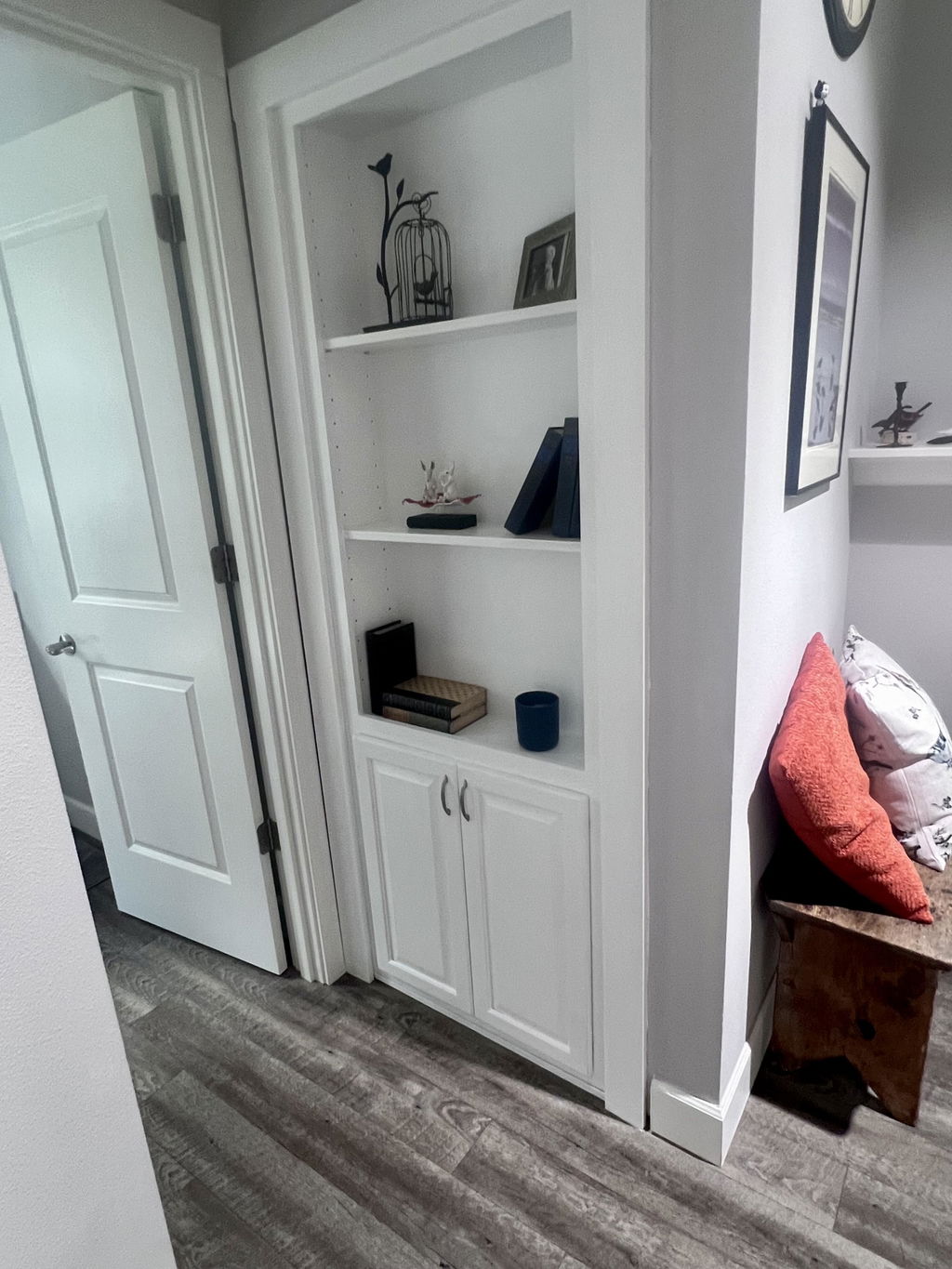
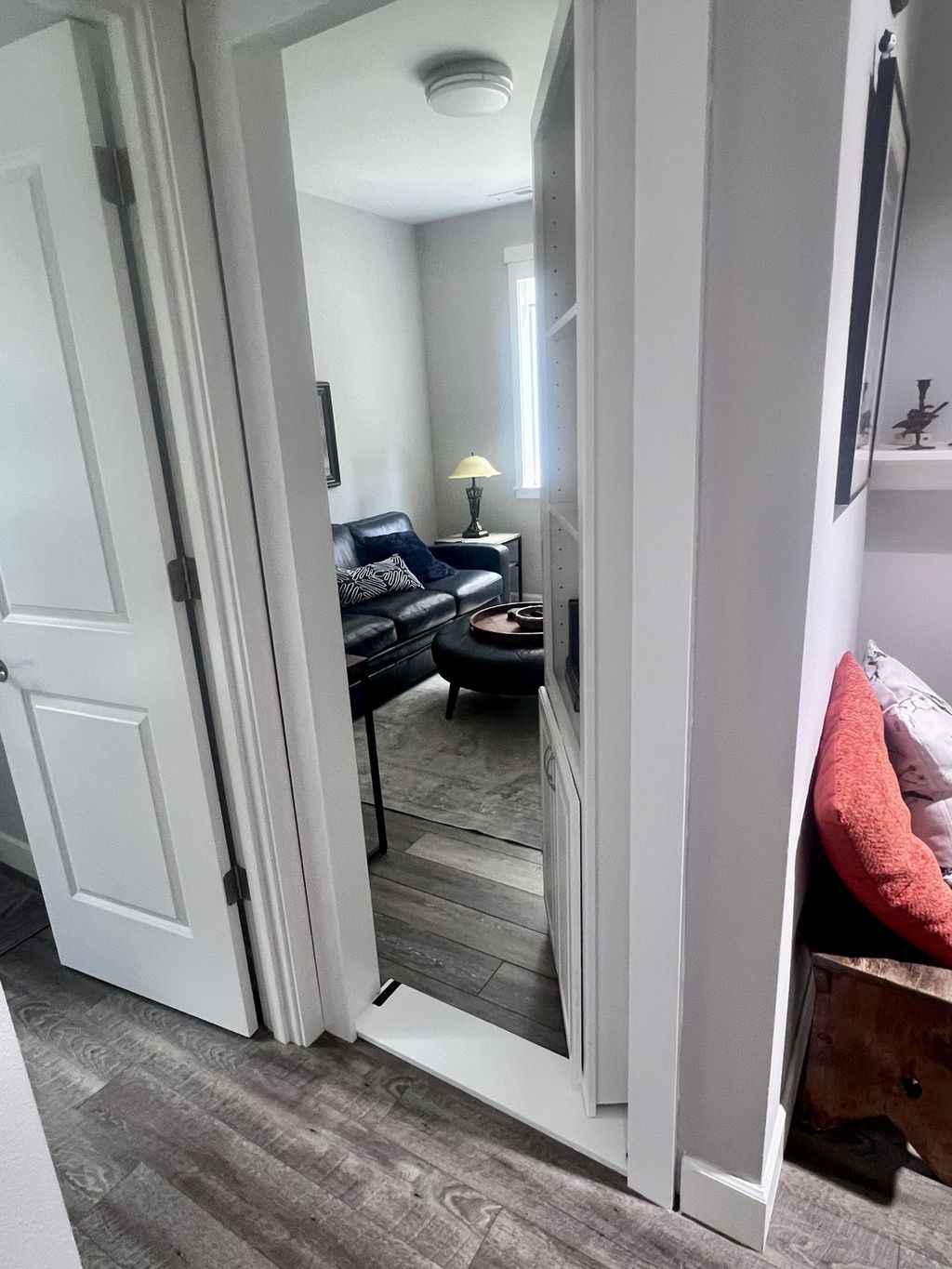
A hidden door is more than a simple partition; it is a complex piece of moving architecture. When we discuss bookshelf door weight capacity, we're referring to the total mass the system can handle, which includes both the weight of the door frame itself and the items you place upon the shelves. Many mass-market hardware kits suggest a flat limit without clarifying if the heavy wood of the unit is already eating into that margin. For a truly functional secret room or space, you must view the unit as a specialized, load-bearing piece of furniture designed to move.
The primary failure point in subpar installations is sagging. This happens when the structural integrity of the door cannot support its own burden over time. A sagging door doesn't just look poor; it scrapes the floor, ruins your carpet, and immediately alerts guests that something is hidden behind the wall. Avoiding this requires a deep understanding of how weight interacts with motion. You aren't just building a shelf; you're engineering a gateway that must remain perfectly plumb for decades.
Static vs. Dynamic Load: Why Movement Matters
Weight behaves differently depending on whether the door is stationary or in motion. A static load is the pressure exerted while the door is closed and resting within its frame. Some DIY hardware ratings report high static capacities, but the dynamic load is where the real engineering challenge lies. This is the stress placed on the hinges and frame during the actual swing of the door. As you pull the bookcase toward you, centrifugal force increases the effective weight of the contents. If the bookshelf door weight capacity isn't calculated with this movement in mind, the sudden shift in momentum can warp the frame or snap inferior hardware. A door that feels sturdy while closed might groan or bind the moment it begins to move.
The Role of the Pivot Point
Standard butt hinges, the kind found on your bedroom door, are entirely insufficient for secret bookcases. They rely on screws driven into the side of the jamb, which will eventually pull out under the leverage of a heavy shelf. High-quality hidden doors utilize a pivot hinge system. This specialized hardware transfers the vertical load directly into the floor or the structural header of the house. By centering the weight on a single vertical axis, the pivot prevents the unit from binding or sticking. It ensures that even a fully loaded shelf moves with the light touch of a finger, maintaining the illusion of a solid, immovable wall. This alignment is critical because even a fraction of an inch of displacement can cause the entire system to fail.
The Mechanics of Load-Bearing: Hinges, Frames, and Distribution
The secret to a door that never sags lies in the marriage of premium materials and industrial-grade hardware. While standard interior doors rely on thin metal plates and wood screws, a high-capacity secret entrance requires a "Steel-on-Steel" pivot system. This design ensures the entire load rests on a hardened steel pin rather than pulling against the door jamb. When calculating the bookshelf door weight capacity, this distinction is vital. A pivot system allows for a smooth, frictionless swing even when the shelves are burdened with hundreds of pounds of literature. It's the dynamic stress of the swing that usually kills cheap kits, but a steel pivot handles that motion with ease.
Hinge Engineering: The Backbone of the Door
To support a 36-inch wide bookcase, the hardware must be rated for significantly more than the anticipated load. Industrial-strength pivots differ from residential-grade hinges in their ability to handle the "lever effect." As the door opens, the weight on the outer edge exerts massive torque on the pivot point. Proper engineering places the pivot in a position that transfers this force directly into the floor or the structural header above the door frame. Without this precise placement, the frame will eventually pull out of plumb, causing the door to stick or reveal the gap behind it. It's a matter of ensuring the pivot point is robust enough to act as a permanent anchor for the entire assembly.
Weight Distribution Across Shelves
How you load your shelves is just as important as the door's construction. To maximize your bookshelf door weight capacity, place your heaviest items, such as encyclopedias or large hardcovers, closest to the hinge side. This reduces the leverage exerted on the outer edge of the frame. Understanding the Mechanical Properties of Wood helps clarify why shelf span matters. Long, unsupported spans are prone to horizontal bowing. Using fixed shelves at key intervals, rather than relying solely on adjustable pins, creates a rigid "box" structure that resists twisting and structural fatigue. This structural rigidity is what keeps the door "sag-free" over years of use.
Deeper units, like the Deep Shelf Door, present an even greater engineering challenge. The increased depth moves the center of gravity further away from the wall, which requires a more robust frame to prevent bowing. This is why professional-grade doors prioritize structural headers that distribute weight across the entire wall opening. If you are planning a library that demands high-capacity storage, exploring a precision-engineered solution ensures your secret stays safe behind a door that operates as smoothly on day one thousand as it did on day one.
Material Matters: Why Solid Wood Outperforms MDF in Weight Tests
The choice of material isn't merely an aesthetic preference. It's the primary factor in determining the long-term bookshelf door weight capacity of your installation. While many mass-market kits rely on Medium Density Fiberboard (MDF) or particle board, these materials are fundamentally ill-suited for the dynamic stresses of a moving bookcase. MDF is essentially compressed sawdust and resin; it lacks the continuous grain structure required to hold heavy loads over time. In contrast, solid hardwoods offer a natural cellular matrix that grips fasteners and resists the bending forces exerted by a full library of books.
When evaluating longevity, our handcrafted door comparison guide highlights how material choices dictate the lifespan of your secret entrance. Real wood maintains its structural tolerances even as humidity levels fluctuate, whereas composite materials can absorb moisture, leading to swelling that ruins the tight clearances required for a hidden door. A door that won't close properly is no longer a secret.
The Strength of Hardwoods
Density is your best friend when building for high capacity. The Janka hardness scale measures the force required to embed a steel ball into wood, providing a clear indicator of a species' durability. For instance, White Oak carries a Janka rating of approximately 1,360, while Sugar Maple reaches 1,450. These dense hardwoods provide exceptional screw-holding power. In a solid wood frame, handcrafted joints like dado and rabbet cuts create a mechanical interlock. This design allows the entire unit to act as a single, rigid structural piece. It won't twist or rack because the wood fibers themselves are supporting the weight, not just the glue or a few cam-locks.
The Failure Points of Composite Materials
Composite materials like MDF suffer from a phenomenon known as "creep." This is the tendency of a solid material to move or deform permanently under the influence of persistent mechanical stresses. If you load an MDF shelf with heavy books, it will eventually develop a permanent "smile" or sag. This deformation is irreversible. More dangerously, MDF has poor pull-out strength for hinges. Under the constant tension of a swinging bookshelf door weight capacity, the screws can literally tear out of the fiberboard. Once those fibers are stripped, the door cannot be easily repaired. For a secret entrance intended to last as long as the home itself, solid wood is the only professional choice.
Planning Your Collection: How Much Can Your Hidden Door Safely Carry?
Designing your dream library requires more than just an eye for aesthetics; it demands a bit of mathematical foresight. To maintain the long-term health of your installation, you must accurately estimate the burden you're placing on the frame. A reliable industry rule of thumb is to budget between 20 and 30 pounds per linear foot of shelving for a standard collection of hardcovers. When calculating your bookshelf door weight capacity, remember that the goal isn't to see how much the door can survive, but how much it can carry while remaining perfectly silent and smooth.
Consider a standard 36-inch wide Alpha Door. With five shelves, you are looking at 15 linear feet of storage. Using our average estimate, that collection could weigh nearly 400 pounds. While our high-end doors are engineered to handle significant loads, you should also account for non-book items that might find their way onto the shelves. Vinyl records, ammunition boxes, or heavy liquor bottles are far denser than paper and glue. These items can quickly push a door past its ideal operating range. We recommend maintaining a 20% safety margin; never load your door to 100% of its rated limit if you want it to last for decades.
Estimating Your Library's Weight
Not all books are created equal. A shelf filled with mass-market paperbacks is light work, but a collection of large, glossy coffee table books can weigh three times as much. You can use a simple formula to get close: (Number of shelves) x (Width in feet) x 25 lbs. A fully loaded 8-inch deep shelf typically weighs between 50 and 75 pounds depending on book density. This calculation gives you a baseline to ensure your collection fits within the safe bookshelf door weight capacity of your chosen model.
Organizing for Longevity
Strategic loading is the key to a sag-free life. Always keep your heaviest items on the lower shelves and as close to the pivot point as possible. This placement minimizes the leverage exerted on the outer edge of the door frame. If you have more books than the weight limit allows, consider using 'dummy' books or lightweight decor on the outer edges to maintain the look without the mass. Pay attention to the door's behavior. If you notice new grinding sounds or find the door making contact with the floor, it's a clear signal that the system is overloaded. If you're ready to build a library that doesn't compromise on strength, choose an Alpha Door designed for serious collectors.
Choosing a High-Capacity Solution: The Alpha Door Engineering Standard
When your project demands the highest possible bookshelf door weight capacity, compromise isn't an option. The Alpha Concealment Door represents the pinnacle of this engineering, designed for those who refuse to settle for the limitations of flat-pack alternatives. While standard kits might suffice for light decor, the Alpha Door utilizes traditional cabinetry techniques to create a structural unit that supports full libraries without hesitation. This isn't just a door; it's a precision-built machine that maintains its alignment through thousands of cycles. A secret entrance is only as good as the weight it can move effortlessly. If the door binds or requires a heave to open, the illusion of a solid wall is instantly shattered.
Professional installation plays a critical role in this success. Even the most robust door will struggle if the rough opening isn't perfectly square or the header isn't properly reinforced. Our master artisans focus on the intersection of furniture-grade aesthetics and structural security, ensuring that the frame distributes the load evenly across the wall. This holistic approach prevents the common failures seen in DIY projects where the weight of the books eventually pulls the jamb out of plumb.
Custom Engineering for Unique Loads
Every collection is different. We understand that some clients need to secure more than just paper and ink. Whether you are installing a Gun Cabinet Door for a private armory or a Wine Rack Door for a curated cellar, our designs accommodate these specialized, high-density loads. We view over-engineering as a vital feature rather than a flaw. By using real wood finishes and reinforced internal structures, we mask the immense strength of the door behind a facade of elegant home design. This allows you to store heavy items with the confidence that the door will never sag or reveal the hidden space behind it.
Your Next Steps to a Secure Entrance
Before you begin your journey toward a hidden room, start with the fundamentals. Check your rough opening measurements carefully; precision at the start prevents mechanical issues at the end. Consider the weight of your intended collection and select a wood species that matches those needs. Harder species like Oak or Maple provide the best bookshelf door weight capacity for dense collections. If you are planning a high-capacity custom project, the best path forward is to consult with a master artisan who understands the physics of concealment. We're here to help you navigate the technical details, ensuring your secret door remains a functional masterpiece for years to come.
Engineering Your Hidden Legacy
A secret door is a long-term investment in your home's security and character. You've learned that bookshelf door weight capacity depends on the synergy between industrial steel pivots and the natural resilience of solid hardwoods. By avoiding the structural deformation of composite materials and planning for a 20% safety margin, you'll protect the long-term integrity of your entrance. True concealment requires a door that moves as silently on day one thousand as it did during the first reveal.
Every Alpha Door we create is handcrafted in Morristown, TN, using real wood construction to avoid the structural failures of MDF. We support our craftsmanship with a national installation network to ensure your frame is perfectly square and ready to carry a heavy collection. Build Your Custom High-Capacity Alpha Door Today and secure your library with confidence. Your vision for a hidden sanctuary is within reach, supported by engineering that never sags.
Frequently Asked Questions
How much weight can a standard bookshelf door hold?
Most pre-assembled bookshelf doors are designed to support approximately 300 pounds of total weight. This figure typically includes the mass of the door unit itself along with the books or decor you place on the shelves. High-performance models like the Alpha Door utilize industrial pivots to handle these loads while maintaining the effortless motion required for a secret entrance.
Will my secret door sag over time if I fill it with books?
Solid hardwood construction prevents the permanent sagging often seen in cheaper composite alternatives. Sagging is usually a symptom of using MDF or weak hardware that can't handle the leverage of a full library. Ensuring your bookshelf door weight capacity is matched to the collection's mass prevents the frame from bowing or dragging on the floor over years of use.
Is there a weight difference between in-swing and out-swing doors?
The directional swing doesn't fundamentally change the load rating, but it does affect how you manage the door's momentum. Both styles rely on the same heavy-duty pivot points to transfer weight into the floor and structural header. While the capacity remains consistent, in-swing doors require careful planning to ensure the shelf depth doesn't interfere with the internal room clearance when fully loaded.
Can I use a hidden door for heavy items like ammunition or wine?
You can store heavy items, but you must choose a door specifically designed for high-density loads. Our Wine Rack Door and Gun Cabinet Door are reinforced to handle the concentrated weight of glass bottles or lead. Because these items are much denser than paper, placing them closest to the hinge side is essential for maintaining the door's structural balance and ease of operation.
What happens if I overload my hidden bookcase door?
Overloading leads to mechanical binding and visible alignment issues that immediately compromise the secret. You might hear grinding sounds from the pivot hinges or notice the door making contact with the floor. Eventually, excessive weight can cause permanent damage to the pivot points or pull the door frame out of plumb, making the entrance difficult to open or close.
Why is real wood better than MDF for weight capacity?
Hardwoods offer a natural cellular matrix that grips fasteners far more effectively than compressed fiberboard. MDF is prone to a phenomenon called "creep," where the material permanently deforms under constant pressure. For a reliable bookshelf door weight capacity, real wood ensures the hinges stay anchored and the shelves remain straight even under the stress of a heavy hardcover collection.
Do I need special hinges for a heavy hidden door?
A heavy-duty pivot hinge is non-negotiable for any door intended to carry more than basic decor. Standard butt hinges rely on the strength of the door jamb and will eventually pull loose under the weight of a bookcase. Pivot systems transfer the vertical load directly into the floor, allowing the door to swing freely without putting undue tension on the side of the wall frame.
How often should I maintain the hinges on a high-capacity door?
Annual inspections are recommended to keep high-capacity hardware operating at peak performance. You should check the pivot points for debris and ensure the fasteners remain tight. Since high-capacity doors moving heavy collections place more stress on the moving parts, a simple yearly check prevents mechanical wear and ensures the door continues to operate with a quiet, confident touch.