The Ultimate Guide to Hidden Pool Cue Rack Doors for 2026
A secret door is only as good as the engineering hidden behind its finish. Most homeowners dream of a covert entrance but hesitate because they've seen flimsy MDF alternatives fail under the weight of a standard billiard set. You shouldn't have to choose between a secure room and a functional game space. It's a common frustration to see cues leaning against walls or ball sets cluttering up a refined room because your storage doesn't match your style.
This ultimate guide to the hidden pool cue rack door in 2026 promises to show you how to combine high-end storage with seamless room concealment. You'll learn why handcrafted real wood is non-negotiable for supporting up to 11 cues and a full rack of balls without the risk of sagging. We are diving into the technical execution of furniture-grade craftsmanship; we will explore how these bespoke systems provide both a rugged, dependable entrance and a sophisticated aesthetic that complements your home’s finest finishes.
Key Takeaways
Understand how a hidden pool cue rack door serves as a dual-purpose architectural element that balances professional storage with the intrigue of a secret entrance.
Learn why solid hardwood construction is essential to manage the dynamic weight of cues and balls while preventing the hinge fatigue common in inferior MDF products.
Discover how to select wood species and finishes that seamlessly match your billiard table and existing room trim for a truly invisible finish.
Master the technical requirements for rough openings and swing directions to ensure your concealment solution remains perfectly aligned and functional.
Explore the benefits of furniture-grade, Tennessee-made craftsmanship that prioritizes enduring durability and security over mass-produced alternatives.
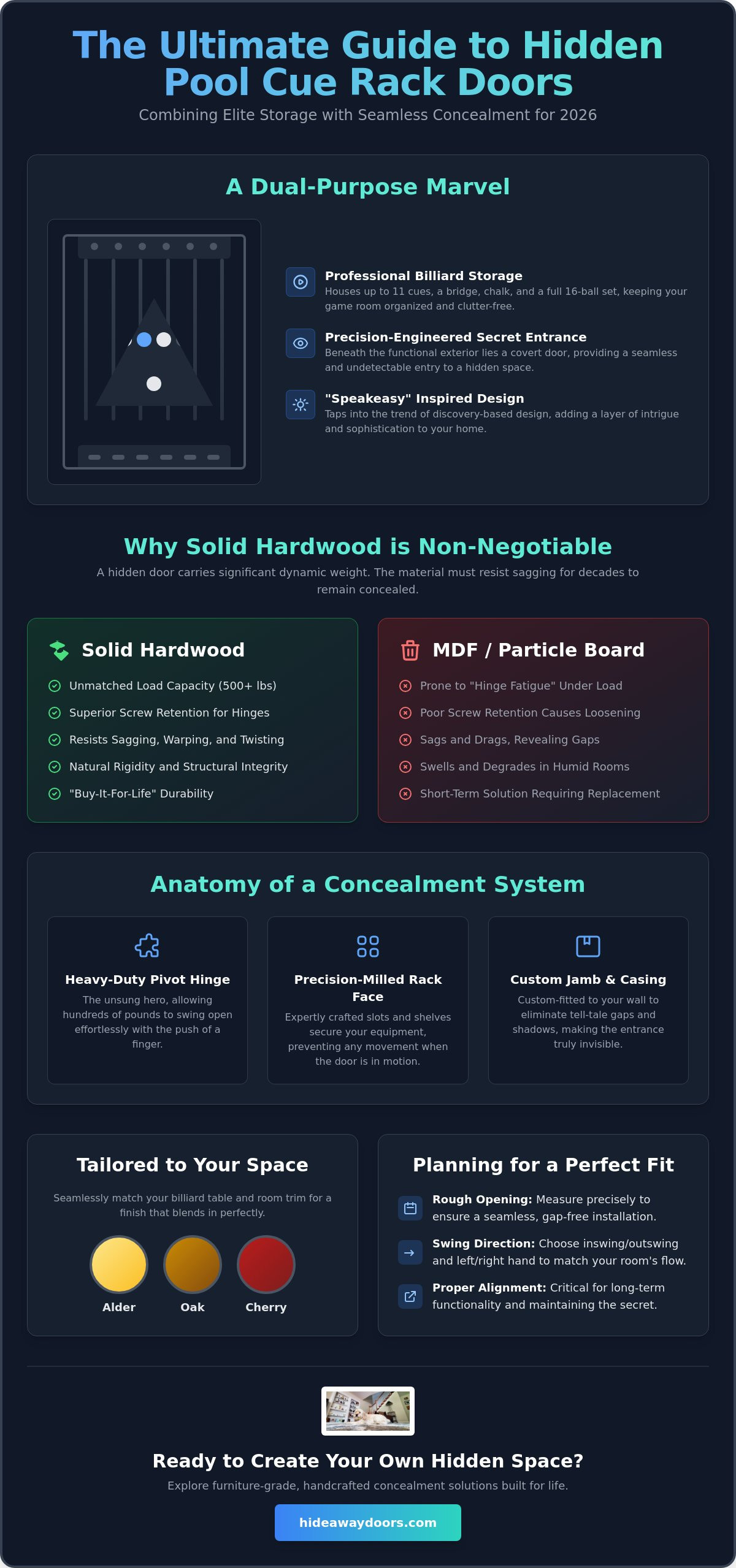
A hidden pool cue rack door is a high-performance architectural element that serves two distinct roles. On the surface, it's a professional-grade billiard rack designed to house an entire set of cues, balls, and accessories. Beneath that functional exterior, it's a precision-engineered secret entrance that conceals a private room. Unlike a standard door that simply occupies space, this system transforms a necessary wall opening into a centerpiece of your game room's design.
The "Speakeasy" aesthetic has seen a massive resurgence in 2026. Homeowners are moving away from open-concept layouts in favor of intentional, discovery-based design. This trend draws heavily from the history of secret passages, where utility and mystery intersected. By installing a billiard rack that doubles as a door, you create a sense of intrigue while maximizing every square inch of your entertainment space. It isn't just about the "wow factor"; it's about reclaiming wall space that would otherwise be wasted.
Beyond the visual appeal, these doors provide superior organization. A well-designed unit offers vertical storage for cues, bridges, chalk, and up to 16 pool balls. Everything is kept within reach of the table but tucked neatly away from the floor. For those seeking the highest level of security, options range from standard pivot models to the elite alpha concealment door, which offers reinforced structural integrity for high-security areas.
The Anatomy of a Billiard Concealment System
Precision is the hallmark of a quality concealment system. The rack face features precision-milled slots and shelving that ensure your equipment stays secure even when the door is in motion. The pivot hinge is the unsung hero of the assembly. It's a heavy-duty mechanical component that allows a door weighing hundreds of pounds to swing open with the push of a single finger. Finally, the jamb and casing are custom-fitted to your wall, eliminating the tell-tale gaps and shadows that usually reveal a secret entrance.
Common Uses for Hidden Game Room Entrances
Most clients use these doors to solve specific spatial or security challenges. You might use one to separate a loud game room from a private home office or a "man cave." Others prefer to use the rack to secure a safe room or a vault, hiding high-value items behind a functional hobby display. In luxury builds, we often see these units used as a seamless transition to a hidden wine cellar door, maintaining a consistent high-end aesthetic throughout the basement or entertainment wing.
Engineering for Weight: Why Real Wood is Non-Negotiable
A billiard rack isn't a static piece of furniture; it's a high-torque storage system. When you calculate the physics of a hidden pool cue rack door, the numbers quickly add up. A standard set of 11 cues, a bridge, and a full rack of 16 professional-grade billiard balls adds significant weight to a door frame that is already heavy. This creates a constant downward force on the hinges. To maintain a perfect "invisible" seal, the door must resist sagging under this dynamic load for decades.
Cheap alternatives often rely on MDF or particle board. These materials are essentially compressed sawdust and glue. They lack the internal structural integrity to handle tension. Over time, the weight of the equipment causes "hinge fatigue," where the screws slowly pull out of the soft composite material. Humidity in a basement or game room only accelerates this process, causing the door to swell and eventually drag on the floor. Once the door sags even a fraction of an inch, the secret is out; the gaps in the trim become uneven and obvious.
Real wood is the only solution for a "buy-it-for-life" concealment system. Handcrafted hardwoods like Alder, Oak, and Cherry provide the natural rigidity required to support 500 lbs or more of static load. Understanding the mechanical properties of wood is essential for proper engineering. Solid wood fibers offer superior screw retention, meaning the heavy-duty pivot hinges stay anchored exactly where they were installed. This ensures the door swings with the same smooth, effortless motion on year ten as it did on day one.
Real Wood vs. MDF: A Durability Comparison
The natural alignment of wood fibers in solid lumber provides a high modulus of elasticity, which effectively resists the bowing and warping often seen in composite materials under heavy stress. This structural advantage is why solid hardwood is essential for long-term hinge stability; the fibers wrap around screw threads to create a permanent bond. Furthermore, the aesthetic result is incomparable. You'll achieve a furniture-grade finish with deep grain patterns that MDF simply cannot replicate, allowing the door to blend perfectly with high-end billiard tables.
Maintenance and Longevity of Billiard Doors
Solid wood offers a level of longevity that engineered products can't match. If the door is scratched or dinged during a rowdy game of 8-ball, it can be sanded and refinished. Keeping your game room's climate stable will help maintain the tight tolerances required for total concealment. Investing in a secret pool cue rack door is a strategic home upgrade that adds permanent value. If you're looking for a dependable way to secure your space while organizing your gear, choosing a real wood system ensures your secret stays safe for a lifetime.
Customizing Your Hidden Door: Woods, Finishes, and Features
Customization is where the "wow factor" of discovery meets the technical precision of architectural harmony. A hidden pool cue rack door shouldn't just fit the wall; it needs to disappear into the room's existing narrative. Whether you're aiming for the rugged charm of a mountain lodge or the polished sophistication of a modern penthouse, the choice of materials and finishes determines the success of the concealment. Because these doors are handcrafted from real hardwoods, you have the flexibility to match the specific grain and stain of your billiard table, creating a cohesive look that masks the door's secondary purpose.
Standard configurations typically accommodate 9 cues for a 30 to 34 inch wide door, while a 36 inch version can hold 11 cues. Most designs also feature dedicated shelving for up to 16 pool balls, chalk, and bridge sticks. If your collection is more extensive, custom layouts can expand these capacities. The goal is to keep your equipment organized and accessible without the cluttered look of floor racks or wall clips. By integrating these tools directly into the door face, you turn a utility item into a piece of functional art.
Wood Species for Every Game Room Aesthetic
The wood species you select acts as the foundation for the door's durability and style. Knotty Alder is a favorite for rustic basement bars; its visible knots and straight grain provide a textured, traditional feel. For a more refined or contemporary billiard room, Maple and Cherry offer a tight, smooth grain that takes stain beautifully. If your game room features dark, rich tones, Walnut provides an unmatched level of elegance. We also offer paint-grade options for homeowners who want the door to match their wall color exactly, allowing the rack to look like a built-in shelving unit rather than an entrance.
Advanced Concealment Features
Security and privacy are often the primary drivers for installing a secret entrance. Beyond simple magnetic catches, you can opt for advanced locking mechanisms like RFID or biometric scanners that remain completely invisible to the naked eye. One of the most intriguing custom features is the "cue key" mechanism. This allows you to designate a specific pool cue as a lever; when tilted or turned in a precise way, it triggers the internal latch to release the door. To ensure the secret remains safe, automatic return systems can be installed to pull the door shut behind you. If the hidden room is a private sanctuary or a home office, adding soundproofing seals helps maintain a quiet environment regardless of the noise from the game room.
Planning and Installation: Preparing Your Game Room
Precision is the thin line between a secret entryway and a visible architectural eyesore. When you prepare to install a hidden pool cue rack door, your measurements must be exact. A rough opening that sits out of plumb by even a fraction of an inch will cause the door to bind or, worse, swing open on its own. This is why we prioritize the "pre-hung" advantage. By receiving a fully assembled unit, you ensure that the factory-set tolerances remain intact during the transition from our workshop to your wall. It eliminates the guesswork of aligning hinges that must support significant weight.
Choosing between an in-swing and an out-swing configuration depends entirely on your game room’s floor plan. You must consider the "strike zone" around your billiard table. You don't want a door swinging into the path of a player lining up a crucial shot. Additionally, check your floor clearance. Thick carpeting can create friction that ruins the smooth, "single-finger" operation we strive for in every build. If you have hardwood or tile, ensure the floor is level at the pivot point to prevent the door from dragging as it moves through its arc.
Weight distribution is another critical factor. A solid wood door loaded with cues and balls places a unique stress on your home's framing. You should verify that your floor joists are positioned to handle a heavy-duty unit. Most standard residential framing is sufficient, but older homes might require a quick inspection to ensure the subfloor won't flex over time. This proactive approach ensures your secret remains secure and the door operates flawlessly for a lifetime.
Structural Requirements for Heavy Secret Doors
A standard door header is usually designed to support a lightweight hollow-core door. A solid wood pool cue rack door requires more robust support. We recommend doubling your header to prevent the wall from bowing under the static load. You should also audit your electrical layout before beginning. Moving light switches or outlets that sit within the swing path is a common requirement that's far easier to handle before the door is set in place.
Professional vs. DIY Installation
If you are a seasoned builder with the right tools, a diy hidden door kit offers a rewarding way to customize your project from the ground up. However, many homeowners prefer the peace of mind that comes with hiring a specialist. Mastering hidden door installation involves verifying that the unit is perfectly plumb, level, and square. This "triple-check" process is the secret to a "ghost-free" swing where the door stays exactly where you leave it without drifting.
The Hide-A-Way Difference: Handcrafted Game Room Security
Choosing a hidden pool cue rack door is an investment in both your home’s security and its character. Based in Tennessee, our family-owned operation focuses on the traditional skills that mass-produced imports simply can't replicate. We believe that a secret entrance should be more than a novelty; it should be a legacy piece of furniture that stands the test of time. This commitment to quality is why we maintain a strict No-MDF Promise. While other manufacturers might use engineered wood to cut costs, we only use real hardwoods. This ensures your billiard rack remains structurally sound even when fully loaded with professional equipment.
The "wow factor" of a secret door comes from its seamless integration. By 2026, home design has shifted toward more personalized, high-utility spaces. Our national shipping and support network ensures that your custom project is handled with care from the initial design phase to the moment it arrives at your doorstep. You aren't just buying a door; you're gaining a centerpiece for your home that sparks conversation and provides peace of mind. Whether you're securing a vault or creating a private retreat, the craftsmanship behind the door is what keeps the secret safe.
Why Real Wood is a Superior Investment
Beyond the immediate aesthetic appeal, high-quality secret doors increase home appraisal values by adding a unique, high-end feature that standard renovations lack. The tactile experience of solid wood is also incomparable. You'll notice it in the weight of the swing and the solid, reassuring sound of the door closing into the jamb. Because we use real lumber, you have the freedom to design a door that is uniquely yours. You can choose specific wood species and rack layouts that match your existing billiard room furniture, ensuring a level of customization that mass-market products don't offer.
How to Start Your Custom Project
Beginning your journey is a straightforward process. We recommend consulting with a design expert to determine which Alpha Door configuration best suits your security needs and spatial constraints. You can review wood samples and finish options online to find the perfect match for your home's trim and billiard table. Once you've selected your materials, our artisans get to work on your bespoke build, ensuring every measurement is precise and every finish is furniture-grade.
A hidden pool cue rack door is a significant architectural investment that demands more than surface-level aesthetics. As we've explored, the physics of supporting a full billiard set requires the structural rigidity of real hardwood. Choosing a solid wood build ensures that your door won't sag, warp, or fail over time. It's the difference between a temporary novelty and a permanent, value-adding feature of your home.
Our artisans in Morristown, Tennessee, take pride in building doors that offer quiet confidence and rugged reliability. We never use MDF or particle board; we only use the finest materials to create a secure, seamless entrance. With national shipping available across the USA and Canada, it's easier than ever to bring this level of craftsmanship into your game room. It's time to clear the clutter and add a layer of sophisticated mystery to your favorite space.
A 30 to 34 inch wide door typically accommodates 9 pool cues, while a 36 inch version holds up to 11 cues. Additionally, all standard models include dedicated shelving for a full set of 16 billiard balls. This configuration ensures your entire game set is consolidated into a single vertical unit, keeping your floor space clear of traditional racks or leaning equipment.
Is the door heavy to open when fully loaded with billiard balls and cues?
The door remains remarkably easy to operate even when fully loaded with cues and balls. We utilize a heavy-duty pivot hinge system designed to handle over 500 lbs of static load. This precision engineering allows the door to swing with a smooth, effortless motion that feels light to the touch. You won't feel the weight of the equipment during daily use.
Can I install a hidden pool cue door in an existing wall opening?
Yes, you can install a hidden pool cue rack door in most existing wall openings. These units ship pre-hung and are designed to replace a standard interior door with minimal structural modification. You only need to verify that your rough opening is square and plumb to ensure the secret entrance remains invisible and operates without dragging on the floor.
What is the difference between a standard bookcase door and a pool cue door?
While a standard bookcase door uses flat shelves for general storage, a pool cue door features specialized architectural milling. The face is precision-engineered with specific slots for cues and custom accessory shelving for balls and chalk. This ensures your billiard equipment stays secure and organized during every swing, rather than shifting like items on a flat shelf might.
Do hidden billiard doors come with a locking mechanism?
Various locking mechanisms are available to suit your specific security needs. You can choose from standard magnetic catches for simple closure or upgrade to invisible RFID and biometric scanners for restricted access. Some advanced configurations even allow you to use a specific pool cue as a mechanical key, tilted in a precise way to release the internal latch.
Will the pool cues fall off the rack when the door is opened or closed?
The cues will not fall off the rack during normal operation. Each hidden pool cue rack door is designed with deep, precision-milled slots and secure base rests. These features are engineered to keep your cues and balls seated firmly in place. The rack is built to handle the momentum of the door's swing without risking damage to your equipment.
Can I customize the wood species to match my pool table?
We offer a wide range of real hardwoods to ensure a perfect match with your billiard table and room trim. You can select from the rugged grain of Knotty Alder to the refined elegance of Cherry, Maple, or Walnut. This level of customization allows the door to disappear into your existing decor, maintaining the high-end aesthetic of your game room.
How long does it take to ship a custom handcrafted hidden door?
Handcrafted custom doors require a deliberate production timeline to ensure furniture-grade quality and structural integrity. While lead times vary based on the complexity of your finish and wood choice, we prioritize a methodical build process in our Tennessee workshop. Once completed, we utilize a reliable national shipping network to deliver your fully assembled unit directly to your home.