Hidden Home Office Ideas: Transforming Living Spaces into Secret Workspaces for 2026
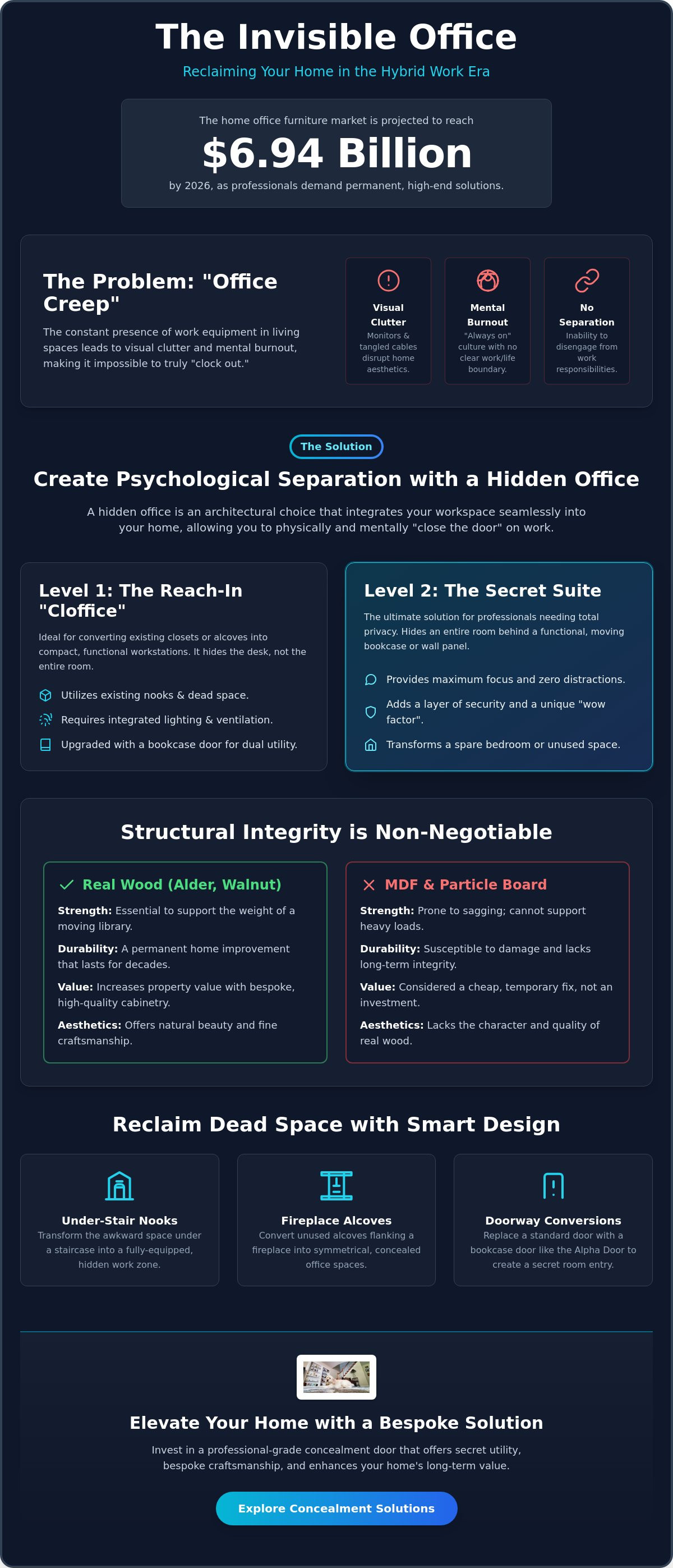
What if your most productive workspace wasn't actually a room at all, but a masterfully crafted secret hidden in plain sight? As the home office furniture market reaches a projected $6.94 billion in 2026, many professionals are moving past makeshift setups toward permanent, high-end solutions. You've likely felt the persistent strain of visual clutter from monitors and tangled cables invading your living space. This lack of mental separation makes it nearly impossible to truly "clock out" when your desk is always visible. If you're tired of cheap DIY fixes that lack durability, it's time to explore sophisticated hidden home office ideas that prioritize both function and fine aesthetics.
Discover how to blend professional utility with architectural beauty using handcrafted, real wood concealment solutions. We'll show you how to transform a standard doorway into a functional masterpiece that disappears when the workday ends. By utilizing premium installations like the Alpha Door or a Double Bookcase Door, you can achieve a balance of commercial durability and residential elegance. This guide previews how to create a workspace that doubles as a security feature, increases your home value through expert cabinetry, and provides that elusive "wow factor" through traditional craftsmanship and innovative design.
Key Takeaways
Understand why psychological separation is the defining requirement for 2026 remote work and how concealment solutions provide that essential mental "off" switch.
Explore diverse hidden home office ideas that range from compact alcove conversions to expansive secret suites accessed through a Double Bookcase Door.
Discover why structural integrity is paramount, specifically why solid wood like Alder or Walnut is required to support the weight of a functional, moving library.
Identify architectural opportunities to reclaim dead space, such as transforming under-stair areas or fireplace alcoves into high-end, invisible work zones.
Learn how to elevate your home’s value by selecting professional-grade solutions like the Alpha Door that offer both secret utility and bespoke craftsmanship.
Why Hidden Home Office Ideas are Essential for 2026 Lifestyles
The modern home has undergone a fundamental shift. By 2026, the "Hybrid Home" is the standard, making mental separation the absolute priority for remote professionals. We are no longer satisfied with makeshift setups that bleed into our personal lives. A hidden office is a workspace designed to be completely invisible to the casual observer, appearing as a standard wall, a functional bookcase, or a piece of fine cabinetry. It is a strategic architectural choice for preserving home aesthetics.
Moving beyond the simple "cloffice" requires a shift in mindset. While a desk tucked into a closet was a functional start, today's homeowners demand sophisticated hidden home office ideas that feel like a natural part of the room's architecture. This transition from basic utility to high-end craftsmanship ensures that your workspace is a permanent home improvement rather than a temporary fix. It is about moving away from thin, hollow doors and embracing robust, real wood secrets that offer both security and style.
The Psychology of Mental Separation
The "out of sight, out of mind" principle is a powerful tool against professional burnout. When your desk is visible from your sofa, your brain never truly disengages from the workday. By utilizing a physical barrier like a hidden door, you create a ritual of "closing the door" on your responsibilities. This physical act signals to your subconscious that work is over, allowing for genuine relaxation. These dedicated focus zones also shield you from common household distractions, providing a sanctuary where deep work can actually happen without the visual reminder of unfinished chores.
Reclaiming Your Living Space from "Office Creep"
"Office creep" is the slow invasion of technology into your personal sanctuary. Large monitors, tangled cables, and bulky ergonomic chairs can quickly dominate a dining room or living area, stripping away the comfort of your decor. A hidden office restores the balance. By integrating your workspace into the home's structure, you achieve several key benefits:
Preserve Aesthetics: Maintain a sophisticated, guest-ready home at a moment's notice without hiding laptops in drawers.
Functional Utility: Keep your professional tools organized and accessible behind a facade that complements your interior design.
Home Investment: Enhance property value with permanent, high-quality built-in solutions rather than cheap, disposable furniture that lacks durability.
Choosing real wood over inferior materials like MDF ensures these structures last for decades. It's about building a legacy of quality that supports your professional lifestyle and your home's long-term worth. When your workspace disappears, you reclaim the freedom to enjoy your home as it was intended to be: a place of rest and connection.
Categorizing Your Concealment: From Desk Nooks to Secret Rooms
Not all hidden home office ideas are created equal. Some solutions focus on tucking a workstation into a small alcove, while others involve architectural transformations that hide entire executive suites from view. Selecting the right approach depends on your floor plan and the level of privacy required for your professional life. Understanding the distinction between hiding a desk and hiding a room is the first step toward a successful installation.
The Reach-In Closet Office (Cloffice)
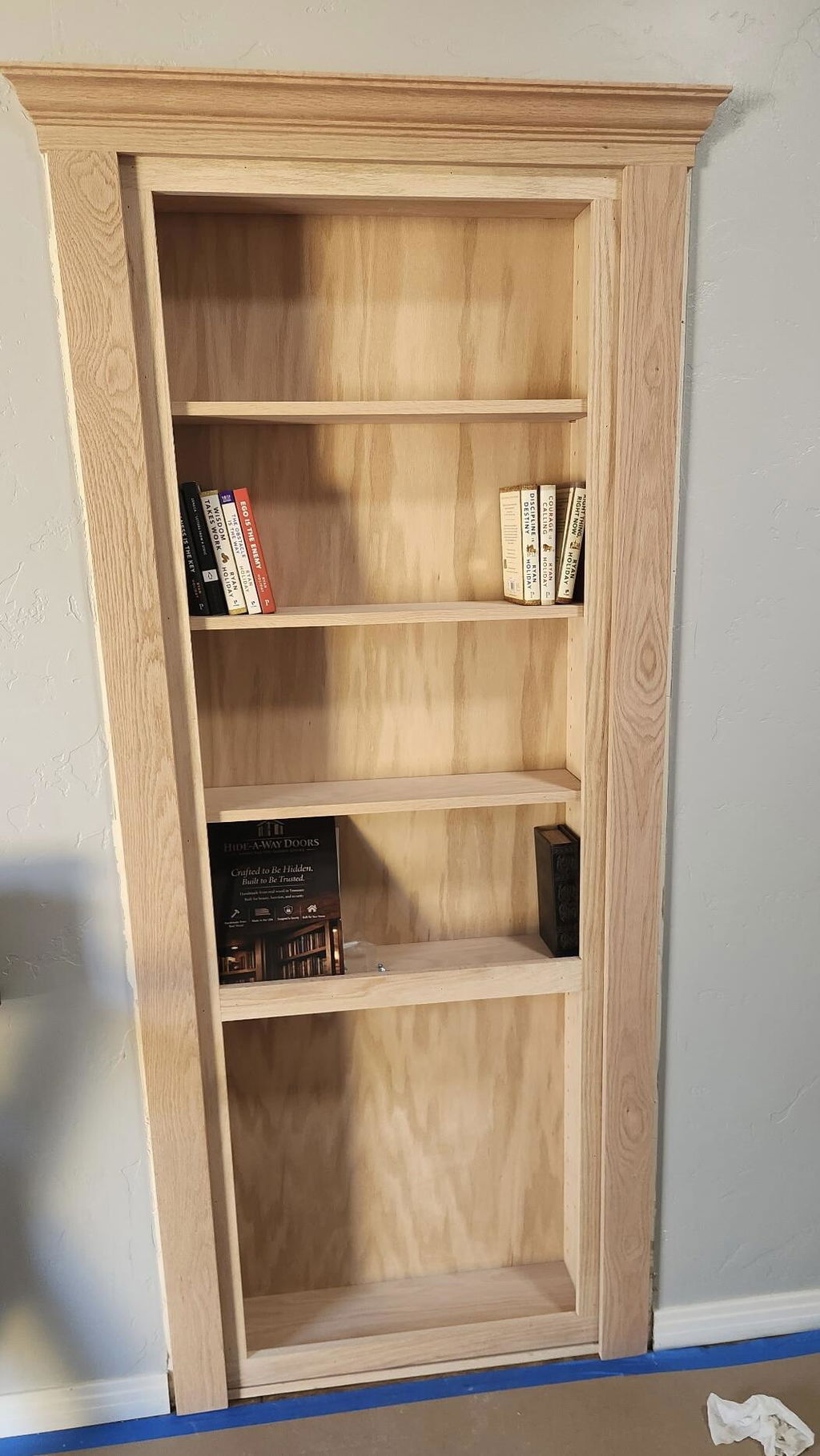
A standard closet with a 24-inch depth is the perfect candidate for a reach-in desk. This setup utilizes existing alcoves and transitional spaces without requiring a full room renovation. To make these enclosed workspaces truly functional, you must prioritize integrated LED lighting and proper ventilation to manage hardware heat. Replacing standard, flimsy bi-fold doors with a functional, handcrafted bookcase provides double utility. This upgrade offers dedicated shelf space for your library while completely masking the office behind a facade of real wood. It turns a simple storage area into a high-end architectural feature that feels permanent and purposeful.
The Secret Room Behind a Moving Bookcase
For homeowners with a spare bedroom or an unused walk-in pantry, the "Secret Suite" offers the ultimate in professional isolation. By installing a double bookcase secret door, you can hide an entire private office behind what appears to be a permanent library wall. This creates a profound "Narnia Effect" that adds a sense of intrigue and quiet confidence to your home. Beyond the aesthetic appeal, these rooms serve as high-security zones for sensitive document storage or can even function as a temporary safe room. The structural integrity of solid wood ensures the door remains stable and silent despite the weight of the books it carries.
Transitional spaces like wide hallways or areas under a staircase also offer unique opportunities for a "Passage Office." These are ideal for quick tasks and can be hidden behind a single bookcase door or a specialized Mirror Door. When deciding between a simple nook and a full secret room, evaluate your daily meeting schedule and the need for acoustic privacy. If you require absolute silence for video calls or deep focus, a secret room is the superior investment for your home and career. If you're ready to move from inspiration to execution, you can explore the various custom door configurations designed to meet these specific architectural challenges.
Real Wood vs. MDF: Why Structural Integrity Matters for Office Doors
The physics of a hidden entrance are unforgiving. When you integrate a workspace behind a moving wall, you aren't just installing a door; you're engineering a piece of kinetic furniture that must support hundreds of pounds. Many hidden home office ideas found on social media rely on "hacks" using mass-produced MDF or particle board. While these materials might look acceptable in a static photo, they lack the internal fiber strength to hold a hinge under constant tension. A functional library door carries the weight of the wood, the hardware, and your entire collection of professional texts and equipment.
The "Sag Factor" is the inevitable result of using inferior materials. Within 12 months, the hinges on a particle board unit often begin to pull away, causing the door to scrape the floor or fail to align with the frame. This compromise ruins the illusion of concealment and creates a mechanical hazard. For a workspace that remains a secret, structural integrity is the only path to long-term functionality. Real wood hidden doors offer furniture-grade finishes that MDF cannot replicate, ensuring your office entrance remains as beautiful as it is durable.
The Weight of Knowledge: Shelving Requirements
Calculating the load is a critical step in the design process. A single shelf of hardcover books can easily weigh 25 to 30 pounds per linear foot. When you multiply that across five or six shelves, the total weight on the door frame becomes substantial. This is why handcrafted hidden doors utilize specialized heavy-duty pivot hinges rather than standard side-mount hinges. These pivot systems transfer the weight directly into the floor, allowing a solid Oak or Walnut door to swing effortlessly for decades. In high-use professional areas, the lifespan of solid wood far exceeds that of compressed wood products, which tend to warp or crumble at the stress points over time.
Furniture-Grade Finishes for Professional Interiors
Tactile quality matters in a luxury home environment. When you run your hand across the grain of a real Alder or Walnut door, there's a sense of permanence and manual skill that paint-covered MDF simply lacks. Choosing real wood allows for stain-grade finishes that highlight the natural beauty of the timber, making it easy to match your secret entrance to existing crown molding or hardwood flooring. This level of customization ensures the door feels like a built-in architectural feature rather than an afterthought. Real wood stands up to the daily wear and tear of a busy professional life, resisting the chips and dents that often plague cheaper alternatives.
Creative Layouts for Your Hidden Workspace
Layout is about more than just concealment; it's about utilizing the specific geometry of your home to create a seamless professional environment. One of the most elegant hidden home office ideas involves the "Library Entry" layout. By flanking a fireplace with a hidden bookcase door, you create a symmetrical, high-end visual that masks the entrance to a rear workspace. This design feels like a natural extension of the room's architecture, providing a classic aesthetic that hides a modern utility.
For larger homes or grander office transitions, French-style Double Bookcase Doors offer a majestic solution. These units provide massive amounts of storage while acting as a sophisticated gateway to a double-wide office space. It's a statement piece that commands respect while maintaining total secrecy. Whether you're concealing a small nook or a large executive suite, the layout should prioritize flow and the "wow factor" of a perfectly integrated entrance.
Utilizing Dead Space: Nooks and Hallways
Identifying "wasted" square footage is the first step toward a more efficient home. Look for deep hallway ends or the triangular void under a staircase. These "Harry Potter" style offices turn neglected areas into cozy, productive sanctuaries. You can design a shallow-depth workstation that requires zero structural changes to your load-bearing walls. Since these nooks are often windowless, focus on high-CRI (Color Rendering Index) lighting and warm wood tones to prevent a cramped feel. It's a clever way to add a dedicated focus zone without sacrificing your primary living areas.
The Mirror Door Solution for Small Bedrooms
In a master suite retreat, space is often at a premium. A Mirror Door serves a dual purpose: it doubles the perceived size of the room while hiding your desk and hardware. It's a practical, daily-use item that happens to be a high-security barrier. By keeping your laptop and sensitive documents behind a reflective surface, you add a layer of protection against prying eyes. This setup is particularly effective for those who want a workspace in their bedroom but don't want to look at a monitor while trying to sleep. It's the ultimate blend of vanity and utility.
Selecting the right entrance is the final, most critical step in bringing your hidden home office ideas to life. While we have explored various layouts and the necessity of real wood construction, the Alpha Door represents the pinnacle of this craft. It is often referred to as the gold standard for home office concealment because it blends the strength of a structural partition with the elegance of a custom bookcase. This isn't a temporary fixture or a flimsy DIY kit. It is a precision-engineered piece of architectural furniture designed to operate with whisper-quiet precision for a lifetime.
The transition from a standard doorway to a secret executive suite should be seamless. Ordering a custom Alpha Door involves a methodical process where measurements are verified to ensure a perfect fit within your existing frame. Because these doors are manufactured with traditional joinery techniques, they don't suffer from the mechanical failures common in mass-produced alternatives. When you close an Alpha Door, the click of the latch provides a sense of security and the peace of mind that your professional world is safely tucked away.
Customizing Your Alpha Door for Utility
A truly functional hidden office requires specialized storage that goes beyond standard bookshelves. When customizing your Alpha Door, you can integrate adjustable shelving specifically designed to house tech gear like routers, printers, and heavy reference volumes. This keeps your essential tools within reach but entirely out of sight. Choosing the right wood species is equally important for matching your home’s executive style. Whether you prefer the deep, rich tones of Walnut, the classic grain of Oak, or the smooth finish of Cherry, each door is stained to your exact specifications. For added privacy, specialized locking mechanisms can be integrated, ensuring your workspace remains a restricted zone even when you aren't there.
The Path to Ownership: Shipping and Installation
High-end craftsmanship shouldn't be limited by geography. We utilize a robust national shipping process and a professional installation network to ensure your door arrives safely and is set up correctly. There is a distinct advantage to working with a family-owned business in Tennessee rather than a big-box retailer. Our master artisans prioritize substance and heritage over fleeting trends, resulting in a product that feels established and award-winning from the moment it’s installed. We handle the logistics and technical execution so you can focus on the satisfaction of a perfectly executed home upgrade.
The "wow factor" of a hidden office is only achieved through precision. When every line is flush and the movement is silent, the illusion is complete. Ready to hide your work and reclaim your living space? Explore Alpha Door options at Hide-A-Way Doors and discover how a handcrafted entrance can redefine your professional lifestyle.
Reclaiming Your Home’s Architectural Integrity
The transition toward permanent hybrid work in 2026 requires more than a temporary desk; it demands a permanent architectural boundary. By prioritizing hidden home office ideas that utilize real wood construction, you ensure your workspace remains a secret for decades. We've explored how solid wood prevents the inevitable sag found in MDF alternatives, and how creative layouts can turn dead square footage into a private executive retreat. This is an investment in the long-term value and tranquility of your living environment.
Our solutions are handcrafted in the USA with a focus on traditional skills and enduring quality. We never use MDF or particle board, ensuring that every Alpha Door or bookcase entrance maintains its structural integrity under heavy loads. With a national installation network at your disposal, achieving a whisper-quiet, professional finish is a seamless process. It's time to stop letting office clutter dictate your home's aesthetic and embrace the peace of mind that comes from expert craftsmanship.
Your most productive days and most restful evenings are just one masterfully hidden door away.
Frequently Asked Questions
Can a hidden bookcase door really hold the weight of all my office books?
Yes, our handcrafted doors are engineered to support several hundred pounds when properly installed. Unlike standard hinges that pull on the frame, we use heavy-duty pivot hinges that transfer the weight directly into the floor. This allows you to fill your shelves with hardcover reference books and professional equipment without worrying about the door sagging or sticking over time.
How much depth do I need for a hidden home office behind a door?
You typically need a minimum of 24 inches of depth to accommodate a standard desk and an ergonomic chair. When considering hidden home office ideas, remember that the door unit itself requires approximately 8 to 10 inches of clearance for the shelving. If you are converting a standard reach-in closet, ensure the interior space is deep enough to allow the door to close fully while your chair is tucked in.
Are hidden doors difficult to install in an existing doorway?
Installation is straightforward because our units are designed to fit into standard rough openings. While a skilled DIYer can handle the process, we provide access to a national installation network to ensure the door operates with whisper-quiet precision. The critical factor is ensuring the floor is level and the frame is square, which allows the pivot mechanism to swing effortlessly without any visible gaps.
Is real wood better than MDF for a hidden door?
Real wood is the only viable option for a door that must support weight while moving. MDF and particle board lack the internal fiber strength to hold screws under the constant tension of a swinging bookcase. By using solid species like Oak, Alder, or Walnut, we provide a furniture-grade finish and structural integrity that won't crumble or warp after a year of daily use.
Can I lock my hidden office door for security?
Yes, you can integrate several types of locking mechanisms to keep your workspace private. Options range from traditional mechanical deadbolts to sophisticated electromagnetic locks triggered by a hidden switch or a wireless remote. These features turn your office into a secure zone for sensitive documents and expensive hardware, providing peace of mind when you aren't at your desk.
Does a hidden office require special ventilation?
Ventilation is essential if you plan to run a computer, printer, or server in a confined space. Heat buildup can damage your hardware and make the workspace uncomfortable. We recommend incorporating passive vents into the cabinetry or installing a small, active exhaust fan. This ensures a steady flow of air even when the door is closed for extended periods.
What is the difference between an in-swing and out-swing hidden door for an office?
An in-swing door pushes into the office, which is ideal if you want the bookcase to sit flush with the exterior wall. An out-swing door pulls toward you into the main living area. Your choice depends on your floor plan; in-swing doors require clear floor space inside the office, while out-swing doors need clearance in the hallway or living room to open fully.
How do I hide the cables and power cords in a hidden home office?
Effective cable management starts with integrated grommets and hidden channels within the desk and shelving. You can route power cords through the back of the bookcase or use specialized wire management trays mounted under the work surface. This prevents a tangled mess of wires from ruining the aesthetic of your hidden home office ideas and keeps the floor clear of tripping hazards.