How to Design and Install a Hidden Panic Room Door for Ultimate Home Security
The most effective security measures are the ones an intruder never sees. You’ve likely considered a safe room, but the fear that a massive, industrial vault door looks too obvious is a valid concern. A visible security door often tells a criminal exactly where your most valuable assets are hidden. Integrating a hidden panic room door into your home provides the ultimate tactical advantage by utilizing the element of surprise.
It’s natural to feel anxious about home security, especially with the U.S. home security market projected to reach $17.38 billion by the end of 2026. You want a sanctuary that offers more than just a locked door; you want a space built with the precision of a master artisan. We’ll show you how to convert any standard room into a secure retreat using concealment doors that function as high-end furniture while maintaining absolute structural integrity. From understanding FEMA P-361 standards to selecting materials that won't fail in an emergency, this guide provides a methodical roadmap to achieving peace of mind through superior craftsmanship.
Key Takeaways
Understand the psychological power of concealment and how a hidden panic room door creates a critical tactical delay by keeping your sanctuary's location unknown to intruders.
Identify why master craftsmanship requires solid wood species like Oak or Alder, avoiding the structural failures common with inferior MDF or particle board materials.
Master the technical requirements for installation, including assessing structural header support and choosing between inswing or outswing configurations for maximum defense.
Balance rapid access with unyielding security by evaluating the functional differences between modern electronic locks and traditional mechanical systems.
Learn to extend the utility of your secure space by integrating specialized features like gun concealment and high-value asset protection for a truly bespoke sanctuary.
The Philosophy of Concealment: Why Stealth is Your Best Defense
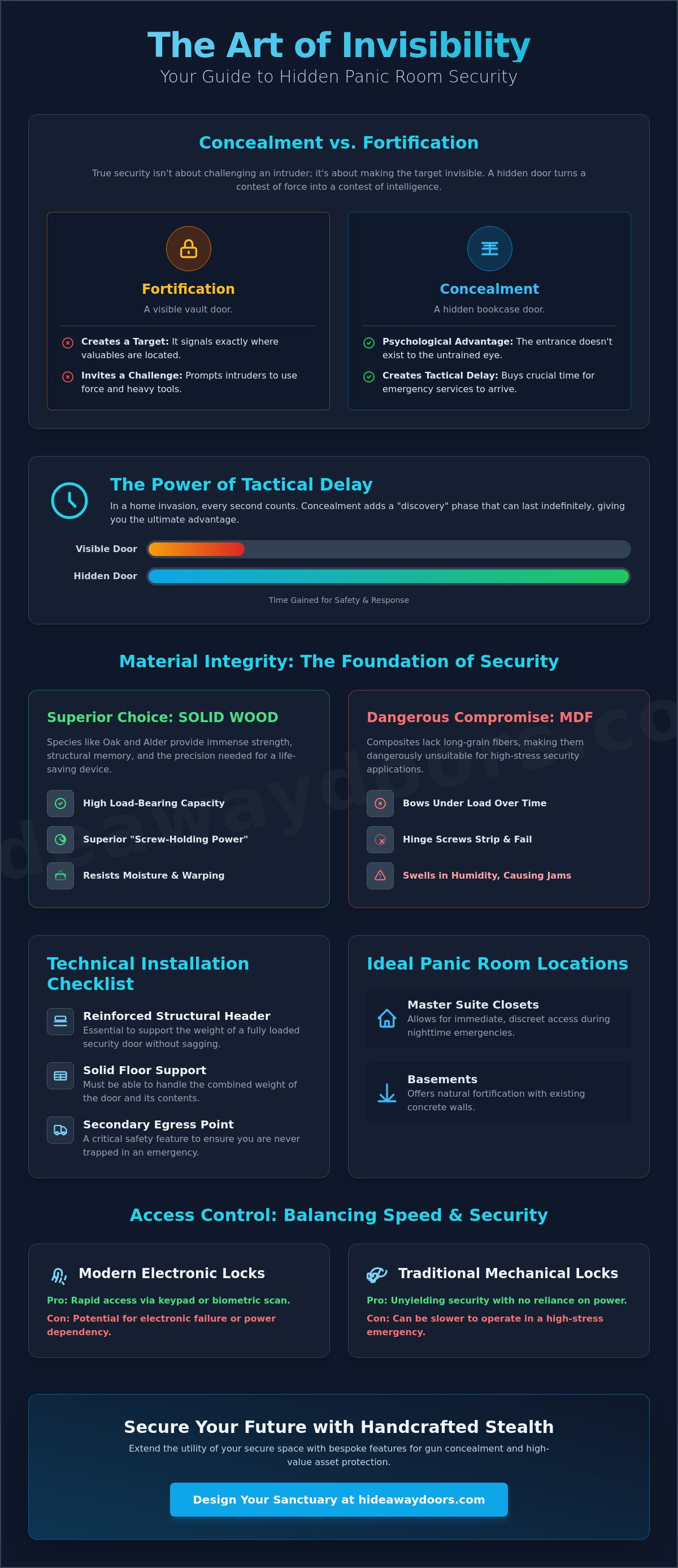
True security doesn't announce its presence. While a heavy steel vault door might look impressive, it serves as a glaring beacon to any intruder, signaling exactly where your family and valuables are located. This is the fundamental flaw in traditional safe room design. If a criminal sees a high-security door, they know they've found the prize. By contrast, a hidden panic room door relies on the psychological advantage of invisibility. It prevents the threat from ever beginning because the entrance simply doesn't exist to the untrained eye.
In a home invasion, every second counts. Security experts often discuss the concept of "Tactical Delay." This refers to the time it takes for an intruder to identify, reach, and breach a secure area. When you research what is a safe room, you'll find that many structures focus solely on the "breach" phase. However, concealment adds a "discovery" phase that can last indefinitely. If an intruder spends ten minutes searching your home without finding the entrance, that is ten minutes of safety you've gained for emergency services to arrive.
Concealment vs. Fortification
Fortification is a contest of strength, but concealment is a contest of intelligence. A reinforced steel door is a challenge to be overcome with tools and force. A hidden door is a mystery that remains unsolved. Beyond the physical protection, there's a profound sense of peace that comes from knowing your home's layout hasn't been compromised. Stealth also protects you from social engineering; a contractor or guest might notice a vault door and mention it elsewhere, but they'll never comment on a bookcase that looks perfectly natural in your study.
Identifying the Ideal Location for a Secret Panic Room
Choosing the right spot requires a balance of accessibility and structural reality. Master suite closets are popular choices because they allow for immediate entry during nighttime emergencies. Basements offer the benefit of existing concrete walls, which provide natural fortification. However, you must consider the weight of the unit. A professional-grade hidden panic room door, such as a heavy-duty bookcase or mirror door, requires a solid floor and a reinforced structural header to function smoothly. Always ensure the room has a secondary egress point; you never want to be trapped without an alternative exit if the primary path is blocked by fire or debris.
Structural Integrity: Why Real Wood Defines Panic Room Security
A hidden panic room door must perform two contradictory tasks. It has to look like a permanent, stationary fixture while functioning as a high-precision moving part. Achieving this requires materials that possess inherent structural memory and immense load-bearing capacity. Solid wood species like Oak, Alder, and Cherry aren't chosen merely for their aesthetic beauty. They are selected for their density and cellular structure, which allow them to support hundreds of pounds of shelving contents without bowing or losing alignment over time. Precision matters when your life is on the line.
Standard interior doors are often hollow or filled with foam, making them useless for security. In contrast, a professional-grade hidden panic room door utilizes furniture-grade finishes to mask the industrial-strength hinges underneath. These hinges are the backbone of the system. They allow a massive bookcase to swing with the touch of a finger while remaining completely invisible to anyone standing in the room. This intersection of heavy-duty engineering and refined carpentry is what defines a true security sanctuary.
The Dangers of MDF in Security Applications
MDF and particle board are common in standard furniture, but they're dangerous in a security context. These composite materials lack the long-grain fibers necessary for "screw-holding power." Over time, the weight of a fully loaded bookcase pulls at the hinges, causing the screws to eventually strip the brittle composite holes. Even worse, MDF is highly susceptible to atmospheric moisture. A slight increase in humidity can cause the door to swell or warp, potentially jamming the unit into the frame. Structural integrity is the critical difference between a functional exit and a trapped occupant in a life-threatening emergency.
Alpha Concealment Door: The Master Artisan Standard
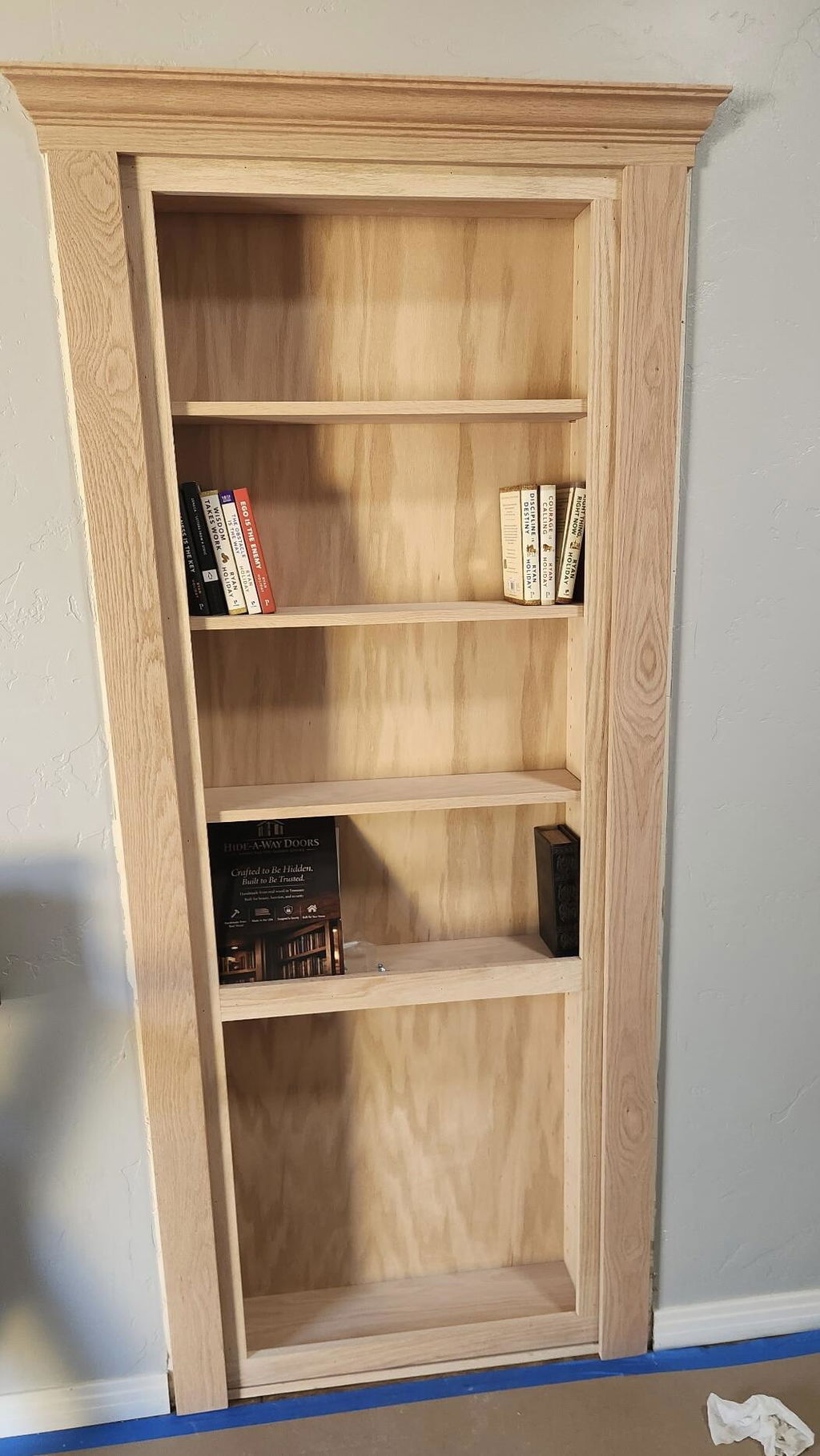
The engineering of the alpha concealment door represents the pinnacle of this craft. Unlike mass-produced alternatives, these units utilize industrial-strength steel hinges that are meticulously recessed into solid wood frames. This allows the door to remain perfectly plumb even when carrying a heavy load of books or security gear. Each unit features handcrafted joinery that distributes weight evenly across the entire structure, preventing frame failure under stress. Whether you choose the rugged durability of Knotty Alder or the refined strength of Cherry, the result is a hidden panic room door that operates with silent, heavy precision. When you invest in a handcrafted hidden door, you're choosing a piece of functional art that prioritizes your family's safety through unyielding material quality.
Evaluating Locking Mechanisms and Access Control
The lock is the final handshake between your sanctuary and the outside world. While the previous sections established the importance of stealth and structural wood quality, those elements are compromised if the locking system is either too complex to operate or too flimsy to resist force. A hidden panic room door requires a specialized approach to access control that prioritizes speed without sacrificing the secret nature of the entrance. You need a system that remains invisible to the observer but responds instantly to the authorized user.
Mechanical locks, such as heavy-duty deadbolts, remain a staple for many homeowners because they don't rely on electricity. They're immune to power outages and electronic interference. However, electronic systems have evolved significantly. Modern biometric and keypad systems allow for rapid entry, which is vital when you're under extreme stress. The primary risk with electronics is the potential for failure during a crisis. If you choose an electronic route, a manual override is a non-negotiable requirement for any secure installation. You must be able to get in, and out, regardless of the state of the power grid.
Primary Locking Options for Secret Doors
Deadbolts provide the most significant structural reinforcement by physically anchoring the door to the reinforced header and jamb. For those looking for more advanced options, electromagnetic locks offer incredible holding power, often exceeding 1,200 pounds of force. These require a consistent power source, making high-capacity battery backups essential. For a deep dive into specific hardware choices, consult our hidden door locking mechanism guide. Many homeowners prefer a "hidden in plain sight" trigger. This might include a magnetic key disguised as a decorative object or a specific book that must be tilted to engage the release. These methods maintain the illusion of a standard room while providing rapid, intuitive access.
Emergency Access Protocols
Speed of entry is only half of the equation; speed of exit and internal control are equally vital. Every hidden panic room door must include a simple, mechanical release on the interior side that requires no key or code to operate. This ensures that even in a high-pressure scenario, you aren't trapped by a malfunctioning electronic component. When configuring your system, you'll choose between fail-safe and fail-secure settings. A fail-secure system remains locked when power is lost, which is the preferred setting for a security sanctuary. This ensures the room remains a vault even if an intruder cuts the home's power. By setting up unique codes for family members, you can also monitor who enters the space, providing an extra layer of home security and oversight.
Precision is the hallmark of a master artisan. When you begin the transition from a standard room to a secure sanctuary, the planning phase dictates the success of the entire project. You aren't just hanging a door; you're installing a complex mechanical system that must integrate seamlessly with your home's architecture. This requires moving beyond simple aesthetics to focus on the technical requirements of a hidden panic room door.
The first step involves assessing your rough opening. A professional-grade concealment door is significantly heavier than a standard interior door, often exceeding 200 pounds when loaded with books or equipment. This weight requires a structural header that can support the load without sagging over years of use. Once the structure is verified, you must choose your concealment style. Whether you select an Alpha Door for its classic bookcase look or a Mirror Door for a sleek hallway finish, the unit must match the existing trim and decor of the surrounding area to maintain the illusion. Measuring for a precision fit is a task that allows for zero error. Even a small gap can create 'light leaks' that reveal the room behind the door. You should measure the width and height at three different points to account for any house settling or slightly out-of-square framing.
Inswing vs. Outswing: The Tactical Difference
Inswing doors are the preferred choice for panic rooms because they offer a significant defensive advantage. When a door swings into the secure space, the door frame itself acts as a physical stop, making it nearly impossible for an intruder to pull the door open even if they manage to grip the unit. Outswing doors are often used in narrow hallways where interior space is limited. These require careful management of the 'reveal' to ensure that the bottom of the door doesn't leave marks on the floor, which is a common giveaway of a secret passage.
Pre-Installation Checklist
Before the unit arrives, you must verify that the floor is perfectly level. A floor that slopes even slightly will cause 'ghost swinging,' where the door fails to stay in the position you leave it. You should also ensure that the wall studs are doubled up on the hinge side to handle the constant torque of the heavy unit. Finally, plan for your communication lines. You should run power and hardwired internet lines into the room before the door is set, ensuring your sanctuary remains connected to the outside world during an emergency. If you're confident in your carpentry skills, you can order a DIY Door Kit to begin your custom security project today.
Customizing Your Sanctuary: Beyond the Entrance
The successful installation of your hidden panic room door is the first step toward true security, but the interior of the room dictates its long-term utility. A sanctuary should be as organized as it is stealthy. Beyond the threshold, the design should reflect your specific defensive needs and the protection of your most valued assets. This is where the intersection of elegant home design and secret utility becomes most apparent. You aren't just building a room; you're creating a tailored environment designed for resilience.
For many homeowners, this involves integrating specialized storage solutions that keep equipment out of sight but within reach. You might consider a gun concealment door within the panic room itself to keep defensive tools secondary and secure. Likewise, utilizing a secret door for ammunition storage ensures that hazardous materials are kept in a climate-controlled, discrete location. If your primary goal is the protection of heirlooms or sensitive data, a secret door to safe room configurations can provide a secondary layer of defense that thwarts even the most persistent intruders. Every wood species and trim detail should be meticulously matched to your home's existing decor to ensure the hidden panic room door remains invisible to the casual observer.
The Alpha Door Advantage
In a market flooded with mass-produced imports, handcrafted Tennessee craftsmanship stands apart. The Alpha Door represents a commitment to rugged, dependable quality that composite materials simply cannot match. Solid wood construction ensures that your door handles the wear of high-traffic areas without sagging or losing its precision fit. Because every home has unique architectural requirements, choosing a custom configuration allows you to select the exact wood species, stain, and dimensions needed for a seamless integration. It's the difference between a temporary fix and an enduring investment in your home's legacy.
Finalizing Your Security Plan
A secure room is only effective if you can reach it. Once your door is installed, you must conduct dry-runs with your entire family to ensure everyone knows how to engage the locks and trigger the concealment mechanism under pressure. Regular maintenance is also vital. You should periodically inspect the heavy-duty pivot hinges and test electronic locking hardware to ensure smooth operation. If you're ready to move from inspiration to execution, contact Hide-A-Way Doors for a professional design consultation. Our master artisans are ready to help you navigate the technical details of your custom project, ensuring your peace of mind is built on a foundation of superior craftsmanship.
Securing Your Future with Handcrafted Stealth
You've learned that true security relies on the element of surprise and unyielding structural integrity. By prioritizing stealth over obvious fortification, you gain the tactical advantage of time. We've explored why solid wood construction is the only acceptable standard for a load-bearing hidden panic room door, ensuring your entrance remains functional when it matters most. From choosing the right locking mechanism to planning for a precision architectural fit, every detail contributes to a sanctuary that is both beautiful and impenetrable.
At Hide-A-Way Doors, we take pride in our heritage of manual skill and dependable craftsmanship. Our products are handcrafted in Morristown, TN, using real wood construction with absolutely no MDF or particle board. With a national network of professional installers, we ensure your project moves seamlessly from initial inspiration to technical execution. Design your custom hidden panic room door with Hide-A-Way Doors today.
Building a secure retreat is a significant commitment to your family's safety. With the right planning and the precision of a master artisan, you can transform any standard room into a reliable sanctuary that offers protection without compromising your home's elegant design. Your peace of mind is worth the investment in quality that lasts for generations.
Frequently Asked Questions
Is a wooden hidden door strong enough to be a panic room door?
Solid wood is remarkably resilient when engineered correctly. Unlike composite materials that shear under pressure, the long-grain fibers of Oak or Cherry provide the necessary tensile strength to resist forced entry. A hidden panic room door built from these materials acts as a structural barrier that is far more durable than any standard interior door, provided it's paired with a reinforced header.
Can I install a hidden panic room door in an existing doorway?
Yes, you can certainly convert a standard closet or room entrance into a secure passage. Our units are designed to fit standard rough openings, though you'll need to ensure the framing is reinforced to support the increased weight. This makes it an ideal upgrade for existing master suites or home offices where a discrete, secure retreat is needed without major renovation.
What is the best wood species for a heavy security bookcase door?
Oak and Cherry are the preferred choices for high-security applications due to their exceptional density and hardness. These species offer the best screw-holding power for the heavy-duty hinges. Knotty Alder is another excellent option for those seeking a rugged, traditional look without sacrificing the structural integrity required for a heavy, functional bookcase.
How do you open a hidden panic room door from the inside during an emergency?
Every security door we manufacture includes a simple, mechanical release on the interior side. This ensures that you and your family can exit the room instantly without needing a key, code, or electronic device. In an emergency, your exit must be intuitive and fail-proof, which is why we prioritize mechanical overrides that function independently of the primary locking system.
Do hidden doors require a special type of wall construction?
Most standard 2x4 or 2x6 wall constructions are compatible, but the hinge side must be properly reinforced. Because a hidden panic room door can weigh over 200 pounds, we recommend doubling up the wall studs and ensuring the structural header is secure. This reinforcement prevents the door from sagging or pulling the frame out of alignment over years of use.
Can a hidden door be made bulletproof?
While solid wood provides significant mass, it isn't ballistic-rated on its own. However, our doors can be customized with ballistic-resistant backing panels during the manufacturing process. This adds a layer of protection against projectiles while the exterior of the door maintains the appearance of high-end furniture, ensuring your safe room remains both secret and secure.
What happens to the door if the power goes out?
If you use a manual deadbolt, the door functions normally regardless of the power status. For electronic systems, we utilize fail-secure locks that remain engaged if power is lost, keeping the room sealed from the outside. The internal mechanical release always allows you to exit the room safely, so you aren't trapped by an electrical failure during a crisis.
How much weight can a Hide-A-Way bookcase door actually hold?
Our bookcase doors are engineered to support up to 300 pounds of shelf weight in addition to the weight of the door itself. This capacity is made possible by our industrial-strength pivot hinges and handcrafted Tennessee joinery. You can fully stock your shelves with books or security gear without worrying about the unit sagging, dragging, or jamming.