Hidden Door Locking Mechanisms: The Complete Reference Guide for 2026
The most secure entrance is the one that remains completely undetected, even under close inspection. Achieving this level of total concealment requires more than just a clever hinge; it demands a sophisticated hidden door locking mechanism that integrates seamlessly into the door's internal structure. You've likely spent hours perfecting the alignment of a bespoke Alpha Door or a heavy Double Bookcase Door, only to realize that standard hardware risks exposing the secret. Worse yet, inferior locks often sag or fail under the weight of genuine, solid wood craftsmanship.
We understand the frustration of hardware that ruins a visual profile or the nagging fear of being locked out by an electronic failure. This guide provides the technical expertise you need to master secret door security, ensuring your entrance stays both inaccessible and invisible. We will explore the latest 2026 advancements in biometric scanners, RFID technology, and high-strength electromagnetic locks that support up to 1,200 pounds of force. From fail-safe egress to zero-footprint exterior finishes, you'll learn how to build a system that prioritizes both elegance and absolute peace of mind.
Key Takeaways
Understand why standard deadbolts fail the concealment test and how to achieve a zero-footprint exterior using specialized hardware.
Compare the fail-safe reliability of mechanical triggers against the high-strength holding force of an electromagnetic hidden door locking mechanism.
Discover creative methods for concealing access points, from pivoting decorative trim to hiding digital keypads within furniture drawers.
Learn why solid wood construction is vital for maintaining structural integrity and preventing hardware failure under the weight of heavy bookcases.
Assess your specific security needs and user requirements to select a system that balances absolute protection with ease of operation.
The Role of Stealth in Hidden Door Locking Mechanisms
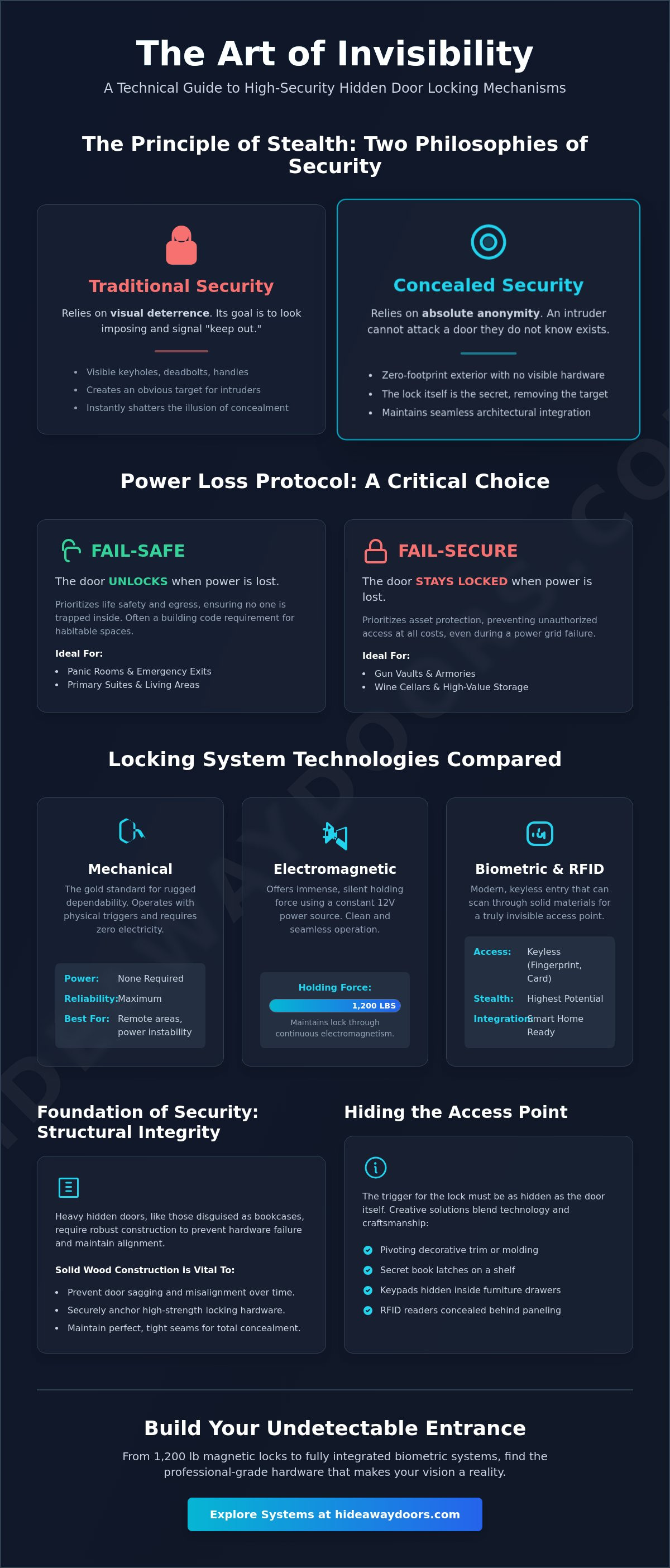
Stealth isn't just an aesthetic choice. It's a structural requirement. A true concealment lock is defined as hardware designed to secure an opening without any external visual indicators. While a standard front door relies on a heavy deadbolt to signal "keep out," a hidden entrance relies on the fact that an intruder doesn't even know a door exists. If you can see a keyhole, a handle, or a gap in the trim, the illusion is shattered instantly. Real security in this context is found in the absence of evidence.
Standard deadbolts fail the "hidden" test because they require a visible cylinder and a bulky strike plate. These components create a physical break in the wood's grain or a mirror's frame that the human eye is trained to notice. In a 2026 home environment, balancing daily convenience with long-term security means choosing a hidden door locking mechanism that operates entirely from within the door's core. There's a powerful psychological advantage here: if a malicious actor can't find the lock, they can't pick, bump, or drill it. You've effectively removed the target from the equation.
Concealment vs. Traditional Security
Traditional security is built on visual deterrence. It wants to look imposing. In contrast, hidden locks rely on absolute anonymity. Any visible hardware, even a small latch, creates a "seam" that catches the eye. This is especially critical for a flush-mount Alpha Door or a Mirror Door where the edges must remain perfectly tight. To maintain this profile, many master builders utilize concealed door closer mechanisms that pull the door shut with precision without revealing a bulky arm or floor plate. This ensures the bookcase or mirror remains indistinguishable from the surrounding wall while maintaining a secure, locked state.
Fail-Safe vs. Fail-Secure: What You Must Know
When selecting your hardware, you must decide how the system reacts to a power loss. A fail-safe system unlocks the door when the power goes out. This is a critical life-safety requirement for rooms used as emergency exits or panic rooms, ensuring you aren't trapped inside during a fire. It's often required by local building codes for habitable spaces. Conversely, a fail-secure system remains locked when power is cut. This is the gold standard for protecting valuables in a gun vault or a wine cellar where unauthorized access must be prevented at all costs.
Your choice depends entirely on the room's purpose. For a Gun Cabinet Door, fail-secure ensures the collection stays protected even if the grid goes down. For a Double Bookcase Door leading to a primary suite, a fail-safe approach might be better to meet egress standards. Precision engineering ensures that whether you choose magnetic or mechanical, the hardware supports the weight of solid wood without sagging over time. This durability is what separates a professional installation from a weekend project.
Comparing Mechanical, Magnetic, and Biometric Locking Systems
Selecting the right hardware is a matter of balancing engineering with intent. While the philosophy of stealth is universal, the physical execution relies on three primary categories: mechanical, magnetic, and biometric. Each system offers a distinct profile for holding force, operational reliability, and integration. A Wine Rack Door protecting a rare vintage requires a different approach than a Pool Cue Door in a high-traffic game room. The choice of a hidden door locking mechanism ultimately dictates how the door feels, how it sounds, and how it responds when the grid goes down.
Mechanical Locks: These remain the gold standard for rugged dependability. They require zero power and utilize physical triggers to engage the strike.
Electromagnetic Locks (Mag-locks): These offer immense holding force, often ranging from 600 lbs to 1,200 lbs. They provide a clean, silent operation but require a constant 12-volt power source.
Biometric and RFID Systems: These provide a modern, keyless experience. They allow for "invisible" entry by scanning through solid materials or recognizing unique physical traits.
Mechanical Precision: The Book Latch and Beyond
Mechanical systems are favored for their permanence and tactile quality. A classic book latch functions as a physical trigger; pulling a specific volume on a Double Bookcase Door moves a hidden cable that releases the strike. These systems are ideal for remote cabins or areas with power instability. Because they don't rely on batteries or wiring, they offer a lifetime of service with minimal maintenance. If you value traditional craftsmanship, exploring meticulously crafted secret doors with mechanical triggers is a wise starting point.
High-Tech Access: RFID and Biometric Scanners
Modern technology has turned the "open sesame" myth into a functional reality. RFID locks operate on a 13.56 Mhz frequency, allowing you to place a sensor behind solid wood that reads a key card or fob through the material. For even greater sophistication, biometric scanners with an IP66 water resistance rating can be integrated into natural touch points. These scanners can store up to 990 users, making them perfect for high-security gun rooms. Wireless fobs add another layer of convenience, allowing you to operate your door with the same ease as a luxury vehicle.
When comparing these systems, consider the weight of the door. A solid wood Gun Cabinet Door or a heavy Mirror Door requires hardware that won't sag under tension. While a magnetic lock provides a smooth, handle-free pull, a mechanical deadbolt offers a physical barrier that is nearly impossible to bypass without significant force. Your decision should reflect the level of security required and the frequency of use the entrance will see.
Concealment Techniques: Hiding the Access Point
Concealment is a performance. The most effective hidden door locking mechanism is one that is triggered by a motion so mundane it escapes notice. This is known as the "Natural Interaction" rule. An observer should see you merely straightening a book, adjusting a piece of trim, or placing a decorative object on a shelf. They shouldn't see you fumbling with a concealed latch or inputting a code on a visible keypad. If the act of opening the door looks like a normal household task, the secret remains safe even in plain sight.
Creative mechanical triggers provide the most immersive experience. While the classic book-pull is iconic, modern artisans often utilize sliding crown molding or weight-sensitive shelves that respond only when a specific item is added. Integrating a hidden door locking mechanism into a weight-sensitive shelf requires precise calibration to ensure the door remains secure under the weight of solid wood furniture. For electrified systems, cable management is the silent hero. Wires must be routed through the hinges or via a power transfer loop to ensure no visible leads betray the door's function. Digital interfaces, such as RFID readers or keypads, should be tucked inside a nearby drawer or behind a magnetically attached panel that blends into the cabinetry.
Pivoting Decorative Items: A bust, a clock, or a trophy that rotates to engage a cable release.
Sliding Trim Pieces: A section of the baseboard or chair rail that slides to reveal a hidden button.
Magnetic 'Keys': An unmarked spot on a shelf that only responds when a magnet, hidden inside a coaster or vase, is placed on it.
The Art of the Hidden Trigger
The pinnacle of this craft involves integrating the trigger into the very architecture of the piece. For instance, a magnetic key disguised as a small sculpture can be placed on an unmarked spot on a shelf to disengage a solenoid. This technique is particularly effective for an Alpha concealment door, where every detail is designed for elite-level secrecy. By using a specific book as a mechanical lever, you create a physical connection between the library's aesthetic and the room's security.
Secondary Egress and Interior Releases
Safety must never be sacrificed for the sake of a secret. Every hidden room requires a secondary egress or a manual interior release to comply with building codes and ensure life safety. This "panic release" should be easily accessible from the inside but entirely invisible from the exterior. It's often hidden within the framing or behind a removable piece of trim. Maintenance access is equally vital. You must have a plan for what to do if the primary trigger fails or a battery dies. This usually involves a mechanical override hidden in a secondary location, ensuring you aren't permanently locked out of your own vault or panic room.
Structural Requirements for High-Security Hidden Door Hardware
Engineering a secret entrance is primarily a challenge of managing mass and momentum. While the previous sections focused on the nuances of access, the actual security of the installation often comes down to structural integrity. Weight capacity is the most common reason a hidden door locking mechanism fails. If the door frame or the door itself sags by even a fraction of an inch, the lock will no longer align with the strike plate. This misalignment causes "lock bind," where the friction of the door's weight prevents the latch from releasing, effectively trapping the user or forcing the system to fail.
Reinforcing the jamb side of the lock is equally critical to the door's longevity. To prevent forced entry, the strike plate must be anchored deep into the wall's structural framing, not just the decorative trim. This ensures that the hardware can withstand external pressure without the wood splintering. A secure installation requires that the lock and the frame act as a single, rigid unit that resists the natural tendency of heavy furniture to pull away from the wall.
Mounting Locks in Real Wood vs. MDF
Materials matter when you're installing high-holding-force hardware. MDF and particle board lack the fibrous density needed to hold screws securely under constant tension. When an electromagnetic lock exerts 1,200 pounds of force, the screws in an MDF door can "blow out," causing the hardware to detach entirely. Handcrafted joinery ensures that the door remains square and true over decades of use. Because Hide-A-Way Doors uses real wood, it's possible to carve deeper, more secure mortise lock pockets that house the hardware within the heart of the door. This protects the hidden door locking mechanism from tampering and ensures a flush, invisible finish that won't degrade over time.
Managing Torque and Tension
Consider a bookcase door fully loaded with 300 pounds of books. This weight creates significant torque on the latch every time the door is closed. Heavy-duty pivot hinges must be perfectly synced with the locking mechanism to distribute this load evenly across the frame. Superior structural integrity ensures that the door frame remains rigid, preventing the lock bind that often plagues heavier, poorly constructed units. To ensure your project starts with a foundation of strength, consider the handcrafted quality of solid wood hidden doors that are built to support professional-grade security hardware.
Selecting the Right Locking System for Your Concealment Project
Choosing the right hidden door locking mechanism is the final, most critical decision in your project. It's the moment where your architectural vision meets the reality of daily security. You aren't just buying hardware; you're investing in the reliability of your secret entrance. The ideal system must align with the specific demands of your environment, the weight of your door, and the frequency of access required. A system that works for a simple closet will likely fail when applied to a heavy, full-sized Double Bookcase Door.
Assessing your security level is the first step. Are you hiding a private office or protecting a high-value vault? For higher security, the hardware should offer significant resistance to forced entry. You must also consider the "Who" in your household. If children or elderly guests need to operate the door, the interface should be intuitive. A biometric scanner is often more accessible for these users than a complex mechanical sequence. Budgeting for quality is non-negotiable here; the lock is the heart of the system and the last place you should attempt to cut costs.
In the 2026 landscape, the smart door lock market has grown to a projected $3.7 billion, driven by systems that offer both convenience and high-level encryption. Modern homeowners are increasingly integrating their hidden doors with home automation platforms. These 2026 systems allow for remote monitoring via smartphone and even utilize AI to identify usage anomalies, providing an extra layer of peace of mind for your most sensitive spaces.
Top Recommendations by Use Case
Best for Safe Rooms: High-strength electromagnetic locks with a 1,200 lb holding force and a dedicated battery backup ensure the door remains secure even during a power grid failure.
Best for Home Offices: Biometric scanners with IP66 water resistance are ideal for quick access. These units can store up to 990 users, making them perfect for environments where multiple staff or family members need frequent entry.
Best for DIY Kits: Robust mechanical book latches offer a timeless solution. They provide simplicity and longevity without the need for complex electrical wiring or battery maintenance.
The Professional Installation Advantage
Precision alignment is the difference between a secret door and a stuck one. Even a minor calculation error during the mounting process can lead to lock bind, especially when dealing with the torque of a solid wood Mirror Door or a Pool Cue Door. Professional installers possess the specialized tools and experience to handle the complex wiring of hidden electronic locks, ensuring that cables are routed safely through the frame without becoming pinched or visible. This technical expertise guarantees that your door operates with the quiet, smooth confidence that a bespoke project deserves.
Ready to secure your space? Explore our Alpha Door collection for the ultimate in secure concealment.
Secure Your Sanctuary with Precision Engineering
True security is found at the intersection of structural integrity and invisible design. As we've explored, the success of your hidden door locking mechanism depends on more than just the hardware you choose. It requires a foundation of solid wood construction to prevent sag and a trigger system that blends seamlessly into your home's aesthetic. Whether you're protecting a high-security vault with electromagnetic force or adding intrigue to a home office with a mechanical book latch, the quality of the build determines the longevity of the secret.
Don't settle for inferior materials that fail under the tension of professional-grade locks. Our products are handcrafted in the USA using real wood construction, ensuring your entrance remains both sturdy and undetectable. With our national installation network, you can move from the dreaming phase to technical execution with absolute confidence. Build Your Custom Secure Hidden Door Today and experience the peace of mind that comes from a perfectly executed project. Your home deserves the quiet confidence of a master artisan's touch.
Frequently Asked Questions
What is the best locking mechanism for a hidden bookcase door?
The ideal choice depends on whether you prioritize mechanical reliability or high-strength security. Mechanical book latches are the gold standard for long-term dependability because they require no power and operate via a simple, physical trigger. For high-security applications, an electromagnetic hidden door locking mechanism with a 1,200 lb holding force provides superior protection. Both systems perform best when integrated into solid wood frames that can manage the structural tension.
Can I install a smart lock on a secret door?
You can certainly integrate smart technology, although standard residential locks with visible keypads are avoided to maintain the concealment effect. Instead, professional builders utilize biometric fingerprint scanners or RFID readers that are concealed behind solid wood panels or tucked inside furniture drawers. These systems allow for seamless, keyless entry while keeping the exterior of the door completely flush and indistinguishable from a standard wall or bookcase.
How do I open a hidden door if the power goes out?
Access during a power failure depends on whether your system is configured as fail-safe or fail-secure. Fail-safe systems automatically unlock when power is lost, which is essential for emergency egress in habitable rooms. Most professional installations also include a hidden mechanical override, such as a concealed cable or a secondary manual latch, to ensure you can always operate the door regardless of the electrical state of the home.
Are magnetic locks (mag-locks) safe for home use?
Magnetic locks are highly effective for residential use when paired with proper safety measures. These systems provide immense holding force, often up to 1,200 lbs, making them nearly impossible to force open. To ensure safety, they must be installed with a dedicated internal release button or a fail-safe configuration that allows for immediate exit during an emergency, ensuring your installation complies with local building and fire safety codes.
What happens if the RFID card for my secret door is lost?
If an RFID card is lost, you can typically de-authorize that specific card through the lock's control panel to maintain security. Access can then be restored using a backup card or a secondary entry method like a biometric scan. It is always recommended to have a mechanical override hidden in a separate location to ensure you can gain entry if all electronic methods are temporarily unavailable due to lost hardware.
Do I need a professional to install a hidden door lock?
While DIY kits are available for simpler mechanical latches, professional installation is strongly advised for electronic or high-security systems. Precision alignment is vital; even a minor shift in the door's weight can cause a hidden door locking mechanism to bind or fail. Professionals also handle the complex task of routing wires through hinges and frames to ensure the technology remains completely invisible to the naked eye.
Will a locking mechanism make my hidden door harder to open?
A well-engineered locking system should not add significant resistance to the door's daily operation. When a high-quality latch or magnetic lock is perfectly synced with heavy-duty pivot hinges, the door should swing freely once the lock is disengaged. The key is ensuring the structural frame is rigid enough to support the weight of the solid wood without sagging, which prevents the hardware from catching or dragging during use.