Hidden Door Latch Types: A Buying Guide for Secure Secret Passages
What if the most sophisticated secret door in your home was rendered useless by a single visible screw or a latch that refused to catch? You've likely spent hours dreaming of a perfectly concealed entrance, yet the technical reality of hardware can be daunting. It's a common concern; the fear that a heavy bookcase door might eventually sag, causing the latch to misalign and ruin the illusion. Many homeowners also worry about being locked out during a power failure or having bulky, visible hardware betray the location of a private sanctuary.
Understanding the various hidden door latch types is the first step toward a secure and functional secret passage. You deserve a locking mechanism that feels professional and operates with quiet confidence. This guide explores the latest 2026 security standards, such as the UL 10C requirements for anti-tamper encryption and other advanced building security protocols effective as of February 1, 2026. We'll show you how to maintain a seamless aesthetic while achieving the high-security protection your home demands, from traditional mechanical strength to the newest biometric sensors.
Key Takeaways
Distinguish between primary latches that maintain a flush, seamless appearance and secondary locking systems designed for professional security.
Evaluate various hidden door latch types to select a mechanism that supports the door's weight without compromising the secret illusion.
Explore why electromagnetic locks provide the necessary strength for Double Bookcase Doors while electronic strikes offer precision for single-door configurations.
Select from sophisticated access methods like wireless remotes or biometric readers to ensure reliable entry for family members without using visible hardware.
Secure your peace of mind by integrating essential components like battery backups to ensure your secret entrance remains accessible during unexpected power failures.
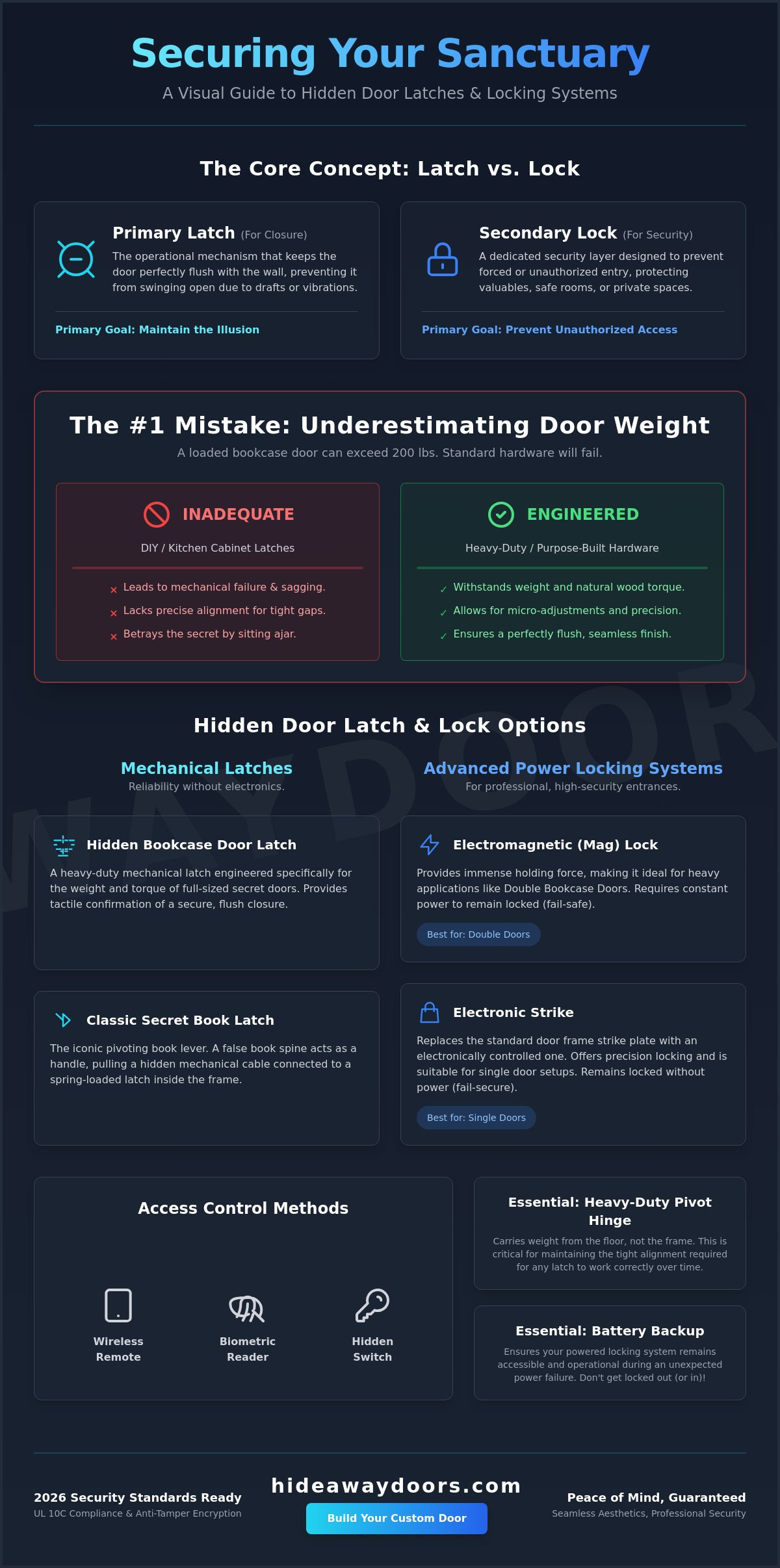
Understanding Hidden Door Latch vs. Locking Systems
A latch is the operational mechanism that ensures the door stays flush with the surrounding wall or casing. It prevents the door from swinging open due to drafts or minor vibrations. A lock is a secondary layer of security, designed specifically to prevent unauthorized entry. In the history of secret passages, concealment was often the only defense. Modern engineering allows us to combine that invisible aesthetic with professional-grade security.
Achieving a perfect illusion requires more than just a clever door. It requires hardware that remains entirely out of sight. This is where the pivot hinge plays a vital role. Unlike standard butt hinges that require a visible gap and pin, a heavy-duty pivot hinge carries the weight from the floor. This stability is essential for maintaining the tight tolerances required for various hidden door latch types to align correctly over years of use.
Closure vs. Security: Which do you need?
Not every secret door requires a high-security vault lock. For a hidden playroom or a simple closet concealed behind a Mirror Door, a basic mechanical closure might suffice. However, for gun cabinets or safe rooms, you need a system that resists forced entry. The alpha concealment door is a prime example of how integrated systems can provide both. It uses sophisticated internal mechanisms to ensure the door remains flush while offering the rugged security of a professional locking system.
The Weight Factor in Latch Selection
Weight is the most overlooked factor in hidden door design. Many DIY guides suggest using push-to-open magnetic latches designed for kitchen cabinets. These are dangerously inadequate for a handcrafted door made from solid oak or maple. A standard bookcase door can easily exceed 200 pounds once loaded with books. Using underpowered hidden door latch types on heavy furniture leads to mechanical failure and compromised secrecy.
Real wood requires heavy-duty strike plates that won't bend under the door's natural torque.
Alignment tolerances for handcrafted furniture are measured in sixteenths of an inch; cheap latches lack the adjustment needed to maintain this precision.
Friction-based catches often fail on heavy doors, leading to sagging that reveals the door's edges.
Mechanical Latches: Discretion Without Electronics
Mechanical simplicity offers a timeless reliability that digital systems sometimes lack. For many homeowners, the goal is a passage that functions perfectly without the need for complex wiring or constant battery monitoring. Among the various hidden door latch types, specialized mechanical solutions provide the necessary strength for heavy, handcrafted installations. The Hidden Bookcase Door Latch, priced at $44.95, is engineered specifically for the weight and torque of a full-sized secret door. Unlike generic hardware, this mechanism provides a tactile confirmation that ensures the door is flush and secure every time it closes.
Many builders mistakenly rely on magnetic touch latches found at local big-box hardware stores. While these work for lightweight kitchen cabinets, they're often the weakest link in a high-end secret room build. Real wood doors, such as a solid oak Pool Cue Door or a Double Bookcase Door, are subject to environmental changes. Humidity causes natural wood to swell or shrink. If a door shifts even a fraction of an inch, a simple magnet will lose its grip. This results in a door that sits slightly ajar, betraying the secret to anyone walking past. High-quality mechanical latches overcome this by using physical engagement rather than just magnetic force.
The Classic Secret Book Latch
The pivoting book lever is the hallmark of traditional secret rooms. This mechanism uses a false book spine as a physical handle that pulls a hidden mechanical cable. This cable connects to a spring-loaded latch tucked inside the door frame. The engineering behind this often references a concealed latch patent that ensures the trigger is both discrete and reliable. To keep this system running smoothly, you should occasionally inspect the tension on the internal spring. A well-maintained book latch should feel effortless and operate without any metallic grinding or resistance.
Heavy-Duty Ball Catches and Roller Latches
Ball catches provide a friction-based closure that is ideal for doors where a physical lever isn't desired. These latches use a spring-compressed ball that nests into a recessed strike plate. For secret entrances, top-mounted latches are significantly superior to side-mounted options. Placing the hardware at the top prevents the latch from binding if the door sags slightly over time. Stainless steel hardware is the preferred choice for longevity, though brass remains a popular option for its traditional aesthetic. If your project involves a heavy-duty entrance that requires more robust retention, you might explore specialized mechanical hardware components designed to handle the unique stresses of secret furniture.
Advanced Power Locking Systems for High-Security Entrances
For those seeking the pinnacle of home security, mechanical solutions often give way to advanced power locking systems. While mechanical hidden door latch types provide reliable closure, electromagnetic locks offer a level of sophisticated defense that feels truly professional. These systems move beyond simple friction to provide an active, energized seal that is virtually impossible to bypass without the correct credentials. They represent the intersection of modern tech and traditional craftsmanship, ensuring that your secret sanctuary remains exactly that.
Electromagnetic locks, or mag-locks, are considered the gold standard for a Double Bookcase Door. Because these doors have two meeting points in the center, a standard mechanical latch can struggle with alignment over time. A mag-lock solves this by using a powerful magnetic field to pull the doors into a perfect, flush position. Unlike mechanical locks that might rattle or have slight play, an electromagnetic system provides a rock-solid, silent bond. This silence is a critical component of the "wow factor" when a door opens seemingly by magic, without the tell-tale click of a metal bolt.
When selecting a power system, you must understand the difference between fail-safe and fail-secure configurations. A fail-safe lock releases when power is cut, ensuring you are never trapped during a power failure. A fail-secure lock remains bolted even without electricity. For most residential secret passages, fail-safe is the preferred choice for safety, though it requires a reliable battery backup to maintain security during outages.
The 300 PSI Electromagnetic Lock
The 300 PSI Electromagnetic Lock for Bookcase Doors, priced at $89.95, is widely regarded as the "sweet spot" for residential applications. While industrial locks can offer 1,200 PSI or more, such force is often overkill and can actually put unnecessary strain on wood frames. A 300 PSI rating provides more than enough holding force to secure a heavy bookcase while maintaining a compact footprint that is easily concealed within the header. Installation in double configurations requires precise mounting to ensure both magnets engage simultaneously, creating a seamless and sturdy seal.
Electronic Strikes and Latches
Electronic strikes are the best application for a Mirror Door or a single bookcase. Unlike mag-locks, which use a magnet to hold a plate, an electronic strike replaces the standard strike plate in the door frame. It works in tandem with a mechanical latch, releasing the latch's "keeper" when triggered. This allows you to integrate high-security electronics with standard-looking door hardware. Wiring these systems requires careful planning, especially with pivoting door frames, to ensure the cables don't pinch or fray as the heavy door rotates on its axis.
Access Control Methods: From Remotes to Biometrics
Accessing your secret room should feel like a natural extension of your home's design. While the physical hidden door latch types provide the mechanical or magnetic closure, the control method is what bridges the gap between a piece of furniture and a secure portal. You don't want a bulky keypad betraying the location of your sanctuary to every guest who walks by. Discretion is the primary objective, and the right interface ensures your entrance remains a mystery to everyone but you.
The Wireless Remote Fob ($24.95) is the master of discretion. It offers a clean, hardware-free exterior by allowing you to trigger the release from your pocket or a nearby nightstand. This eliminates the need for physical contact with the door frame, preserving the "invisible" illusion. For those prioritizing safety, the green "Push to Exit" Button ($21.95) is a non-negotiable component. It provides an immediate, illuminated release from the inside, ensuring that family members can exit the room quickly and safely without needing a remote or a code.
Wireless Key Fob Systems
The reliability of a remote system depends heavily on the signal integrity of the hardware. The Wireless Receiver Replacement ($39.95) is designed to be tucked away within the door header, keeping the electronics completely out of sight. These systems offer impressive range and allow for pairing multiple fobs. This is ideal for households where several family members need secure access to a shared space, such as a Wine Rack Door or a hidden library. Ensuring the receiver is positioned correctly prevents signal interference from the heavy wood construction of the door itself.
Biometric and Keypad Integration
For high-security areas like a Gun Cabinet Door, advanced authentication provides unmatched peace of mind. The Thumbprint Reader Replacement ($69.95) utilizes biometric technology that aligns with the latest 2026 UL security updates for anti-tamper encryption. If you prefer a numerical code, the Key Pad Replacement Controller ($79.95) allows for programmable access for multiple users. To maintain the secret, many master artisans conceal these readers behind a sliding trim piece or a pivoting decorative element. Pairing these biometrics with electronic strikes creates a sophisticated, "Mission Impossible" style entry that is both secure and impressive.
A secret door is only as good as its reliability. While the aesthetic of a Mirror Door or a Pool Cue Door captures the imagination, the internal hardware determines whether that door remains a functional asset or a mechanical liability. Selecting the correct hidden door latch types is just the beginning. To ensure a professional-grade installation, you must consider the ecosystem of components that support the latch, from power management to signal integrity. A failure in any of these areas can lead to a door that sags, binds, or worse, fails to open when you need it most.
Installation mistakes often stem from a lack of foresight regarding cable management. Unlike a standard interior door, a secret bookcase door is a heavy, moving piece of furniture. If you don't use high-flex wiring and protective loom, the constant pivoting will eventually pinch or fray the cables. This leads to intermittent power to your locks or a complete system failure. Master artisans prioritize clean, routed channels within the door frame to keep all electronics protected and completely out of sight, preserving the "wow factor" of the concealment.
The Role of the Battery Backup
The Hidden Door Battery Backup System ($199.95) is a non-negotiable component for any high-security application. In the event of a local power grid failure, this system seamlessly switches from AC to DC power without interrupting the lock's operation. This is particularly critical for safe rooms and panic rooms. If your system is configured as fail-secure, a power outage could lock you out of your own vault. If it's fail-safe, the door might swing open, revealing your secret to anyone in the house. A dedicated backup ensures your security remains absolute, providing peace of mind that your sanctuary is accessible and protected 24/7.
Choosing Your System: A Comparison
Your choice of hardware should align with the specific door model and your daily usage patterns. A Single Mirror door often performs best with a discrete Wireless Remote Fob, as it requires minimal hardware and maintains a slim profile. For a high-traffic entrance or a Double Bookcase Door, a Thumbprint Reader Replacement ($69.95) offers faster access without the need to carry a physical key. When building your setup, remember that double-door configurations usually require twin locking points to prevent the units from pulling apart at the center. You can browse the full Power Locking System Parts collection to build a kit tailored to your specific needs.
Wireless Remote: Best for maximum discretion and long-range triggering.
Biometric Reader: Ideal for high-security areas like gun cabinets or private offices.
Wireless Receiver Replacement ($39.95): Essential for maintaining signal integrity in homes with thick walls or heavy timber construction.
Battery Backup: The foundation of any reliable electronic locking system.
Securing Your Vision with Professional Precision
Building a secret passage is more than a home improvement project; it's the creation of a private legacy. By understanding the functional differences between hidden door latch types, you ensure that your entrance remains both discrete and dependable. Whether you choose the rugged simplicity of a mechanical ball catch or the sophisticated security of a 300 PSI electromagnetic lock, the hardware must match the quality of the door it secures. Real wood construction requires professional-grade components to handle the weight and natural movement of the material over time, ensuring the illusion never fails.
Every piece we offer is handcrafted in the USA with the same dedication to quality that you bring to your home. You don't have to settle for flimsy MDF or generic cabinet magnets that fail under pressure. From battery backups that protect against power failures to biometric readers for restricted access, the right tools are within reach. It's time to move from inspiration to installation. Shop the Power Locking System Parts Collection today to find the components that will make your secret room a permanent, secure reality. Your perfectly executed project starts with hardware built to last.
Frequently Asked Questions
What is the best latch for a heavy real wood bookcase door?
A heavy-duty mechanical ball catch or a 300 PSI electromagnetic lock is the superior choice for solid wood units. Real wood doors, such as a Double Bookcase Door, require hardware that can manage significant weight without sagging. These hidden door latch types provide the necessary tension to keep the door flush while ensuring the mechanism doesn't bind under the torque of a 200lb furniture piece.
Will an electromagnetic lock work if the power goes out?
Electromagnetic locks require a constant electrical current to remain engaged, meaning they will release during a power failure unless a backup is present. To maintain security, you should integrate a dedicated battery backup system. This ensures your secret passage remains locked and functional during local grid failures, providing a seamless transition from AC to DC power without compromising your privacy.
Can I install a fingerprint reader on a hidden door myself?
You can install a biometric reader yourself, especially when using one of our DIY Door Kits designed for straightforward integration. The process involves mounting the reader and routing the wiring through the door frame to a power controller. While it requires basic comfort with low-voltage electrical work, most homeowners can complete the installation with standard tools to achieve a high-tech, secure entrance.
What is the difference between a fail-safe and a fail-secure lock?
A fail-safe lock automatically unlocks when power is lost, which is the standard choice for emergency egress in residential secret rooms. A fail-secure lock remains in the locked position even without electricity, requiring a mechanical override or a battery backup to open. For most hidden applications, fail-safe systems are preferred to ensure that family members are never trapped inside a room during an emergency.
How do I hide a keypad or thumbprint reader so it stays secret?
Concealing access hardware is best achieved by integrating it into the architectural details of the door or surrounding trim. Many professionals hide readers behind a sliding piece of decorative molding or a pivoting book spine. This keeps the hardware accessible for daily use while ensuring that no visible electronics betray the location of your secret passage to guests or intruders.
Why should I choose a 300 PSI lock over a standard cabinet magnet?
Standard cabinet magnets lack the holding force required to keep a full-sized door flush, often leading to visible gaps that ruin the illusion. A 300 PSI electromagnetic lock provides professional-grade security that physically pulls the door into alignment. This higher holding power is essential for preventing heavy wood doors from swinging open due to air pressure changes or minor floor vibrations.
How much does a complete power locking system for a hidden door cost?
The total cost for a complete system depends on your specific security needs and the complexity of your access control methods. A basic setup might include a latch and a wireless remote, while a high-security configuration involves electromagnetic locks, biometric readers, and battery backups. Rather than a single flat fee, you can customize your security by selecting individual professional-grade components that fit your project's requirements.
Can a wireless remote fob be used with a double bookcase door?
A wireless remote fob is an excellent choice for a Double Bookcase Door because it can trigger two separate locks simultaneously. By wiring both electromagnetic locks to a single wireless receiver, you can open both halves of the door with one button press. This setup maintains a clean, hardware-free exterior on both bookcases, ensuring the secret remains perfectly hidden from view.