Engineering Excellence: The Structural Integrity of Bookcase Doors
A secret door is only as good as the physics supporting it. While the allure of a hidden room captures the imagination, the reality of a 150 pound bookcase resting on a single pivot point demands more than just a clever latch. If the engineering fails, your dream of a seamless entrance quickly turns into a sagging, floor scraping nuisance that ruins your hardwood and your sanity. Maintaining the structural integrity of bookcase doors requires a marriage of heavy duty hardware and furniture grade construction that defies the constant pull of gravity.
It's natural to worry that adding hundreds of pounds of books will eventually cause the frame to rack or the hinges to bind. You deserve the peace of mind that comes from a door designed to stay perfectly flush, regardless of the load it carries. This guide explores the critical engineering principles and material standards that ensure your installation remains functional and sag free for decades. We will examine the essential differences between kit grade hardware and master artisan craftsmanship, providing the technical clarity you need to execute a flawless project.
Key Takeaways
Master the physics of moving walls to ensure your hidden entrance remains square and functional under a full load of books.
Understand the "screw-pull" factor and why solid wood is the only reliable choice for supporting heavy, pivot-based furniture.
Learn how specialized pivot hinges maintain the structural integrity of bookcase doors by transferring weight away from the frame and into the floor.
Follow a technical checklist to prevent racking, ensuring your door stays flush with the wall without ever scraping your flooring.
Recognize the engineering differences between kit-grade components and handcrafted, furniture-grade construction for long-term reliability.
The Physics of a Moving Wall: Defining Structural Integrity
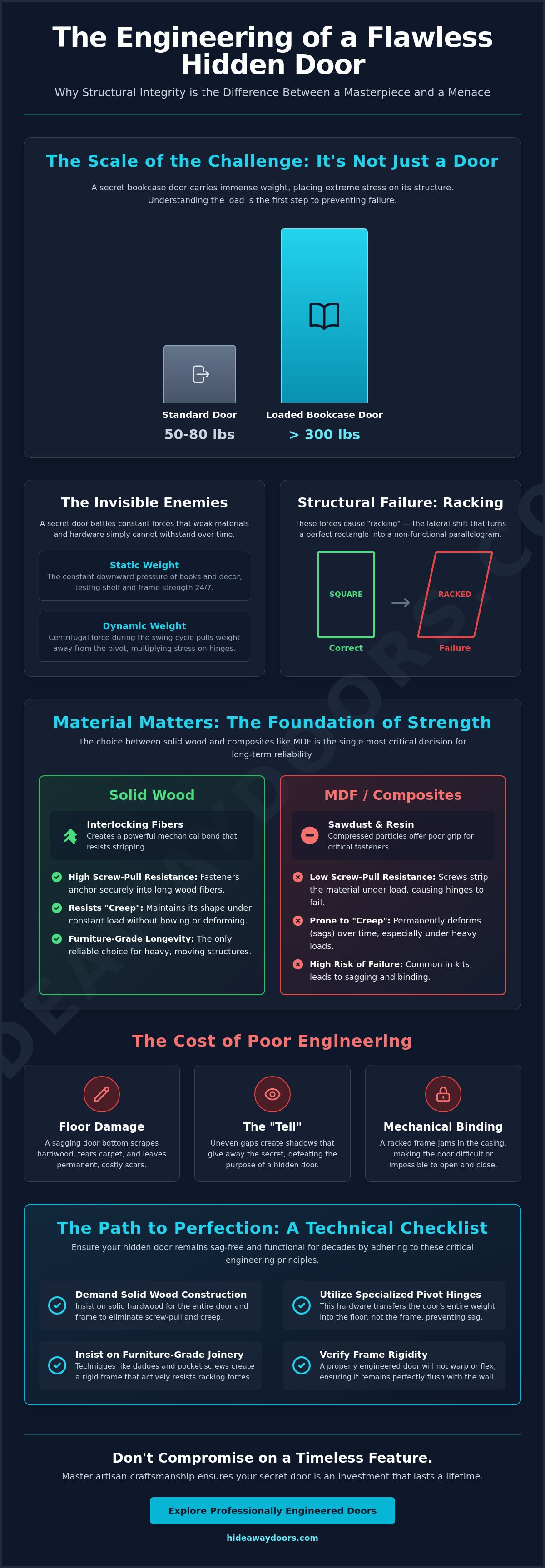
A bookcase door is a mechanical paradox. It must function as a heavy duty storage unit while operating with the effortless grace of a standard interior door. In this context, the structural integrity of bookcase doors is defined as the unit's ability to maintain a perfect rectangle, or "squareness," even when loaded with hundreds of pounds of literature and decor. While a standard interior door might weigh between 50 and 80 pounds, an empty bookcase door typically starts at 125 to 150 pounds. Once fully loaded, that weight can surge past 300 pounds, placing immense stress on every joint and fastener.
True structural integrity ensures that the internal frame remains rigid enough to keep the door flush with the surrounding wall. Without this internal strength, gravity becomes a relentless enemy. The door will eventually sag, causing the top corner to pull away from the jamb and the bottom edge to drag across the floor. This rigidity isn't achieved by chance. It requires precision woodworking joinery techniques designed to resist racking, which is the lateral force that tries to turn your rectangular door into a parallelogram. Only a frame built with furniture-grade standards can withstand these forces over a lifetime of use.
Understanding Static vs. Dynamic Weight
Engineering a secret door requires accounting for two distinct types of stress. Static weight represents the constant, downward pressure of books resting on shelves. This force tests the shelf pins and the horizontal rails of the door. Dynamic weight is the far more challenging force applied during the swing cycle. As you open the door, centrifugal force pulls the weight away from the pivot point, creating leverage that can strain even the most robust hinges. This momentum affects the latching mechanism; a door that isn't structurally sound will eventually fail to "catch" properly as the frame warps over thousands of cycles.
The Consequences of Structural Failure
When engineering is sacrificed for cost or convenience, the results are both visible and audible. Common signs of failure include:
Floor Damage: A sagging door will scrape hardwood or bunch up carpet, leaving permanent scars on your home's interior.
The "Tell": Structural failure creates uneven gaps in the trim. These shadows act as a visual giveaway, immediately alerting observers to the secret entrance's location.
Mechanical Binding: If the frame loses its squareness, the door will eventually jam within the casing, making it difficult or impossible to operate smoothly.
Material Science: Why Solid Wood Outlasts MDF and Composites
Material selection is the foundation of any engineering project. If the substrate is weak, even the most advanced hardware will eventually fail under the stress of daily use. When evaluating the structural integrity of bookcase doors, the choice between solid wood and Medium Density Fiberboard (MDF) isn't just a matter of price or aesthetics. It's a question of mechanical survival. MDF is essentially a composite of sawdust and resin. While it appears stable in a controlled showroom, it lacks the internal fiber structure necessary to resist the constant pull of gravity and the centrifugal forces of a swinging door.
The most common failure in composite doors is the "screw-pull" factor. Because MDF consists of compressed particles rather than continuous fibers, fasteners have very little to grip. Over time, the leverage created by a loaded bookcase causes the hinge screws to strip the surrounding material. In contrast, solid hardwoods like Oak or Alder possess long, interlocking cellulose fibers. When a screw is driven into solid timber, it wedges between these fibers, creating a mechanical bond that supports a much higher hinge load capacity. This inherent strength is what keeps the door from sagging as the years pass.
The Myth of MDF in Heavy Cabinetry
Many mass-produced kits rely on MDF because it's inexpensive and provides a smooth surface for paint. However, MDF is prone to "creep," which is a permanent deformation that occurs when a material is subjected to constant weight. If you load an MDF shelf with heavy books, it will eventually bow and stay bowed. In a hidden door, this deformation leads to racking, eventually making the door impossible to close. Understanding why real timber is non-negotiable is vital for anyone who values long-term functionality over short-term savings. Real wood has a "memory" that helps it maintain its shape even under significant stress.
Selecting Timber Species for Strength
Choosing the right species is a balancing act between density and weight.
Oak: This is the industry standard for heavy-duty load bearing. Its incredible density makes it highly resistant to the lateral forces that cause racking.
Alder: A favorite for many master artisans, Alder provides excellent structural rigidity while remaining light enough to ensure a smooth, quiet swing cycle.
Cherry and Walnut: These luxury hardwoods offer dense grain patterns that hold fasteners with exceptional tenacity, ensuring the frame remains square for decades.
Starting with the right timber ensures the structural integrity of bookcase doors remains uncompromised. If you're planning a project that requires both beauty and brawn, exploring handcrafted solid wood doors is the only way to guarantee a result that lasts a lifetime.
Hinge Systems and Load Bearing: The Engineering Backbone
A secret door's success isn't measured by how it looks when it's closed, but by how it behaves while it's moving. The hardware is the invisible spine of the entire unit. While material choice provides the body, the hinge system dictates the lifespan. Standard butt hinges, the kind found on a typical bedroom door, are designed for lateral tension. They pull against the side jamb, relying on the strength of the wall studs to stay level. For a 300 pound bookcase, this is a recipe for disaster. The structural integrity of bookcase doors relies on a pivot system that shifts the primary load from the wall to the floor.
Our Alpha Door system utilizes custom-engineered steel pivots rather than off-the-shelf hardware. These pivots are designed to handle the massive torque of a rotating shelf without the metal fatigue common in lighter kits. Door thickness also plays a critical role here. As a bookcase door becomes deeper to accommodate larger volumes, the hinge clearance must be calculated with mathematical precision. If the pivot point is even a fraction of an inch off, the inner corner of the unit will bind against the casing, destroying the "flush-to-wall" aesthetic you've worked to achieve. Proper weight distribution means transferring the load directly into the floor joists, which are far more capable of supporting heavy cabinetry than a vertical door frame.
The Pivot Hinge Advantage
Vertical weight is best managed by a bottom-mounted pivot. By placing the weight on the floor, we eliminate the stress on the side jamb that typically leads to unsightly wall cracking or door sag. This setup also allows for three-dimensional adjustability. You can fine-tune the reveal to maintain that perfect, invisible fit without ever removing the door from its mount. This level of precision ensures that even as your home settles over time, the door remains perfectly aligned with the surrounding trim.
Load Ratings and Real-World Capacity
Calculating the "Total Payload" is a non-negotiable step in the engineering process. You have to account for the weight of the assembled door, the hardware, and the maximum weight of the books themselves. We don't just aim for a system that is "strong enough." We build for a significant safety margin. A 500lb-rated hinge is necessary for a 200lb door to prevent metal fatigue over decades of operation. In master artisan engineering, we utilize a 5:1 safety ratio; this means the hardware is designed to withstand five times the anticipated operational stress to ensure it never fails, regardless of how many heavy hardbacks you stack on the shelves.
Just as ALEON applies rigorous engineering to its premium aluminum suitcases to ensure they meet specific capacity needs, our doors are built to handle heavy payloads without compromising structural integrity.
Preventing Racking and Sag: A Technical Checklist
Precision engineering is the only defense against racking. In the world of high-end cabinetry, racking refers to the lateral shifting of a frame from a perfect rectangle into a weak parallelogram. This occurs when the vertical and horizontal components lose their 90-degree relationship, often due to the uneven distribution of weight during the door's swing cycle. For a standard stationary shelf, this might just look like a slight tilt. For a secret entrance, it means the door will no longer clear the jamb. Maintaining the structural integrity of bookcase doors requires joinery that resists these diagonal forces through every inch of movement.
Simple butt joints, where two pieces of wood are merely screwed together, are insufficient for a moving wall. Master artisans utilize dado joints, where the horizontal shelf is recessed into a precision-cut groove in the vertical upright, often reinforced with pocket screws. This creates a mechanical interlock that prevents the frame from twisting under load. However, even the best joinery can't compensate for a poor foundation. The rough opening must be perfectly level and plumb. If the floor has even a slight pitch, the pivot point will be off-axis, creating a cam effect that forces the door to drag or pop open on its own.
The Structural Role of the Cabinet Back
The back panel is the most misunderstood component of a hidden door. It isn't just a visual backdrop; it's the primary anti-racking tool. When a back panel is recessed into the frame, glued, and fastened every few inches, it creates a box beam effect. This transforms the bookcase from a collection of boards into a rigid, singular unit. While kit-grade doors often use thin 1/4" plywood, a high-capacity door requires a 1/2" panel to provide the necessary shear strength. This added thickness ensures that as you load the shelves with up to 50 lbs of books each, the frame remains immovable and square.
Pre-Installation Structural Requirements
Before the door ever arrives, the home itself must be prepared for the weight. If you are installing a double bookcase secret door, reinforcing the header is mandatory. A double door system can easily exceed 600 lbs when fully loaded, requiring a structural header that won't deflect over time. Floor preparation is equally critical. You must ensure a dead-level surface for pivot rotation to prevent the door from walking out of alignment. For a successful outcome, follow our guide on measuring for a hidden door to ensure your rough opening meets these professional standards.
Ready to build a secret entrance that stands the test of time? Explore our Alpha Door collection to find a system engineered for permanent stability.
The Alpha Door Standard: Handcrafted Structural Integrity
The structural integrity of bookcase doors isn't just a technical specification; it's a promise of permanence. At Hide-A-Way Doors, we've developed the Alpha Concealment Door to serve as the industry benchmark for engineering excellence. While competitors might settle for the convenience of particle board, we firmly reject MDF in favor of handcrafted real wood. This commitment ensures that every unit we ship possesses the grain strength required to support a lifetime of operation without the risk of racking or structural fatigue.
Our proprietary steel pivot system is the core of this standard. Unlike generic kits that rely on plastic bushings or light-gauge metals, our hinges are custom-engineered to handle the unique physics of a moving wall. We factory-test our weight capacities to ensure they exceed standard residential needs, providing a foundation that remains flush and silent through thousands of swing cycles. This is where high-end design meets rugged, dependable utility. Our doors are rated to carry up to 300 lbs of weight, a standard that far surpasses the capabilities of kit-grade alternatives.
Handcrafted in the USA: The Artisan Difference
There's a significant gap between a mass-produced kit and a made-to-order masterpiece. Every Alpha Door is constructed with family-owned oversight, where master artisans inspect each joint for precision. This hands-on approach ensures that the "Furniture Grade" promise isn't just a marketing label. It's a guarantee that your door will comfortably support 300+ lbs of payload while maintaining the elegant aesthetics of a bespoke library. By controlling every step of the manufacturing process in our local facility, we eliminate the structural inconsistencies often found in offshore assembly lines.
Designing Your Secure Entrance
Strength doesn't have to come at the expense of style. You can customize your door using various wood species, from the rugged durability of Oak to the refined texture of Alder, ensuring the structural integrity of bookcase doors matches your home's existing decor. Beyond the frame, we offer the integration of high-security locking mechanisms that reinforce the unit without compromising the pivot's balance. Whether you're building a panic room or a private study, the engineering must be flawless. Design your custom Alpha Door today and invest in a secret entrance built to last for generations.
Securing Your Legacy with Precision Engineering
Engineering a hidden door is an investment in both home security and architectural beauty. The success of your project rests on rejecting the compromises of mass-produced kits. By prioritizing solid timber construction and utilizing a proprietary heavy-duty steel pivot system, you eliminate the common risks of racking and floor damage. The structural integrity of bookcase doors depends on this critical intersection of material density and mechanical precision. It's the difference between a door that sags within a year and one that operates smoothly for a lifetime.
Every unit we create is handcrafted in the USA with a strict no-MDF or particle board guarantee. This ensures your secret entrance remains flush and silent, even under the weight of a complete personal library. You deserve a solution that matches the sophistication of your home without the anxiety of mechanical failure. With artisan-grade construction, your hidden room remains a seamless discovery for decades to come.
Your vision of a perfectly concealed entrance is within reach. Trust in the craftsmanship that prioritizes enduring substance over fleeting convenience.
Frequently Asked Questions
How much weight can a hidden bookcase door actually hold?
Our doors are engineered to support a payload of up to 300 lbs in addition to the weight of the unit itself. This capacity is made possible by the use of solid timber and professional grade pivot hardware. While a standard interior door might fail under such a load, our master artisan construction ensures the unit remains functional and square even when fully stocked with heavy volumes.
Will a bookcase door sag over time if I fill it with heavy books?
Sagging is typically the result of poor material choice or inadequate hinge systems. Because we utilize solid hardwoods and a proprietary steel pivot, the structural integrity of bookcase doors is maintained over decades. The vertical load is transferred directly into the floor rather than the side jamb, preventing the frame from pulling out of square or dragging across your flooring.
Do I need special framing in my wall to support a hidden door?
Standard 2x4 framing is often sufficient for single doors, but you must ensure the rough opening is perfectly plumb and level. For wider installations or load bearing walls, a reinforced header is necessary to prevent the ceiling weight from compressing the door frame. We recommend consulting a professional if you're modifying a structural wall to accommodate the unit's weight.
What is the difference between an in-swing and out-swing door regarding strength?
Both configurations offer exceptional strength, but they manage force differently. An in-swing door rests against the stop when closed, which provides additional stability against pressure. An out-swing door relies entirely on the latch and pivot system. In both cases, our steel pivot hardware is over engineered to ensure that the swing direction doesn't compromise the door's long term alignment or security.
Can I install a bookcase door in an existing doorway without structural changes?
You can install our units in a standard finished opening, provided the dimensions are accurate and the floor is dead level. However, you'll need to remove the existing door, hinges, and stop molding to create a flat surface for the new casing. If the floor is carpeted, you might need to install a transition strip to provide a solid base for the bottom pivot.
Why is solid wood better than MDF for a hidden door?
Solid wood possesses long, interlocking fibers that provide superior screw holding capacity and resistance to "creep" or permanent bowing. MDF is a composite of particles that can't support the high torque of a 300 lb pivoting load. Over time, MDF fasteners will strip or pull through, leading to a total failure of the structural integrity of bookcase doors.
How do I maintain the structural integrity of my door after installation?
Maintenance is minimal but important for lifetime operation. Periodically check that the pivot fasteners are tight and ensure the path of travel remains free of debris. If your home settles, you can use the built in adjustability of our pivot system to realign the reveal. This ensures the door stays flush with the wall and continues to operate without binding or scraping.
What happens if my floor is not perfectly level?
An unlevel floor is the most common cause of installation failure. If the floor has a pitch, the door will want to walk open or closed on its own, and the pivot axis will be tilted. This creates uneven gaps in the trim and puts unnecessary stress on the hinges. We recommend using shims or a leveling compound to create a flat foundation before mounting the bottom pivot.