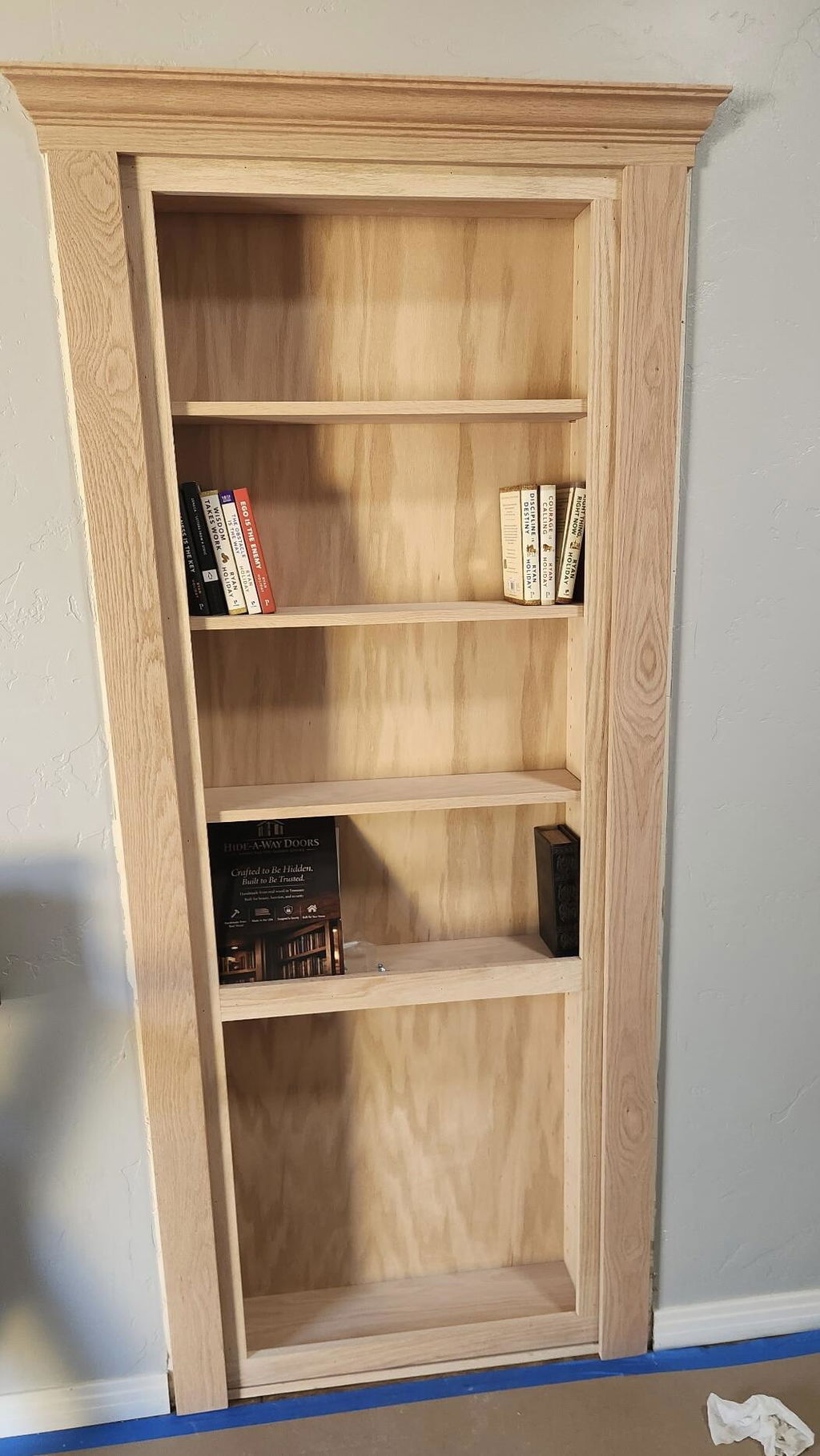
Solid Wood Bookcase Doors: Why Real Timber is Non-Negotiable for Secret Rooms
A hidden door isn't just a piece of furniture; it's a high-stress mechanical system that will eventually fail if built with inferior materials. Most homeowners dream of a secret passage, yet they often fear the day their heavy, loaded shelf starts to sag, stick, or scrape against the floor. You want the "wow factor" of a seamless transition, not a project that looks cheap or breaks under the weight of your library. Choosing a solid wood bookcase door is the only way to ensure your secret remains hidden and functional for decades.
We'll dive into the structural truth behind timber and why the May 2026 AWI Standards emphasize precision construction, like stile and rail designs, to prevent the warping common in lesser materials. You'll discover how real wood handles the immense leverage of a swinging bookcase while maintaining furniture-grade aesthetics that blend into high-end interiors. This guide covers everything from weight capacity to the mechanical hardware required to keep your Alpha Door or Mirror Door flush, silent, and secure for a lifetime.
Key Takeaways
Identify the critical structural risks of using MDF and particle board at high-stress pivot points where screw-holding power is essential.
Master the physics of vertical load distribution to ensure your hidden entrance remains flush and silent for decades without scraping the floor.
Navigate the Janka hardness scale to select a solid wood bookcase door that offers the ideal balance of heavy-duty strength and manageable weight.
Evaluate the long-term functional benefits of investing in a handcrafted, pre-hung system versus the inherent limitations of basic DIY kits.
Learn how premium timber and traditional joinery transform a structural moving partition into a seamless piece of high-end furniture.
The Secret Door Dilemma: Why Material Choice Defines Your Entrance
A hidden door is far more than a decorative piece of furniture. It's a structural moving partition that must perform with the precision of a high-end vault. Throughout history, secret passages have served as sanctuaries and private quarters, but their success has always relied on total invisibility. In a modern home, achieving this level of concealment requires a solid wood bookcase door that can support hundreds of pounds without shifting. Unlike a stationary bookshelf that sits against a wall, a pivoting system is under constant physical stress.
The psychological appeal of a secret room lies in its absolute secrecy. This relies on a perfect 1/8-inch gap around the entire perimeter of the unit. If the material warps or the frame settles by even a fraction of an inch, the shadow lines change and the secret is revealed. While a standard shelf only needs to hold weight vertically, a hidden door must resist twisting and bowing while in motion. This requires a level of engineering that goes beyond basic carpentry.
The Anatomy of a Concealment Door
Every high-performance secret entrance consists of three critical components: the reinforced frame, the industrial-grade pivot, and the case itself. When you fill those shelves with heavy books or collectibles, the weight creates immense torque on the hinge side. A solid wood bookcase door uses the natural density of timber to keep the assembly rigid. Furniture-grade construction is a requirement here, not a luxury. It ensures that the case stays perfectly square even when it's fully loaded and swinging through its arc.
Why "Good Enough" Materials Fail
Standard interior doors are often hollow or made from lightweight composites that can't handle the physics of a pivoting bookcase. Even a 2-millimetre sag is enough to cause the bottom of the case to scrape the floor or create an uneven gap at the header. These minor failures ruin the illusion and lead to mechanical breakdown. True mechanical longevity in home design comes from materials that can hold a screw under tension for decades. Choosing real timber prevents the pivot points from stripping, ensuring the door remains as silent and secret on day 5,000 as it was on day one.
Myth vs. Reality: Why MDF and Particle Board Are Structural Risks
Many manufacturers push MDF as a superior choice because it's "dimensionally stable." This is a half-truth. While MDF doesn't expand or contract with the seasons as much as a single slab of wood, it lacks the internal architecture needed for a solid wood bookcase door. In a secret room application, the door acts as a lever. Every time it opens, the weight of the shelves puts immense stress on the fasteners. Composite materials simply aren't designed to handle these dynamic forces over the long term.
The science of screw-holding power explains why. According to the USDA's comprehensive guide, Wood as an Engineering Material, the mechanical properties of timber are derived from its long, continuous fibers. MDF is essentially compressed dust and resin. It has no grain to "grip" a screw. Humidity is another silent killer. If an MDF door is exposed to a damp basement or high-humidity climate, it absorbs moisture like a sponge. Unlike real wood, which breathes and returns to its shape, MDF often stays swollen, losing its structural integrity permanently.
Tensile Strength and Fastener Failure
Hardwoods like oak possess a complex cellular structure that acts like a series of tiny, interlocking tubes. When a screw enters oak, the fibers displace and then clamp down on the threads. MDF lacks this elasticity. Over time, the constant vibration and torque of a swinging bookcase will cause the hinges to wallow out the engineered core. Fastener withdrawal resistance in hardwoods is the force required to pull a screw directly out of the wood grain; in solid timber, this value is significantly higher than in composite materials. For those seeking a permanent solution, exploring handcrafted bookcase doors ensures your investment stands the test of time.
The Aesthetic Compromise
Beyond the structural risks, there is a clear sensory difference. A paint-grade MDF door looks flat and lacks the organic character of stained hardwood grain. When you tap on an engineered door, it sounds hollow and thin. A solid wood bookcase door provides a satisfying, heavy thud that signals security and quality. Real wood also allows for repair and refinishing. If a solid timber door gets scratched, it can be sanded. If MDF chips, the repair is rarely invisible. There is also the "creep" factor. This is the tendency of a material to deform permanently under a constant load. An MDF shelf will eventually bow into a permanent "U" shape under the weight of books, a failure rarely seen in well-constructed timber.
The Physics of the Pivot: How Real Wood Engineering Prevents Sagging
A standard door is a static barrier. A solid wood bookcase door is a moving machine. To function correctly, it must manage complex vertical load distribution across a single axis. When you load a shelf with 100 hardcover books, you're adding roughly 150 to 200 pounds of dead weight to the structure. This mass creates massive leverage against the hinges. Solid wood stiles act as structural beams, providing the necessary stiffness to resist the natural tendency of the unit to rack or tilt toward the floor.
Every opening and closing cycle applies dynamic stress to the frame. Unlike stationary furniture, a hidden door experiences torque that wants to pull the top hinge away from the wall. Real timber possesses the tensile strength to counteract these forces. This is why material choice is the foundation of mechanical success; without a rigid substrate, the entire system eventually succumbs to gravity.
Structural Integrity of Bookcase Doors
Managing this torque requires more than just thick boards. The Alpha Concealment Door utilizes the inherent density of timber to maintain a square profile even under a full load. A reinforced threshold and header are essential in these wood systems to distribute weight into the home's framing rather than letting it hang off the decorative trim. Vertical grain orientation in the stiles ensures that the wood resists deflection, keeping the unit perfectly upright over years of use. Traditional joinery like dovetail or pocket-hole joints thrives here because the screws and glue bond with actual wood fibers, creating a connection that won't crumble under pressure.
Hardware Synergy
High-performance pivot hinges are only as strong as the material holding them. These hinges require a deep, permanent bite into the substrate to remain aligned. In composite materials, the pivot point is a weak link where the hardware eventually pulls free. A rigid wood frame also protects your home's infrastructure. It absorbs the kinetic energy of the door closing, which prevents stress cracks from forming in the surrounding drywall or plaster.
Every swing involves friction. The relationship between door weight and pivot friction is delicate. A solid wood bookcase door provides the necessary rigidity to keep the pivot points perfectly vertical. If the frame flexes even slightly, the friction increases, making the door difficult to operate and eventually causing mechanical failure. This engineering precision is what separates a true secret entrance from a simple novelty shelf.
Selecting the Right Hardwood: A Framework for Strength and Style
Choosing the specific timber for a solid wood bookcase door is a decision that balances mechanical requirements with interior design. The Janka hardness scale serves as a master artisan's guide for this process. It measures the force required to embed a steel ball into the wood, which directly correlates to a species' ability to resist dents and, more importantly, its screw-holding capacity. For a secret room entrance, you need a material that can support a heavy load without the fibers crushing or the fasteners pulling free over time.
While aesthetics often drive the initial choice, the structural demands of a pivoting system are primary. High-density hardwoods ensure that the pivot points stay true, preventing the sagging issues that plague composite alternatives. Whether you are building a single Alpha Door or a wide-span Double Bookcase Door, the species you select defines the door's lifespan and its ability to remain perfectly flush within the wall.
Top 4 Woods for Hidden Doors
Oak: With a Janka rating of approximately 1,290 to 1,360, Oak is the gold standard for high-traffic areas. Its prominent grain and immense strength make it ideal for heavy-load bookcases that must endure daily use.
Alder: Often called the "cherry of the west," Alder is a favorite for those who want a sophisticated look with a slightly lighter weight. It is exceptionally stable and takes stains beautifully, offering a high-end appearance without the extreme mass of Oak.
Cherry: This luxury hardwood is the premier choice for master suites and formal libraries. Its Janka rating of 950 provides plenty of structural integrity, while its natural darkening over time adds a layer of heritage to any secret entrance.
Maple: If your design calls for a smooth, durable painted finish, Maple is the ultimate choice. It is incredibly hard (Janka 1,450) and lacks the deep pores of Oak, ensuring that the final paint job looks like a piece of factory-finished furniture rather than a DIY project.
Grain Patterns and Secret Gaps
Total concealment relies on the eye's inability to find a seam. Tight grain patterns, such as those found in Maple or Cherry, help minimize the visual impact of the door's 1/8-inch clearance gap. When the wood grain of the bookcase matches the surrounding trim perfectly, the door becomes a seamless part of the architecture. Matching the stain or paint color is the final step in this process. A professional finish ensures that the light reflects off the wood consistently across the entire wall, leaving no clues for the uninitiated. To see how these materials look in a completed home, you can browse our handcrafted hardwood collections to find the perfect match for your interior.
Selecting a stain-grade wood allows the natural beauty of the timber to shine, while paint-grade options offer a more modern, integrated look. Regardless of the finish, the underlying structure must remain rigid. By matching the door wood to your existing trim, you create a visual continuity that makes the secret room truly impossible to detect without the proper knowledge.
From Vision to Installation: Investing in a Handcrafted Secret
Investing in a secret room is a commitment to long-term structural quality. While mass-market retailers often push flat-pack DIY kits as a budget-friendly solution, these units frequently rely on composite components that struggle under the weight of real books. A pre-hung solid wood bookcase door arrives as a fully integrated system, built to withstand the physical demands of daily use. This professional approach ensures that the frame, pivot, and case are perfectly aligned before they ever reach your doorstep, eliminating the frustration of on-site structural adjustments.
Choosing a handcrafted system over a kit means you're prioritizing mechanical longevity. A secret entrance is only effective if it operates flawlessly every time it's used. When a door is built from real timber, it possesses the rigidity required to stay square within the opening. This prevents the unit from binding or developing uneven gaps that might tip off a keen observer. It's the difference between a temporary novelty and a permanent architectural feature.
The Master Artisan Difference
At Hide-A-Way Doors, we lean on a family-owned heritage that prioritizes substance over speed. Every Alpha Door begins with hand-selected timber, chosen for its grain stability and structural integrity. Our promise is simple: we don't use MDF, ever. We believe that a secret entrance should feel like a permanent part of your home's foundation. This dedication to traditional craftsmanship means every joint is tight; every swing is silent; and every finish is furniture-grade.
Planning Your Secret Entrance
Starting the design process is a matter of precision. Accurate measurements are the foundation of a successful installation, especially when aiming for that elusive 1/8-inch gap mentioned earlier. Whether you're interested in a Mirror Door or a Double Bookcase Door, our team guides you through the customization options to match your existing trim and decor. Moving heavy, furniture-grade timber across the country requires specialized logistics. Because a solid wood bookcase door is significantly heavier than composite alternatives, we utilize robust packaging and reliable freight partners. For those who prefer professional help, we offer access to a national network of installers who understand the nuances of anchoring high-load pivoting systems.
A well-planned installation ensures your secret remains safe for decades. By focusing on the intersection of traditional skills and modern utility, you can create a space that is both functional and secure. You can design your custom solid wood bookcase door today and take the first step toward a more intriguing home.
Secure Your Legacy with Handcrafted Timber
Your hidden room deserves a gateway that reflects the same level of care as the treasures it protects. We've explored how the physics of a pivoting system demands the rigid cellular structure of real timber to prevent sagging and ensure mechanical longevity. Choosing a solid wood bookcase door isn't just an aesthetic preference; it's a structural necessity. Without the natural density of hardwood, the constant torque of a fully loaded shelf will eventually compromise the secrecy you've worked so hard to create.
Every unit we produce is handcrafted in Morristown, Tennessee, by artisans who value precision and durability. We maintain a strict standard of excellence, which means there is zero MDF or particle board used in our construction. This commitment to traditional materials ensures your door remains flush and silent for decades. With a national installation network ready to support your project, the path to a perfectly executed secret room is clearer than ever. Browse Our Collection of Real Wood Alpha Doors to find the centerpiece for your next home upgrade. Your secret is safe with a foundation built to last.
Frequently Asked Questions
How much weight can a solid wood bookcase door actually hold?
A standard unit can typically support up to 300 pounds of books and decor while maintaining smooth operation. The structural rigidity of the timber ensures the frame doesn't rack or twist under this load. It's the combination of dense wood fibers and industrial grade pivot hardware that allows for such high weight capacity without mechanical failure.
Will a solid wood door sag more than an MDF door?
No, a solid wood bookcase door is significantly more resistant to sagging than its MDF counterparts. While MDF is prone to permanent deformation under static load, solid timber maintains its shape over decades. The cellular structure of real wood provides the tensile strength necessary to keep the door square even when it's fully loaded with heavy hardcover books.
Can I install a hidden bookcase door in an existing doorway?
You can install these systems in most existing doorways, provided you have sufficient wall space for the swing arc. Our pre-hung systems are designed to fit standard rough openings, though you should always verify your measurements before ordering. It is often a matter of removing the old trim and door before sliding the new unit into the existing opening.
Does solid wood warp more than engineered wood in humid basements?
Solid wood is actually more resilient in variable environments when built using proper stile and rail techniques. While all wood reacts to moisture, engineered products like MDF absorb humidity and swell permanently. A properly sealed hardwood door expands and contracts slightly with the seasons but returns to its original dimensions without losing structural integrity.
What is the best wood species for a secret door that will be painted?
Maple is the premier choice for a secret door that requires a painted finish. Its tight, closed grain structure prevents the textured look often seen in porous woods like Oak. This results in a glass smooth surface that looks like high end cabinetry rather than a construction project, helping the door blend perfectly with your existing trim.
Are solid wood hidden doors harder to open because of their weight?
The weight of the solid wood bookcase door actually contributes to a more stable and premium feel during operation. Because we use high performance pivot hinges, the force required to open the unit is minimal. The mass of the timber provides a satisfying momentum that makes the door feel substantial and secure rather than flimsy or light.
How do I maintain the finish on my handcrafted bookcase door?
Maintaining a handcrafted door involves simple, periodic care to preserve the wood's luster. Use a soft, lint free cloth for dusting and a high quality furniture polish every few months to keep the finish from drying out. It's also wise to check the pivot points annually to ensure they remain clear of debris and operate with their original silence.
What happens if the wood expands or contracts with the seasons?
Seasonal movement is a natural characteristic of timber that we account for during the manufacturing process. By utilizing traditional joinery, we allow the wood to breathe without affecting the critical 1/8 inch clearance gap. This ensures the door remains secret and functional whether the air is dry in the winter or humid in the summer.