The Engineering of Secrecy: A Guide to Bookcase Door Mechanisms in 2026
A bookcase door mechanism is only as reliable as the material it’s anchored to; true stealth requires a synergy of heavy-duty steel pivots and furniture-grade solid wood. You want the "wow factor" of a secret room, but you're likely worried about a heavy shelf sagging over time or that telltale scrape across your hardwood floors. It’s a common frustration for anyone trying to balance high-capacity storage with total concealment. You need a door that stays flush and silent for decades, even when fully loaded with a collection of heavy volumes.
This guide explores the mechanical hardware and structural secrets that allow a massive bookcase to swing with a single finger while remaining perfectly hidden. We’ll examine the technical differences between inswing and outswing configurations, the importance of anti-sag technology, and how the right pivot system ensures your secret stays hidden for years to come. From understanding weight distribution to mastering the art of the invisible gap, you’ll discover how to achieve a professional-grade installation that feels like a master artisan's best-kept secret. By the end, you'll have the clarity needed to transform a standard doorway into a piece of enduring, functional art.
Key Takeaways
Learn why traditional side-mounted hinges fail and how floor-to-ceiling pivot points provide the structural integrity needed for heavy loads.
Understand the physics of dead load versus live load to prevent hardware pull-out and ensure your bookcase never scrapes the floor.
Discover the secrets of a high-performance bookcase door mechanism, including the precision engineering required for a smooth, silent swing.
Master the Three-Dimension adjustment technique to eliminate visible gaps and keep your secret passage flush with the surrounding wall.
Compare the benefits of fully-assembled internal steel frames against standard kits to find the most reliable solution for your project.
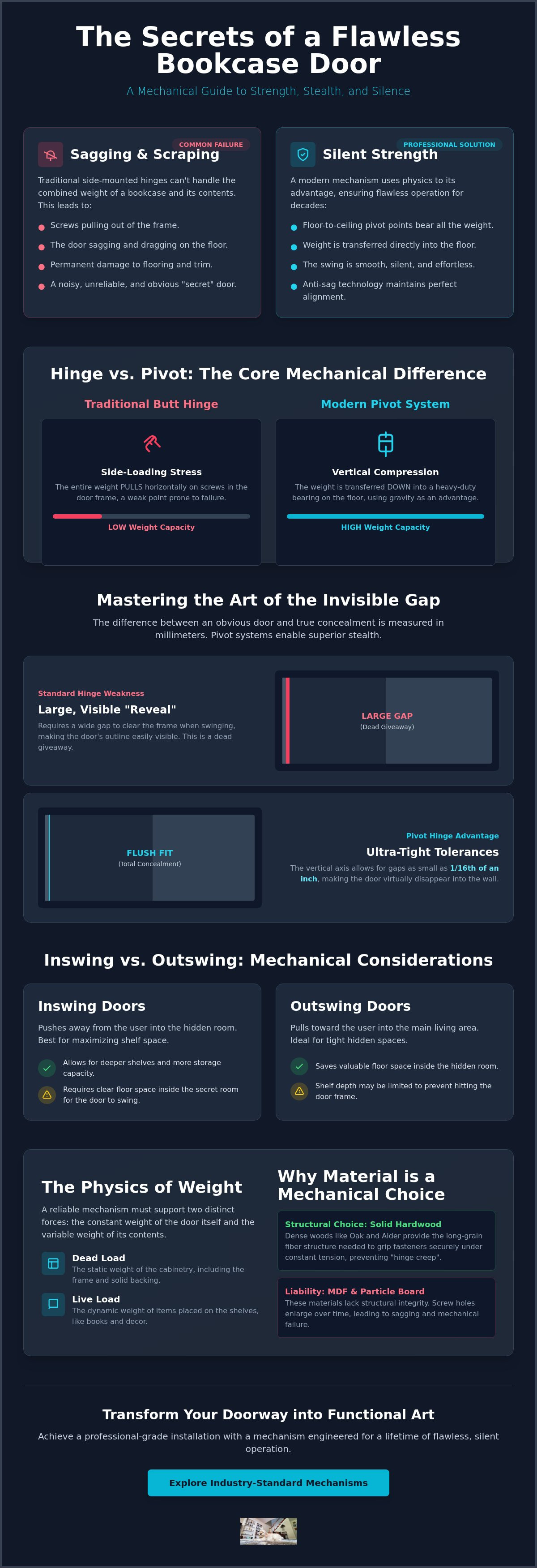
The evolution of the hidden door has moved far beyond the simple hinges found on a standard bedroom door. While the history of hidden bookcase doors often depicts simple wooden shelves on basic iron straps, modern engineering demands much more. A professional bookcase door mechanism relies on a fundamental shift from side-mounted hinges to floor-to-ceiling pivot points. This isn't just a design choice; it's a structural necessity. When you're moving hundreds of pounds of solid wood and literature, the physics of the swing changes entirely.
Traditional butt hinges are the primary cause of secret door failure. These components are designed to pull the weight of a standard, lightweight door away from the frame. When you add the "dead load" of a solid wood bookcase and the "live load" of a book collection, the side-loading stress becomes unsustainable. The wood screws eventually pull out or the door begins to sag, leaving a permanent, unsightly scrape on your floor. A pivot system solves this by transferring the entire load directly into the floor. Instead of pulling on the frame, the weight sits on a heavy-duty steel bearing, turning vertical compression into a mechanical advantage.
Pivot Hinges vs. Standard Butt Hinges
Pivot hinges allow the entire unit to rotate on a single vertical axis. This configuration is essential because it eliminates the wide swing arc common with side hinges. Because the weight is supported from below, the bookcase door mechanism can maintain much tighter tolerances. You can achieve gaps as small as 1/16th of an inch, which is nearly impossible with standard hardware. Standard hinges require a much larger "reveal" or gap to clear the frame as they open. That gap is a dead giveaway to anyone looking for a hidden room.
Inswing vs. Outswing Mechanical Differences
The direction your door opens dictates the entire hardware layout and the depth of your cabinetry. An outswing door pulls toward the user, requiring the pivot point to be set forward. This configuration often limits the usable shelf depth to ensure the bookcase doesn't strike the frame as it rotates. In contrast, an inswing door pushes away from the user. This allows for deeper shelves but requires a more complex "stop" to hide the mechanism from the outside. Consider these factors before installation:
The Stop: This acts as a physical barrier that prevents the door from swinging too far and serves as a visual mask.
Swing Clearance: Inswing doors require clear floor space inside the hidden room, while outswing doors need clearance in the main living area.
Flush Alignment: Properly aligned stops ensure the door sits perfectly flush every time it closes, maintaining the illusion of a permanent wall.
Whether you're installing a DIY Door Kit or a pre-engineered Alpha Door, the pivot placement is the most critical measurement. It dictates how much of the bookcase is hidden behind the trim and how much clearance is needed to maintain the illusion of a solid, immovable object.
The Physics of Weight Distribution and Anti-Sag Technology
Engineering a secret entrance requires more than just a sturdy hinge; it demands a deep understanding of how weight moves through wood. The total burden on a bookcase door mechanism consists of two distinct forces: the dead load and the live load. The dead load refers to the weight of the cabinetry itself, including the heavy frame and solid backing. The live load encompasses everything you place on the shelves, from dense hardcovers to decorative sculptures. Ignoring the synergy between these two forces is the most common path to mechanical failure.
In the world of mass-market furniture, MDF and particle board are king. However, for a concealed door, these materials are a liability. They lack the long-grain fiber structure necessary to grip hardware under constant tension. Over time, heavy vertical pressure causes screw holes to enlarge, leading to "hinge creep" where the door slowly sags away from the frame. This is why real wood hidden doors are a technical requirement for longevity. Dense hardwoods like Oak and Alder act as structural components that resist compression and hold fasteners with an iron grip.
Why Material Choice is a Mechanical Decision
Solid wood doesn't just look better; it behaves better under stress. Unlike engineered products, natural timber expands and contracts in predictable ways, allowing master artisans to build in tolerances that account for seasonal shifts. This stability prevents the door from binding in the summer or showing large gaps in the winter. When you invest in a Double Bookcase Door, you're relying on the material's inherent strength to keep the unit square and the secret safe for decades.
Load-Bearing Limits and Structural Reinforcement
A standard 36-inch bookcase door can easily weigh 150 pounds before a single book is added. Once fully loaded, that weight can triple. To prevent "racking", where the bookcase box twists into a trapezoid under its own weight, internal bracing and a solid backing are essential. A level floor is equally critical. Even the most advanced bookcase door mechanism will struggle if the pivot point is tilted, as gravity will constantly pull the door out of alignment. For larger openings, using a double-door system distributes this massive load across two separate pivot systems, doubling your weight capacity while maintaining a smooth, silent operation.
Stealth Latches and Concealed Locking Mechanisms
While the pivot system manages the heavy lifting, the latching system manages the illusion. A common mistake in custom builds is confusing a latch with a lock. A latch is a mechanical device designed to keep the door flush against the stop, preventing it from swinging open due to air pressure or minor floor vibrations. A lock, conversely, provides actual security. For a bookcase door mechanism to remain truly secret, both must operate without the metallic "clack" associated with standard interior hardware. Silence is a technical requirement, not a luxury.
Magnetic catches are often the preferred choice for a "push-to-open" experience. These high-strength magnets hold the bookcase in a perfectly flush position, requiring a firm press to release the spring-loaded plunger. To ensure a silent closure, a precision-aligned strike plate is essential. By using nylon-coated or dampened strike plates, you eliminate the metal-on-metal contact that could alert a keen ear to the presence of a moving wall. This attention to detail ensures the transition from "wall" to "door" remains entirely undetectable.
The "Magic Book" Latch System
The "Magic Book" remains the gold standard for mechanical triggers. This system uses a hidden cable or a rigid lever arm to translate the tilting motion of a specific book into a pull force that retracts the latch bolt. To maintain reliability, Hide-A-Way Doors utilizes furniture-grade wood for the trigger housings rather than plastic components. Wood provides a stable, non-resonant enclosure that won't warp or become brittle over time. Regular maintenance is simple; a light application of dry graphite lubricant on the cable ensures the trigger won't stick, keeping the entry accessible even after years of disuse.
Security Options for Safe Rooms
When transitioning from simple concealment to high-level security, the hardware must evolve. For gun concealment doors or dedicated safe rooms, you must choose between mechanical deadbolts and electromagnetic locks. Electromagnetic systems offer the benefit of "fail-safe" operation, meaning they unlock automatically during a power failure or fire alarm, which is a critical safety consideration for emergency exits. However, for those prioritizing rugged independence, a mechanical deadbolt concealed within the bookcase trim provides a "fail-secure" solution that works regardless of the power grid. Many master artisans now integrate keypad entries or biometric scanners behind a sliding piece of trim or a false book spine, blending modern security with traditional craftsmanship.
Evaluating Installation Complexity for Different Mechanisms
Installation is the bridge between a technical blueprint and a functioning secret. Even the most sophisticated bookcase door mechanism will fail if the opening isn't prepared with surgical precision. Before the first screw is driven, a master artisan must ensure the rough opening is perfectly plumb and square. If the frame leans even a fraction of an inch, the door's weight will pull it out of alignment, causing the unit to swing open on its own or bind against the casing. Precision is mandatory.
Successful execution relies on the "Three-Dimension" adjustment. This allows you to fine-tune the unit's position along three axes: up and down for floor clearance, left and right for side gap consistency, and in and out to ensure the unit sits flush with the surrounding wall. The most critical step is ensuring the floor pivot is perfectly vertical to the top pivot pin. If these two points aren't on the exact same vertical plane, the door will fight itself during every swing, leading to mechanical binding and premature wear on the bearings.
Retrofitting Mechanisms into Existing Frames
Retrofitting a secret door into a standard interior frame presents unique challenges. Standard frames are typically designed for thin, lightweight doors, not the 8 to 10 inch depth of a functional bookcase. You'll often need to remove the existing casing and reinforce the header to support the top pivot pin. Flooring transitions also require careful planning. A pivot sitting on thick carpet behaves differently than one anchored to a concrete subfloor or hardwood. If you aren't prepared to rebuild the threshold, you might find your door dragging within weeks of the first use.
Professional Calibration for Smooth Operation
Once the door is hung, calibration begins. Experts use the "Paper Test" to verify the disguise. By sliding a single sheet of paper around the perimeter of the closed door, you can identify tight spots or irregular gaps that might reveal the opening. You'll also need to adjust the spring tension on ball-catch latches to find the perfect balance between a secure hold and an easy release. While many enthusiasts find success with DIY Door Kits, complex projects involving heavy loads or high-security needs often benefit from handcrafted hidden door installation techniques. If you want a door that remains silent and secret for decades, consider the benefits of a professionally calibrated system. To ensure your project starts with the right foundation, you can order a precision-engineered Alpha Door that arrives ready for a seamless installation.
Why the Alpha Door Mechanism Sets the Industry Standard
The ultimate test of a bookcase door mechanism is its performance after five, ten, or twenty years of daily use. While many systems rely on the structural integrity of the wood itself, the Alpha Door introduces a paradigm shift with its heavy-duty internal steel frame. This isn't just a hinge attached to a box. It's a rigid skeleton that absorbs the torque and tension generated by hundreds of pounds of books. By housing the mechanical components within a steel chassis, the system effectively eliminates the possibility of sagging. It ensures the door remains perfectly square and the secret remains secure for the life of the home.
Choosing a fully-assembled mechanical system over a box of loose parts is a decision rooted in long-term reliability. A kit of parts places the burden of precision engineering on the installer. If a single hole is drilled a fraction of an inch off-center, the entire system's balance is compromised. In contrast, a factory-calibrated unit is tested under load before it ever reaches your doorstep. This integrated approach ensures that every component, from the pivot bearings to the latching system, works in perfect harmony. You don't have to worry about the trial and error of field adjustments.
The Alpha Difference: Integrated Engineering
The Alpha concealment door represents the pinnacle of this philosophy. Every unit is handcrafted by master artisans who understand that secrecy depends on microscopic tolerances. Unlike field-assembled kits that may develop rattles or play over time, these factory-tested mechanisms are built to maintain a silent, effortless swing. The internal steel frame acts as the spine of the entire unit, preventing the wood from twisting or bowing under the weight of a full library. This level of craftsmanship is backed by a commitment to quality that includes long-term support and warranties, providing peace of mind that your investment in home security and design is protected for decades to come.
Next Steps: Choosing Your Stealth Entrance
Your journey toward a concealed entrance begins with an assessment of your space and storage needs. For standard hallways, a single Alpha Door provides an elegant, high-capacity solution. However, for wider openings or grand library entrances, double bookcase secret doors offer a dramatic and functional alternative. Before you begin, use this final checklist:
Measure the rough opening width and height at three different points to ensure consistency.
Identify the wall type (2x4 or 2x6) to determine the necessary shelf depth.
Choose your swing direction based on the floor plan and interior clearance.
Decide between a standard latch or a high-security locking system.
If your project requires unique dimensions or specialized hobby storage, requesting a custom quote is the best way to ensure the mechanical hardware meets your specific requirements. Whether you're building a safe room or a private retreat, the right bookcase door mechanism is the foundation of a secret that stays hidden. Precision is the key to enduring mystery.
Secure Your Legacy with Precision Engineering
Engineering a secret entrance is a sophisticated balance of physics and artistry. You now understand that a high-performance bookcase door mechanism relies on vertical pivot points and solid wood construction to prevent the sagging and binding common with standard hinges. Precision calibration and a silent latching system are what transform a heavy piece of furniture into an undetectable gateway. It's the difference between a project that eventually fails and a masterwork that functions flawlessly for decades.
At Hide-A-Way Doors, we specialize in this level of enduring craftsmanship. Every unit is handcrafted in Morristown, Tennessee, using real wood to ensure structural permanence. We never use MDF or particle board in our construction. To ensure your vision is executed with absolute precision, we offer a national network of professional installers who understand the nuances of secret door calibration. Explore Professional-Grade Bookcase Door Mechanisms at Hide-A-Way Doors and take the first step toward creating a home that is as secure as it is intriguing. Your project deserves a foundation built on expertise and heritage.
Frequently Asked Questions
Can a bookcase door mechanism be installed on carpet?
Yes, you can install a bookcase door over carpet, but the pivot hardware must be anchored directly to the subfloor. To prevent the unit from dragging or "plowing" through carpet fibers, a low-profile threshold is usually required. This provides a level, friction-free surface for the door to swing across, ensuring the mechanism doesn't strain against the resistance of thick pile or cause the motor-less system to bind.
How much weight can a standard bookcase door mechanism hold?
A professional-grade bookcase door mechanism is typically engineered to support between 300 and 500 pounds of total load. This calculation includes the weight of the solid wood door itself and the books or decor stored on the shelves. For heavier requirements, such as double doors or deep libraries, high-capacity pivot sets are utilized to ensure the door remains effortless to operate without compromising the structural integrity of the frame.
How does a mass-market retail kit differ from a Hide-A-Way door mechanism?
Mass-market kits typically prioritize cost over longevity, often utilizing engineered wood products that lack the necessary screw-holding power for heavy loads. In contrast, Hide-A-Way Doors crafts each system from furniture-grade timber and integrated steel frames. This ensures that the door doesn't just look like a wall, but functions with the silent, heavy-duty precision required for high-capacity storage and total concealment for decades.
Do I need a special header to support a hidden bookcase door?
You must ensure the header is reinforced to support the top pivot pin. Unlike standard doors where weight is distributed to the side jambs, a hidden door requires a solid, plumb top anchor point to prevent the unit from leaning over time. During installation, double-studding the opening and checking that the header is perfectly level is critical for maintaining the tight gaps necessary for a truly secret entrance.
How do you open a secret bookcase door from the inside?
Every secret door includes a mechanical bypass or a secondary trigger located on the interior side of the unit. This is often a simple thumb turn or a discreet lever that manually retracts the latch, ensuring you're never locked inside. For safe rooms, these interior releases are designed to be intuitive and fail-safe, providing a reliable exit path regardless of the primary locking mechanism used on the exterior.
Is it possible to automate a bookcase door mechanism?
While automation is technically possible with third-party components, Hide-A-Way Doors does not sell or support motorized opening systems. We prioritize the reliability of manual operation because it doesn't depend on power or complex electronics that can fail during an emergency. A well-balanced, handcrafted mechanism should swing open with the push of a finger, making motorized assistance unnecessary for most residential applications.
Why is my bookcase door sagging after only six months?
Sagging is almost always caused by the use of inferior materials like MDF or improper vertical alignment of the pivot points. If the screws are pulling out of the material or the frame has twisted, the bookcase door mechanism cannot support the weight. Using solid wood and ensuring the top and bottom pivots are on the exact same vertical plane prevents this failure and keeps the door flush for decades.
What maintenance does a pivot hinge mechanism require?
Pivot hinges require very little maintenance beyond a periodic inspection of the mounting screws and a light application of dry graphite lubricant. You should avoid using heavy oils or grease, as these can attract dust and debris that might eventually bind the bearings. Every few years, check the gap tolerances around the casing to ensure the house hasn't settled in a way that affects the door's swing or concealment.