Mastering Bookcase Door Weight Distribution: The Science of No-Sag Hidden Passages
A hidden door is only as secret as its ability to clear the floor; the moment it starts to drag, the illusion is shattered. You have likely seen DIY kits or MDF units that look impressive in photos but eventually succumb to gravity once they are loaded with a full library. It's frustrating to invest in a custom home feature only to watch it warp and scrape across your hardwood floors. Mastering bookcase door weight distribution is the difference between a lifetime of smooth operation and a permanent structural headache.
We will show you how professional engineering and the use of solid hardwoods like Alder or Walnut prevent the sagging that plagues cheaper alternatives. You'll gain a clear understanding of the physics behind pivot points and why material compression strength is just as critical as your hinge rating. This guide provides the technical insight needed to ensure your passage swings effortlessly for years. You deserve the peace of mind that comes from handcrafted precision and a door that remains as silent and hidden as the day it was installed.
Key Takeaways
Master the physics of bookcase door weight distribution to manage vertical loads and prevent the common floor-dragging issues seen in DIY builds.
Compare the structural integrity of real wood against MDF to see how superior screw-holding strength keeps heavy-duty hinges secure over time.
Learn the engineering secrets of pivot hinges and how calculating the correct pivot offset ensures a smooth, effortless swing even when the unit is fully loaded.
Understand essential installation safeguards, including why a reinforced double-header and a perfectly square frame are vital for long-term stability.
Discover how the Alpha Door system combines traditional Tennessee craftsmanship with modern mechanical science to create a truly permanent hidden passage.
The Physics of Secret Doors: Why Bookcase Door Weight Distribution is Critical
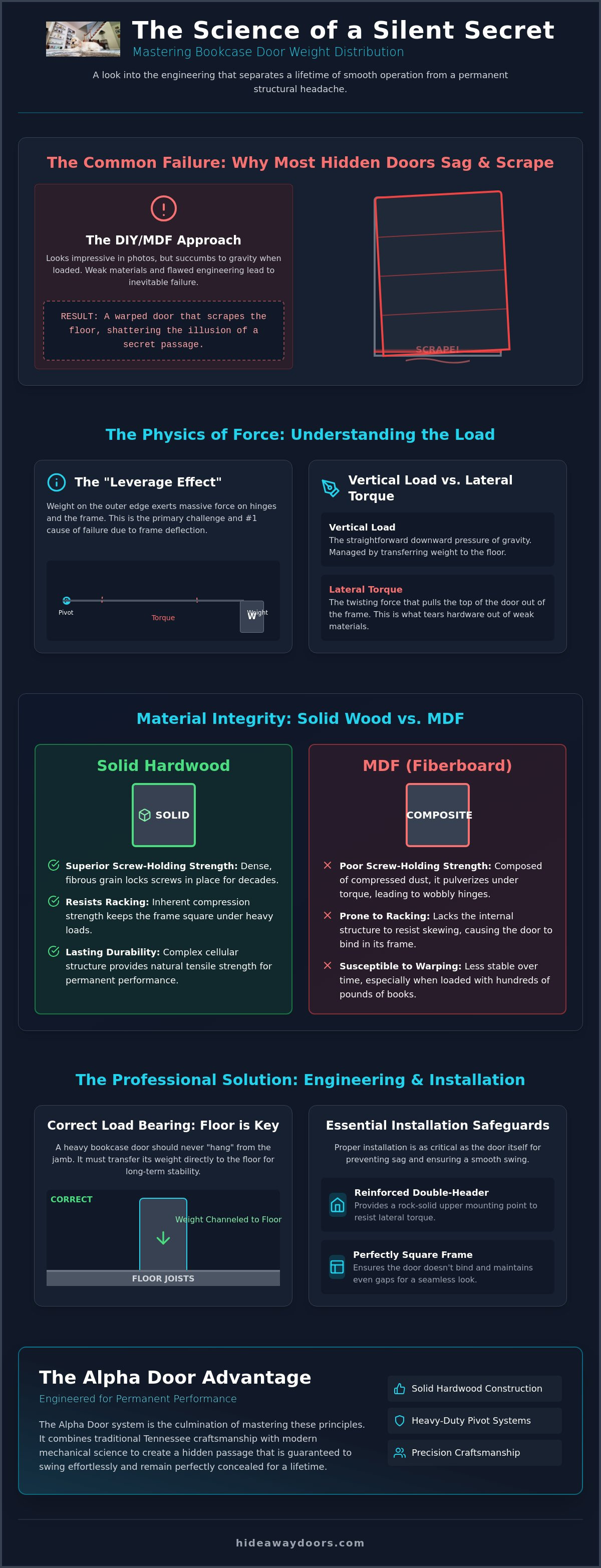
Creating a hidden passage that remains invisible over years of use requires more than just a clever latch. It requires a deep understanding of bookcase door weight distribution, which is the precise management of vertical load and lateral torque. When you fill a secret door with several hundred pounds of books, you aren't just adding weight to a shelf; you're creating a complex mechanical lever. If the engineering behind that lever is flawed, the door will inevitably fail, regardless of how expensive the wood or hardware might be.
The "Leverage Effect" is the primary challenge for any hidden door designer. Consider a standard 36-inch door. Any weight placed on the outer edge, the side furthest from the pivot point, exerts a massive amount of force on the hinges and the frame. This is where The Physics of Secret Doors becomes a critical study. Engineering deflection occurs when structural elements deform under a load. In a bookcase door, this manifests as the top of the door pulling away from the jamb while the bottom begins to scrape the floor. It's a material science problem that cannot be solved with longer screws alone.
Understanding the difference between static and dynamic weight is also vital. Static weight is the force of the books simply sitting on the shelves. Dynamic weight is the force generated when that 300-pound unit is in motion. The momentum of a swinging door creates centrifugal forces that test the rigidity of the entire wall assembly. The #1 cause of hidden door failure is frame deflection under this localized stress. When the wall or the door frame isn't rigid enough to handle these forces, the opening loses its "square" shape, causing the door to bind or sag.
Vertical Load vs. Lateral Torque
Even a professional pivot hinge rated for 500 pounds can fail if the door frame begins to "parallelogram." Vertical load is the straightforward downward pressure of gravity. Lateral torque, however, is the twisting force that pulls the top of the door toward the floor. Books placed furthest from the pivot point increase this load exponentially, putting immense strain on the upper mounting points. In the context of a pivoting bookcase, torque is the rotational force that threatens to tear the hardware out of the wall if the bookcase door weight distribution isn't perfectly balanced.
The Role of the Floor in Load Bearing
Most DIY designs fail because they attempt to "hang" the door from the jamb, much like a standard bedroom door. This is a fundamental mistake. A heavy bookcase needs to transfer its weight directly to the floor joists to maintain long-term stability. While hanging systems rely on the strength of the door jamb and the wall studs, floor-supported pivot systems utilize the ground as the primary load-bearing surface. Hide-A-Way’s heavy-duty pivot systems are designed to channel weight downward, ensuring that the door remains stable and swings effortlessly without putting undue stress on the surrounding architecture.
Structural Integrity: Why Real Wood Outperforms MDF Under Load
The choice of material isn't just about the grain pattern or the finish; it's a fundamental engineering decision. Real wood species like Alder, Oak, and Walnut possess a complex cellular structure that provides inherent tensile strength. In contrast, Medium-Density Fiberboard (MDF) is a composite of wood fibers and resin. While MDF provides a smooth surface for paint, it lacks the internal skeleton needed to support the extreme forces involved in bookcase door weight distribution. When a door is carrying 300 pounds of books, every joint and fastener is under constant stress.
The most critical point of failure in MDF units is screw-holding strength. Because MDF is essentially compressed dust, it doesn't have a grain for screw threads to bite into. Under the constant lateral torque of a swinging bookcase, the screws eventually pulverize the surrounding material. This leads to hinges that wobble and doors that eventually sag or fall. Solid wood provides a dense, fibrous environment where screws remain locked in place for decades. This structural reliability is why we exclusively use real wood for every unit we build.
Solid wood also excels at resisting racking, which is the tendency for a rectangular frame to skew into a trapezoid under a heavy load. The compression strength of hardwoods ensures the cabinet remains square even when fully loaded. This is a functional necessity for a hidden door, where even a fraction of an inch of sag can reveal the secret. Our commitment to real wood is a matter of long-term utility that ensures your investment remains as functional as it is beautiful.
The MDF Sag Factor
MDF is highly susceptible to moisture and humidity, which triggers a phenomenon known as creep. This is a permanent deformation where the material slowly stretches and sags under its own weight. For a hidden passage, this means a door that might fit perfectly on day one will likely drag on the floor within a year. Understanding these risks is why Solid Wood vs MDF: Why Furniture Grade Materials Matter is a topic we discuss with every client. A secret door must be built to last as long as the home itself.
Wood Species and Load Capacity
Different species offer varying mechanical properties of wood that dictate their load-bearing potential. White Oak, for example, offers incredible density and resistance to rot, making it ideal for high-traffic passages. Our craftsmen use traditional joinery like dado and rabbet joints to ensure that weight is distributed through the wood itself, rather than relying solely on metal fasteners. This meticulous approach ensures that the Alpha concealment door remains perfectly square and functional for a lifetime. If you're ready to invest in a door that won't fail, explore our real wood collections today.
Pivot Point Engineering: Calculating Load for Smooth Operation
While the material provides the skeleton, the hardware serves as the mechanical heart of the installation. A sophisticated approach to bookcase door weight distribution demands a pivot system that manages rotational energy rather than just resisting gravity. Standard interior doors hang from a frame; however, a secret bookcase requires a dedicated axis capable of supporting loads exceeding 500 pounds without microscopic shifts in alignment. We focus on the science of the pivot to ensure the door remains a secret, not a maintenance chore.
Why Butt Hinges Fail on Bookcase Doors
Standard butt hinges are engineered for lightweight, hollow-core doors. When applied to a massive bookcase, they inevitably lead to "hinge bind" because the lateral pull of the books forces the hinge pins out of vertical alignment. Pivot hinges eliminate this by channeling the entire load through a single steel axis. This design transfers the weight directly into the floor structure. It removes the stress from the wall studs entirely, making it the only viable choice for high-load hidden passages where stability is paramount.
The Precision of the Alpha Pivot
Our engineering team designed the Alpha concealment door with a precise pivot offset. By moving the axis inward from the door's edge, we alter the swing arc and significantly reduce the leverage force on the mounting hardware. This precision prevents the door from "drifting" or swinging shut on its own when left half-open. We utilize high-grade ball-bearing hardware to ensure the movement remains fluid even under extreme pressure. There is no need for the "frequent adjustments" often cited by competitors. The steel-to-steel contact points are built for permanence, ensuring your hidden passage operates with quiet confidence for a lifetime. This level of mechanical foresight is what separates a professional installation from a temporary DIY project.
Preventing Sag: Installation Techniques for Heavy Bookcase Doors
Proper installation is the final pillar of a successful hidden passage. Even the most robust solid wood unit will fail if the surrounding wall isn't prepared for the task. Effective bookcase door weight distribution begins with the rough opening. You aren't just framing a door; you're building a structural support system for a moving piece of furniture that may weigh several hundred pounds once fully loaded. If the frame isn't rigid, the door will eventually betray its location.
The "Double-Header" rule is non-negotiable for wide or heavy units. A standard single header often deflects under the concentrated load of a 500-pound bookcase. We recommend a reinforced double-header to prevent the top of the frame from bowing over time. Additionally, the pivot side must be anchored by a robust king stud and jack stud assembly. This ensures the lateral torque doesn't cause the wall itself to lean. When these components are correctly aligned, the vertical load is transferred safely through the framing and into the floor joists.
There's a critical distinction between square and level. A door can be perfectly square, but if the frame is un-level, the unit will always drag. This is especially true for pivot systems where the floor serves as the primary load-bearing surface. If the floor is out of level by even an eighth of an inch, the swing arc will be compromised. Our national installation network focuses on these tolerances, ensuring that every door we hang remains perfectly balanced for life.
Framing for the Long Haul
For larger installations, such as double bookcase secret doors, standard 2x4 framing is often insufficient. Upgrading to 2x6 studs on the pivot side provides the extra mass needed to resist wall lean. Floor levelness is equally vital. If the subfloor is uneven, it must be shimmed or leveled before the pivot hardware is secured. This level of preparation prevents the sagging issues that plague many DIY attempts.
The No-Caster Philosophy
Many DIY forums suggest adding casters or wheels to the bottom of a sagging door. We call this the "dead giveaway." A visible wheel or a track worn into your hardwood floors immediately ruins the illusion of a secret passage. Our engineering philosophy rejects casters entirely. By using high-capacity pivot hinges, which can support upwards of 570 pounds, we ensure the door remains suspended and silent. You can learn more about these design principles in The Ultimate Buying Guide to Double Bookcase Secret Doors for 2026. If you want a door that performs without floor-marring tracks, contact our installation experts to get started today.
The Alpha Door Advantage: Engineered for Permanent Performance
The Alpha Door represents the culmination of traditional woodworking and modern mechanical science. While we have discussed the theory of bookcase door weight distribution, this specific unit is where those principles are put into daily practice. Every unit is handcrafted in Morristown, Tennessee, where we maintain strict control over every joint, fastener, and finish. This isn't a mass-produced kit; it's a structural masterpiece designed to remain invisible and functional for decades. By combining the natural strength of solid wood with our specialized pivot engineering, we've created a solution that eliminates the compromises typical of the hidden door industry.
Our engineering allows for more than just standard libraries. The Alpha Door serves as the gold standard for high-capacity storage, whether you're looking for gun concealment or integrated wine racks. These specialized loads require even more precise management of lateral torque than a standard shelf of paperbacks. Because we use solid hardwoods and steel-to-steel pivot systems, our doors can handle these significant weights without the "creeping" sag found in MDF alternatives. The result is a door that feels as light as a standard interior door but carries the payload of a commercial-grade vault.
Uncompromising Quality Control
Every door undergoes a rigorous testing phase before it leaves our facility. We verify that the bookcase door weight distribution is perfectly centered, ensuring the swing arc remains smooth even when the unit is fully loaded. Whether you choose Cherry, Oak, or Walnut, the finish is applied by master artisans who understand how to preserve the wood's natural beauty while reinforcing its structural integrity. As a family-owned business, we provide a level of accountability and warranty protection that large-scale retailers simply can't match. We take pride in the fact that our doors are built to outlast the homes they're installed in.
Ready to Build Your Secret Passage?
A secret door is a significant investment in your home's security and aesthetic value. If you have a non-standard opening or a specific architectural challenge, our design experts are available to provide professional guidance. We offer a vast range of custom wood species and finishes to ensure your new passage blends seamlessly with your existing decor. Don't settle for a door that will eventually drag, scrape, and fail. Design Your Custom Alpha Door Today and experience the peace of mind that comes with professional-grade engineering and American craftsmanship.
Secure Your Legacy with Precision Engineering
A hidden passage is more than a novelty; it's a structural investment that requires a mastery of bookcase door weight distribution. We've explored how the intersection of material science and mechanical engineering prevents the sagging that ruins lesser installations. By choosing handcrafted real wood over unstable MDF and utilizing the specialized Alpha Door pivot system, you ensure your secret remains safe for a lifetime. These systems are designed to handle maximum loads while maintaining the silent, effortless swing that defines true quality.
The final step in achieving a perfect result is proper execution. Our national network of professional installers stands ready to ensure your frame is reinforced and your floor is level, safeguarding your home against the common pitfalls of DIY attempts. You don't have to settle for dragging doors or visible casters. It's time to bring your vision of a sophisticated, secure home to life with a product built on heritage and hard work. Explore the Alpha Door Collection and start your journey toward a perfectly executed hidden entrance today.
Frequently Asked Questions
How many books can a standard hidden bookcase door actually hold?
A quality solid wood shelf can typically support 25 to 50 pounds. For a complete unit like the Alpha Door, the total load capacity often exceeds 500 pounds. This is only possible when the bookcase door weight distribution is managed through a steel pivot axis rather than hanging from the wall. Proper loading ensures the unit remains square and the secret stays hidden for years of daily use.
Will my secret door eventually sag and scrape the floor?
Sagging is not an inevitable fate for a hidden passage. It is almost always the result of using inferior materials like MDF or standard butt hinges. When you use solid hardwoods and a floor-supported pivot system, the weight is channeled directly into the home's foundation. This prevents the frame from warping and ensures the door never touches your hardwood floors, maintaining a perfect clear-span swing.
Do I need a special header in my wall for a heavy bookcase door?
We always recommend a reinforced double-header for any hidden door installation. Standard 2x4 framing is designed for static walls, not the dynamic lateral torque of a moving 300-pound library. A double-header, combined with robust king and jack studs, provides the structural rigidity needed to keep the opening perfectly square. This preparation prevents the "wall lean" that often leads to mechanical failure in DIY projects.
Why is real wood better than MDF for weight distribution?
Real wood offers cellular integrity that MDF simply cannot match. Solid species like Oak or Walnut have a natural grain that provides exceptional screw-holding strength. In MDF, heavy loads eventually cause the fibers to crumble around the screws, leading to loose hinges and structural failure. Solid wood also resists "creep," meaning it won't permanently deform under the constant pressure of a full book collection.
What kind of hinges are best for a 500-pound secret door?
Heavy-duty pivot hinges are the only reliable choice for a 500-pound load. Standard butt hinges rely on the strength of the door jamb, which will eventually bow or pull away under extreme weight. Pivot hinges utilize a single vertical axis to transfer the load directly to the floor joists. This mechanical advantage is why our Alpha Door systems swing effortlessly even when packed with heavy collectibles or specialized equipment.
Can I install a hidden bookcase door on a carpeted floor?
Installation on carpet is possible, but it requires careful planning for clearance. You must account for the carpet's "crush" over time and ensure the bottom of the bookcase doesn't drag on the pile. We often suggest installing a thin, hard-surface transition strip at the threshold. This provides a stable base for the pivot hardware and ensures a smooth, silent swing that won't wear out your carpet.
What happens if my floor is not perfectly level during installation?
An un-level floor is one of the most common causes of hidden door failure. If the subfloor slopes, the door's swing arc will be off-center, causing it to either drift open or bind against the frame. During a professional installation, we use precision shims and leveling techniques to ensure the pivot axis is perfectly vertical. This step is critical for maintaining long-term bookcase door weight distribution.
Do Hide-A-Way doors require a support wheel or caster?
Our doors never require support wheels or casters. A caster is a sign of poor engineering; it leaves visible tracks on your floor and ruins the concealment of the secret passage. We use high-capacity pivot hardware that supports the full weight of the unit through the steel axis alone. This "no-caster" approach keeps your floors pristine and ensures your door remains completely undetectable to the casual observer.