High Security Hidden Doors: The Master Artisan’s Guide to Home Concealment
A secret door that sags, sticks, or reveals a visible seam isn't a security feature; it's a liability that announces your most private spaces to the world. High security hidden doors must be more than just clever carpentry. They must function as impenetrable barriers while remaining completely undetectable to the naked eye. You want the peace of mind that comes from a vault, but you shouldn't have to sacrifice the refined elegance of your home’s interior to get it.
This guide explores how the intersection of structural integrity, advanced locking mechanisms, and master-grade craftsmanship transforms standard entryways into invisible security assets. We'll examine the engineering behind furniture-grade concealment, from the physics of weight distribution to the latest in biometric access. By focusing on real-wood construction and professional-grade hardware, you can ensure your safe room remains truly secret and structurally sound for a lifetime. Discover how the right materials and expert techniques provide the durability you need and the sophisticated finish your home deserves.
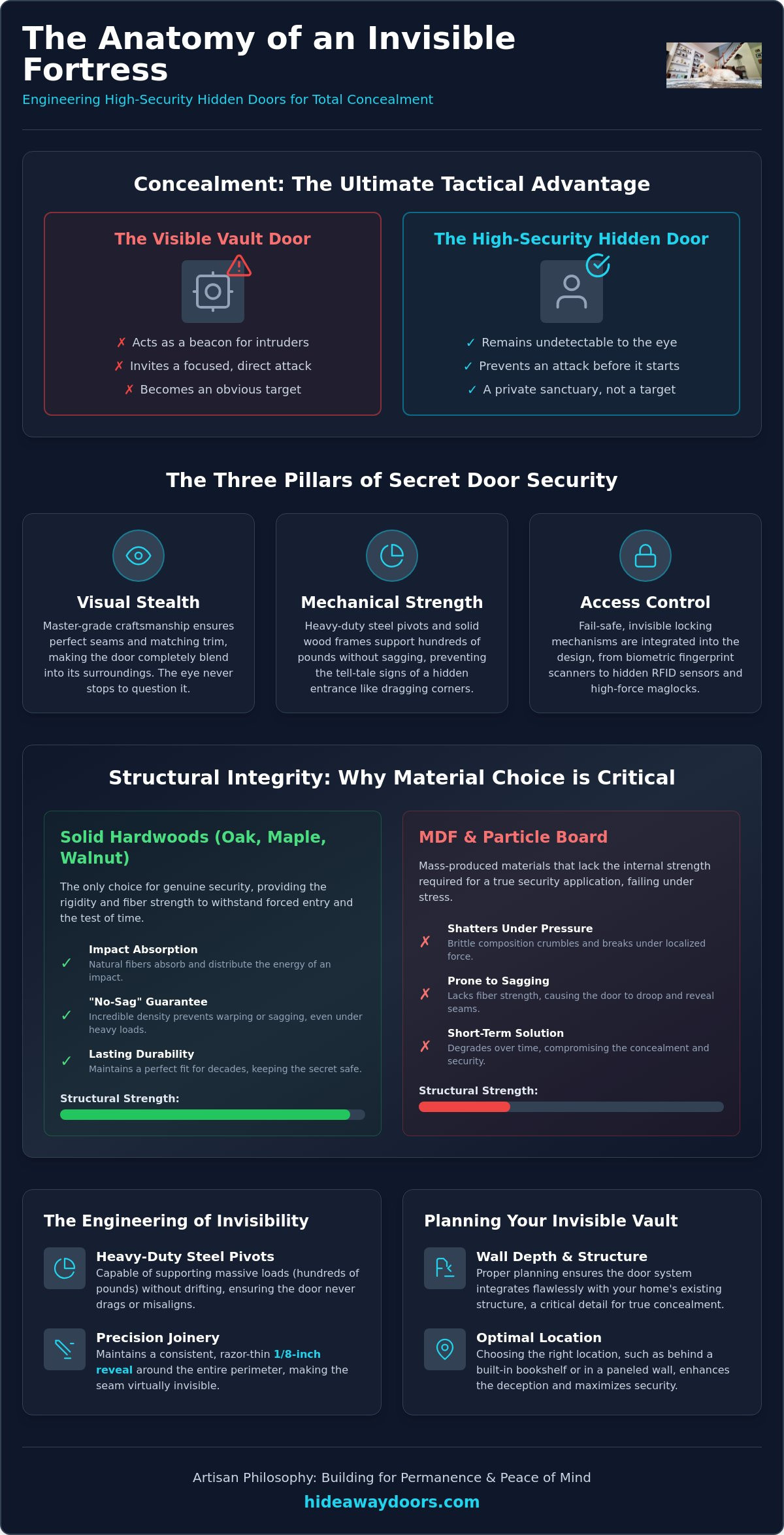
Learn why total concealment acts as your first line of defense, offering a tactical advantage that visible vault doors can't match.
Discover why solid wood is the only material capable of supporting the weight of a security barrier without sagging or revealing the secret seam.
Explore the advanced hardware, including high-force maglocks and biometric triggers, that transforms high security hidden doors into impenetrable barriers.
Gain professional insights on planning your vault, focusing on critical details like wall depth and optimal location for maximum concealment.
Understand the artisan philosophy of building for permanence, ensuring your security solution increases home value while providing absolute peace of mind.
The first rule of security is simple: if an intruder can't find the door, they can't breach it. While a massive steel vault door provides impressive fortification, it also acts as a beacon. It signals exactly where your most valuable assets are kept, inviting a focused and determined attack. High security hidden doors offer a more sophisticated strategy. They rely on the art of deception to prevent an encounter before it starts. By 2026, the standard for these systems has moved beyond mere novelty. It's no longer enough to have a bookshelf that simply swings open. True security now requires a seamless marriage of biometric precision and master-grade joinery.
Concealment as a Tactical Advantage
A hidden entrance creates a powerful psychological barrier. When an intruder enters a home, they look for obvious targets to exploit. A visible safe door is a challenge; a hidden one is a non-factor. Throughout the history of hidden rooms, the primary goal has always been to buy time or avoid detection entirely. In a modern tactical scenario, those extra seconds are everything. High security hidden doors ensure that your safe room remains a private sanctuary rather than a target. This redirection of focus is often more effective than several inches of reinforced steel because it removes the motivation for the breach in the first place.
The Three Pillars of Secret Door Security
To achieve professional-grade results, we focus on three specific areas of engineering:
Visual Stealth: This is where the master artisan's skill is most evident. We use perfect seams and matching trim work so the eye never stops to wonder why a piece of furniture looks out of place.
Mechanical Strength: A high-security door often weighs hundreds of pounds once loaded with books or equipment. We use heavy-duty steel pivots and real-wood frames to prevent the secret from being given away by a dragging corner or a misaligned latch.
Access Control: We integrate fail-safe locking mechanisms that stay completely out of sight, using everything from RFID sensors to fingerprint scanners hidden behind the wood grain.
There's a vast difference between a novelty bookcase and a tactical concealment system. A decorative door might hide a closet, but a tactical system is built to withstand forced entry. We use solid hardwoods like Oak, Cherry, or Walnut to absorb impacts that would shatter a composite or MDF door. In 2026, discerning homeowners are moving away from flimsy store-bought kits. They're choosing bespoke solutions like the Alpha Door, which offers the structural integrity required for genuine protection. It's about building a barrier that's as strong as it is invisible.
True concealment relies on a perfect, unchanging fit. When you install high security hidden doors, you aren't just hanging a door; you're mounting a piece of functional furniture that might weigh several hundred pounds once fully loaded. If the structural frame shifts by even a fraction of an inch, the secret is out. This is why the material choice is the most critical decision in the engineering process. While many mass-produced alternatives rely on medium-density fiberboard (MDF) or particle board, these materials lack the internal fiber strength to handle the constant stress of a security application.
Solid hardwoods like Oak, Maple, and Walnut offer a level of rigidity that composites cannot match. Hard Maple, for instance, is prized by master artisans for its incredible density and resistance to compression. These natural materials absorb the energy of an impact during a forced entry attempt, whereas MDF tends to shatter or crumble under localized pressure. By using real wood, the door remains a formidable barrier that maintains its shape and function even under extreme duress.
The Physics of the 'No-Sag' Guarantee
Precision joinery is what keeps a secret door secret over the decades. We design our systems to maintain a consistent 1/8-inch reveal around the entire perimeter. Achieving this requires more than just a sturdy frame; it necessitates the use of heavy-duty steel pivot hinges capable of supporting massive loads without drifting. This focus on structural durability aligns with ICC guidance on safe room doors, which emphasizes that the mounting and frame are just as vital as the door itself. If you're planning a vault, choosing real-wood hidden doors ensures the frame remains as secure as the lock itself.
Real Wood vs. Compromised Materials
Screw-holding power is a frequently overlooked aspect of home security. In a solid wood frame, the screws for hinges and locks bite into the natural grain, creating a bond that is nearly impossible to pull apart. In contrast, screws in particle board or MDF rely on glue and compressed dust, which eventually fail under the weight of a heavy bookcase. Because MDF is composed of compressed fibers rather than natural grain, it lacks the structural shear strength to prevent hinges from tearing away under the immense weight of a high-security installation. For a door that sees daily use in a high-traffic environment, furniture-grade hardwood is the only material that guarantees both aesthetic beauty and long-term tactical reliability.
A door is only as effective as the hardware that keeps it closed. High security hidden doors require locking systems that match the immense strength of their solid-wood frames without betraying their location. Standard deadbolts often fall short in these specialized applications because they require visible keyholes or handles. Instead, professional-grade concealment systems utilize electromagnetic locks, commonly known as maglocks. These units provide between 600lb and 1200lb of holding force, using powerful magnetic fields to fuse the door to the frame. This makes it nearly impossible to breach the entrance through sheer physical force or prying.
Planning for power outages and emergency egress is a vital part of the security design. We categorize these systems into fail-safe and fail-secure configurations. A fail-safe lock releases automatically when power is lost, which is essential for ensuring a safe exit during a fire or emergency. Conversely, a fail-secure lock remains engaged when the power goes out, prioritizing the protection of your valuables. To get the best of both worlds, we recommend high security hidden doors equipped with dedicated battery backups and hidden mechanical overrides. This ensures you're never locked out of your own safe room, regardless of the home's electrical status.
The Alpha Concealment Door Advantage
The Alpha concealment door represents the peak of integrated security design. It's engineered specifically to house advanced reinforcement options, such as Kevlar lining or ballistic steel backing, directly within the shelving structure. This design prevents punch-through attacks where an intruder might attempt to break through the back of the bookcase rather than attacking the frame. By layering these high-strength materials behind solid hardwood, we create a barrier that is both a sophisticated piece of furniture and a genuine tactical shield. You can customize these doors to meet specific security tiers, ensuring the level of protection matches the value of the assets you're shielding.
Biometric and Digital Access Control
Modern technology allows us to hide access points in plain sight, maintaining the illusion of a standard wall or cabinet. Stealth triggers can be integrated in several ways to keep the entrance undetectable:
Biometric Scanners: Fingerprint readers can be tucked into decorative trim pieces or under a shelf ledge.
RFID Sensors: These are mounted behind the wood grain, allowing the door to unlock only when a specific fob is held against a seemingly blank section of the paneling.
Hidden Latches: Traditional mechanical triggers, such as a specific book that must be tilted, provide a fail-proof way to engage the system.
These digital solutions offer the convenience of smart home monitoring and remote locking via smartphone apps. However, the most reliable systems always include a physical mechanical override. A hidden manual release ensures that even if the electronics fail, you retain full control over your secure space without needing a technician.
A hidden entrance is only effective if its placement makes sense within the logic of your home's layout. High security hidden doors should be positioned where an intruder wouldn't expect a room to exist, such as the end of a long hallway or integrated into a library wall. Tactical advantage comes from the element of surprise; if the door is in a high-traffic area, it must be perfectly disguised as a functional piece of furniture. Beyond placement, you must consider the structural environment. A heavy-duty bookcase door, especially when loaded with books or equipment, exerts significant pressure on the floor. Before installation, it's vital to ensure your floor joists can support the concentrated weight to prevent settling that might reveal the secret seams over time.
Retrofitting an existing home often presents challenges with wall depth. Most standard interior walls use 2x4 studs, but a high-security vault door often requires a 2x6 or deeper rough opening to accommodate the shelving and the reinforcement backing. If you're in the new construction phase, planning for these deeper openings early saves significant time and expense. Don't forget the essentials for life safety within the room. A concealed safe room needs dedicated ventilation for air exchange and a reliable means of communication, such as a hardwired phone line or a cellular signal booster, since the thick walls and security plating can often block standard signals.
Designing the Perfect Safe Room Entrance
For those requiring a wider entryway to move large valuables or equipment, a double bookcase secret door provides the necessary clearance without sacrificing the illusion of a solid wall. If your goal is specifically to protect an armory, the gun concealment door approach offers specialized interior configurations for secure storage. An in-swing door is generally more secure for safe rooms because the door frame itself acts as a physical stop against forced entry attempts from the outside. This configuration ensures that even if the hinges are attacked, the door remains wedged against the structural header and jack studs.
Installation Requirements for High-Security Systems
Precision is the difference between a secure barrier and a failed secret. Professional installation is critical, particularly when integrating electromagnetic locks, as even a minor misalignment can reduce the holding force of the maglock. The rough opening must be reinforced with double jack studs and a heavy-duty header to prevent the frame from bowing under the weight of the solid-wood door. Finally, the integration must be seamless. This means matching your home's existing crown molding and baseboards exactly. When the trim flows uninterrupted across the door, the transition becomes invisible to the casual observer. If you're ready to secure your home, you can view our custom concealment options to find the right fit for your floor plan.
Precision craftsmanship is the silent partner of home security. At Hide-A-Way Doors, we believe that a protective barrier should be as beautiful as it is durable. Every unit we produce is built to order in Morristown, TN, where our master artisans combine traditional woodworking techniques with modern security requirements. We don't mass-produce generic kits or rely on flimsy materials. Instead, we focus on creating high security hidden doors that function as structural assets for your home. This commitment to local manufacturing ensures that every hinge, latch, and wood joint meets our uncompromising standards for quality and performance.
Our "No MDF" pledge is the foundation of our security philosophy. While competitors often use medium-density fiberboard to cut costs, we refuse to compromise. MDF lacks the internal fiber strength to support the heavy-duty hardware and ballistic reinforcements required for genuine protection. By using only real hardwoods like Alder, Oak, Cherry, Walnut, and Maple, we provide a level of rigidity and screw-holding power that composites simply cannot match. This choice of material ensures your door won't sag or warp, keeping the secret reveal perfect for the life of your home. Whether you're shielding a safe room or an armory, the substance of the wood is your first line of defense.
Bespoke Engineering for Unique Security Needs
No two homes are identical, and your security solution shouldn't be either. We specialize in custom sizing to overcome architectural challenges, from non-standard rough openings to unique wall depths. Our team frequently collaborates with architects and security consultants to integrate our systems into comprehensive home defense plans. Beyond standard bookcases, we offer specialized hobby integrations, such as hidden pool cue rack doors, which prove that tactical utility can exist in any room of the house. These bespoke designs allow you to maintain the aesthetic flow of your interior while adding a layer of sophisticated protection.
Your Journey to a Secure Home
The path to owning a professional-grade concealment system begins with a detailed consultation. We guide you through the selection of wood species, finish, and security tiers to ensure the final product aligns with your vision. During the handcrafted hidden doors build cycle, we provide technical drawings and updates as your door moves through our Tennessee shop. Once completed, our national shipping network delivers your door directly to your site, where our professional installation partners can ensure every maglock and pivot hinge is perfectly aligned for maximum security. You don't have to settle for a visible vault when you can have an invisible fortress. Secure your home with a handcrafted Alpha Door today and experience the peace of mind that only master-grade craftsmanship can provide.
True protection is found where structural rigidity meets invisible engineering. The effectiveness of high security hidden doors rests on the triad of perfect concealment, uncompromising material strength, and advanced access control. Choosing solid hardwood over fragile MDF isn't just an aesthetic choice; it's a commitment to a barrier that won't sag, fail, or reveal its secret under pressure. When you prioritize furniture-grade quality, you gain a tactical advantage that visible safes simply cannot replicate.
Every project we undertake is handcrafted in the USA using time-honored techniques and real wood construction. We take pride in delivering a product that increases your home's value while providing absolute peace of mind. With our national installation network, you can trust that your custom vault entrance will be perfectly aligned and structurally sound. It's time to transform your home into a sanctuary that is as elegant as it is impenetrable.
Are hidden doors actually secure enough for a safe room?
Yes, hidden doors are highly effective for safe rooms because they prioritize concealment as the first line of defense. High security hidden doors offer a tactical advantage by removing the visual target, ensuring an intruder never attempts a breach because they don't know the room exists. When these units are constructed from solid wood and reinforced with electromagnetic locks, they provide a level of protection that rivals traditional vault doors.
Can I install a high-security maglock on any bookcase door?
No, you shouldn't install high-tension maglocks on standard or MDF-based doors. These locking systems exert between 600lb and 1200lb of holding force, which can cause composite materials to flex, warp, or even splinter over time. Professional-grade hardware requires a rigid, solid-wood frame to maintain the precise alignment necessary for the magnetic bond to hold under duress.
What is the weight capacity of a solid wood hidden bookcase door?
Our solid wood doors are engineered to support 500 pounds or more, depending on the specific model and hinge configuration. This capacity ensures you can fully load your shelves with books, collectibles, or equipment without the door sagging. Using hardwoods like Oak or Maple provides the shear strength needed to prevent the secret reveal from shifting under a heavy load.
Do high-security hidden doors require a special type of wall construction?
While these doors fit into standard rough openings, we recommend reinforcing the area with double jack studs and a heavy-duty header. Because high security hidden doors are significantly heavier than standard interior doors, the surrounding structure must be rigid to prevent settling. For vault applications, 2x6 wall construction is often ideal to accommodate deeper shelving and ballistic reinforcement layers.
What happens to the magnetic lock if the power goes out?
Maglocks are typically fail-safe, meaning they release when power is cut to ensure emergency egress. To maintain security during an outage, we integrate dedicated battery backups that keep the door engaged for several hours. We also include hidden mechanical overrides, such as a manual latch, so you retain access to your secure space even if the electrical system fails completely.
How do I hide the gap or seam around a secret door?
We hide the seams by using precision-milled trim and molding that overlaps the door's edges. By maintaining a perfect 1/8-inch reveal and matching the existing crown molding and baseboards in your home, the transition becomes invisible. The goal is to create a visual flow where the eye never stops to investigate a break in the woodwork.
Can a hidden door be opened from the inside during an emergency?
Yes, every security door we build includes a reliable internal release mechanism for immediate exit. Whether it's a mechanical lever or an electronic exit button, you won't be trapped inside during an emergency. Safety is a primary concern in our engineering process, ensuring that your sanctuary never becomes a cage.
Is it better to use a single or double door for a vault entrance?
A single door is generally easier to disguise and offers slightly better resistance against forced entry due to the simplified frame. However, a Double Bookcase Door is the superior choice if you need a wider clearance for moving large safes or furniture. Both configurations can be upgraded with high-security hardware to meet your specific protection requirements.